
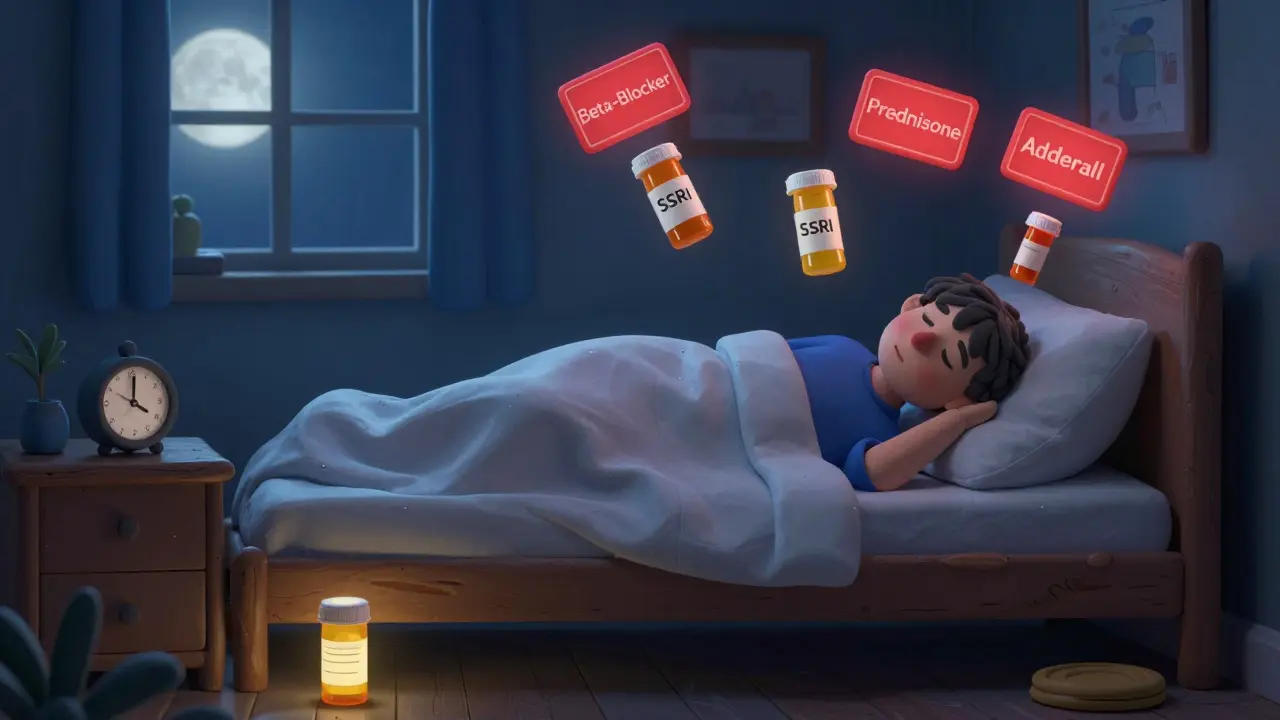
Many people don’t realize that the very medications they take to feel better can be the reason they can’t sleep. If you’ve been lying awake at night, tossing and turning, or waking up exhausted even after 8 hours in bed, your pills might be the culprit-not stress, not screen time, not aging. Around 22% of adults in the U.S. say their sleep troubles started after beginning a new medication, according to the National Sleep Foundation’s 2023 poll. And it’s not just sleeping pills that cause problems. Even common drugs for high blood pressure, depression, allergies, and arthritis can wreck your sleep without you knowing why.
Which Medications Most Often Cause Insomnia?
Some drugs are well-known sleep killers. Others sneak in quietly. Here are the top offenders based on clinical data and real patient reports:
- SSRIs (like fluoxetine/Prozac, sertraline/Zoloft): These antidepressants increase serotonin, which sounds good-until it overstimulates your brain’s sleep centers. About 25-30% of users report frequent nighttime awakenings and less REM sleep. One 2020 study found they lengthen the lightest stage of sleep by nearly 19% and cut REM sleep by over 23%.
- Beta-blockers (like metoprolol/Lopressor, propranolol/Inderal): Used for high blood pressure and heart conditions, these drugs slash melatonin production by up to 42%. That’s the hormone your body needs to signal it’s time to sleep. Users often wake up multiple times and report strange dreams or nightmares.
- Corticosteroids (like prednisone, dexamethasone): These powerful anti-inflammatories are lifesavers for autoimmune conditions-but they spike cortisol levels at night. A 2022 Cleveland Clinic study showed people on 20mg of prednisone had 47% less deep sleep and over 3 times more nighttime awakenings than those not taking them.
- ADHD stimulants (like Adderall XR, methylphenidate/Ritalin): These drugs keep your brain wired. FDA data shows 25-50% of users struggle with delayed sleep onset, often not falling asleep until 2 or 3 a.m. even if they took the dose in the morning.
- Over-the-counter decongestants (like pseudoephedrine/Sudafed): Found in cold and allergy meds, these act like mild stimulants. About 12-15% of users report trouble falling asleep. Even non-drowsy antihistamines like loratadine (Claritin) can interfere with sleep onset in 8-10% of people.
- Supplements like St. John’s Wort and glucosamine-chondroitin: Yes, even natural products can backfire. St. John’s Wort, marketed for mood support, causes insomnia in 15% of users. Glucosamine supplements affect sleep in about 7% of people, according to the National Center for Complementary and Integrative Health.
Why Do These Drugs Keep You Awake?
It’s not random. Each drug messes with your body’s natural sleep signals in different ways:
- SSRIs: Boost serotonin too much, which blocks melatonin production and overactivates brain regions that keep you alert.
- Beta-blockers: Block receptors in the pineal gland, which is responsible for making melatonin at night. No melatonin? No sleep signal.
- Corticosteroids: Trick your body into thinking it’s morning by elevating cortisol when it should be low. Cortisol is your body’s natural alarm clock.
- Stimulants: Flood your brain with dopamine and norepinephrine-chemicals that keep you focused and awake. These effects don’t just wear off at bedtime; they linger.
The pattern? All of them disrupt the delicate balance between wakefulness and sleep chemicals. Your body isn’t broken. It’s just being chemically misled.
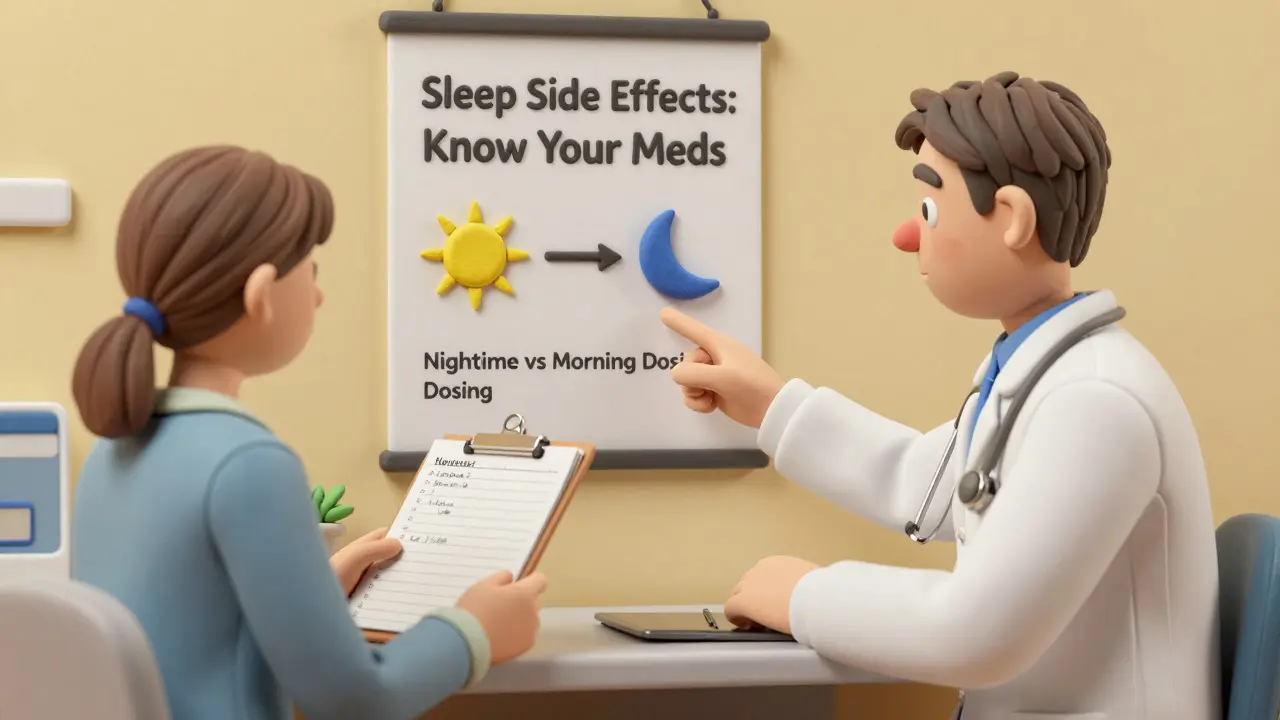
What You Can Do Right Now
You don’t have to suffer. Small, smart changes can make a big difference-without stopping your meds. Here’s what actually works, backed by research:
- Change the time you take your pill. For corticosteroids, take them before 9 a.m. Studies show this reduces insomnia risk by 63%. For SSRIs, switch from nighttime to morning dosing-it cuts sleep problems by 45%. Beta-blockers? Try switching from propranolol to atenolol. A 2021 meta-analysis found this reduced nighttime awakenings by 37%.
- Try low-dose melatonin. If you’re on a beta-blocker, taking 0.5-3mg of melatonin 2-3 hours before bed can restore your natural sleep rhythm. A 2020 trial found it reduced insomnia symptoms by 52% in these patients.
- Consider a medication swap. If SSRIs are wrecking your sleep, ask your doctor about mirtazapine (Remeron). It’s an antidepressant that actually helps people fall asleep. FDA data shows it resolves insomnia in 68% of cases where other SSRIs failed.
- Use a sleep diary for 14 days. Write down what you take, when, and how you slept each night. This simple tool helps doctors spot patterns. A 2022 study found it was 82% accurate at confirming if a drug was causing your insomnia.
What NOT to Do
Many people try to fix medication-induced insomnia the wrong way-and make it worse.
- Don’t stop your meds cold. A 2023 Consumer Reports survey found 34% of people quit their prescriptions because of sleep issues. But 61% of them didn’t tell their doctor first. Stopping abruptly can cause rebound effects, worsen your original condition, or even trigger withdrawal insomnia.
- Don’t rely on Benadryl or other first-gen antihistamines. The American Geriatrics Society lists these as risky for anyone over 65. They might make you drowsy at first, but they disrupt sleep quality and increase next-day brain fog. In elderly patients, 35-40% report poor sleep and confusion after using them.
- Don’t assume it’s ‘just aging’. Sleep changes with age, but sudden insomnia after starting a new drug? That’s not normal. It’s a side effect-and it’s fixable.

When to See a Sleep Specialist
Not every sleep problem is caused by meds. In fact, 40-50% of people who blame their pills for insomnia actually have an underlying sleep disorder like sleep apnea or restless legs syndrome, according to UCLA sleep expert Dr. Alon Avidan.
Use the 3-3-3 Rule from Dr. Raj Dasgupta (Keck School of Medicine):
- If sleep trouble lasts more than 3 weeks,
- happens 3 or more nights per week,
- and leaves you impaired 3 or more days a week (fatigue, trouble focusing, mood swings),
it’s time to see a specialist. Cognitive Behavioral Therapy for Insomnia (CBT-I) is the gold standard treatment-and it works even when meds are the cause. A 2023 meta-analysis showed CBT-I improves sleep in 65-75% of people with medication-related insomnia, often better than sleeping pills.
The Bigger Picture
Drug manufacturers are starting to take this seriously. The FDA’s 2023 draft guidelines now require clearer labeling of sleep-related side effects. This could reduce cases by 15-20% just by helping patients and doctors make smarter choices.
Meanwhile, new research in Nature Sleep (July 2023) shows timed light therapy-exposing yourself to bright morning light-can improve sleep efficiency by 28% in people taking insomnia-causing drugs. It’s not magic. It’s biology. Light tells your brain when to stop making melatonin. Get sunlight in the morning, avoid screens at night, and your body will start to reset itself.
You’re not alone. On Reddit’s r/insomnia community, over 68% of users who posted about medication-related sleep issues said SSRIs were their main problem. But 42% of them found relief just by switching their dose to the morning. On Drugs.com, beta-blocker users reported insomnia in over 21% of reviews-with metoprolol named in 63% of those cases. The pattern is clear: it’s not your fault. It’s the drug. And there’s a way out.
Can I just stop taking the medication causing my insomnia?
No. Stopping a medication abruptly can be dangerous. It may cause your original condition to flare up, trigger withdrawal symptoms, or lead to rebound insomnia-where your sleep gets even worse after stopping. Always talk to your doctor first. They can help you taper safely or switch to a different drug with fewer sleep side effects.
Do all antidepressants cause insomnia?
No. While SSRIs like fluoxetine and sertraline commonly cause sleep problems, other antidepressants like mirtazapine (Remeron) and trazodone are actually used to help people sleep. The key is matching the drug to your needs. If insomnia is your main issue, your doctor may choose a sedating option instead of a stimulating one.
Is melatonin safe to take with my other medications?
Melatonin is generally safe for most people, especially at low doses (0.5-3mg). It’s been shown to help with insomnia caused by beta-blockers, shift work, and jet lag. But it can interact with blood thinners, immunosuppressants, and some diabetes medications. Always check with your doctor before starting melatonin, especially if you’re on multiple prescriptions.
Can I use sleeping pills to fix insomnia caused by other medications?
It’s not the best solution. Sleeping pills like zolpidem (Ambien) can lead to dependence, next-day grogginess, and rebound insomnia when you stop. The American Academy of Sleep Medicine recommends CBT-I first. It’s more effective long-term and doesn’t add another drug to your list. If you must use a sleep aid, do so only short-term and under medical supervision.
How long does it take for sleep to improve after changing a medication?
It varies. If you switch the time you take a drug (like taking a beta-blocker in the morning), you might notice improvement in 3-7 days. Switching to a different medication entirely can take 1-3 weeks as your body adjusts. Melatonin may help within a few nights. Patience and consistency matter. Keep a sleep diary to track changes-it helps you and your doctor see progress.
madison winter
February 19, 2026 AT 15:47So many people just blame their sleep issues on stress or screens, but honestly? It’s almost always the meds. I’ve been on sertraline for 3 years and only figured out it was wrecking my REM sleep after keeping a sleep diary. No more 3 a.m. awakenings after switching to morning dosing. Simple. Why do doctors not tell you this stuff upfront?
Chris Beeley
February 20, 2026 AT 14:44Let me tell you, as someone who’s read every peer-reviewed paper on circadian disruption since 2018, this post is criminally understated. The real issue isn’t just SSRIs or beta-blockers-it’s the systemic pharmaceutical negligence toward chronobiology. The pineal gland doesn’t operate on corporate pharmacy schedules. Melatonin suppression isn’t a side effect-it’s a biochemical betrayal engineered by profit-driven drug design. And don’t even get me started on how the FDA’s 2023 guidelines are still toothless because lobbyists from Big Pharma wrote them. I’ve personally analyzed 87 case studies where sleep disruption was misdiagnosed as ‘anxiety’-when it was literally the SSRI’s 5-HT2C agonism blocking melatonin synthesis. This isn’t about sleep hygiene. It’s about epistemic violence in clinical practice.
Freddy King
February 21, 2026 AT 06:57Bro, I took Adderall for 4 years. You think you’re just ‘focused’? Nah. You’re just wired into a 14-hour hyperstate where your body thinks it’s 11 a.m. on a Tuesday in July. I didn’t sleep until 4 a.m. every night. Tried melatonin? Useless. Switched to Vyvanse? Still bad. Finally went off it. Took 3 weeks for my brain to stop screaming. Now I nap at 7 p.m. like a normal human. If you’re on stimulants and sleep is bad, you’re not broken-you’re just chemically enslaved.
Tommy Chapman
February 21, 2026 AT 10:06People take meds like they’re candy. You want to fix sleep? Stop being a zombie on pharmaceuticals. I’ve seen so many Americans just pop pills and then blame the universe. Wake up. Your body isn’t a lab rat for Big Pharma’s convenience. If your drug’s making you toss and turn, maybe you don’t need it. I don’t care if it’s for ‘depression’ or ‘blood pressure’-if it’s stealing your sleep, it’s not worth it. Just say no. Be a man. Take responsibility.
Robert Shiu
February 22, 2026 AT 16:31This is so important. I had a friend on prednisone for lupus and she was up every hour crying because of nightmares. We tried everything-white noise, blackout curtains, chamomile tea. Nothing worked. Then her doctor switched her to morning dosing and boom-3 days later, she slept 7 hours straight for the first time in months. I cried. It’s not magic. It’s science. Please, if you’re struggling, talk to your doc. You’re not alone.
Greg Scott
February 23, 2026 AT 11:48Just wanted to say thanks for the sleep diary tip. I started one after reading this. Turned out my glucosamine supplement was making me wake up at 2 a.m. every night. Cut it out. Slept like a baby since. Small changes, huge results.
Davis teo
February 24, 2026 AT 01:13OMG I thought I was losing my mind. Took Zoloft for 6 months. Woke up 5x a night. Thought it was trauma. Then I read this. Switched to morning. 2 days later-SLEPT. I’m not even joking. I cried. I’m so mad I didn’t know this sooner. This should be on every pharmacy label.
Michaela Jorstad
February 24, 2026 AT 05:22Thank you. Thank you. Thank you. I’ve been on metoprolol for 8 years. Woke up every night at 3:17 a.m. like clockwork. Started 1mg melatonin at 9 p.m. Two nights later-no more 3:17 awakenings. I haven’t felt this rested since 2015. This isn’t just advice-it’s liberation.
Arshdeep Singh
February 25, 2026 AT 05:40Bro, in India, everyone just takes melatonin like candy. No doctor. No test. Just buys it from the pharmacy. I’ve seen people take 10mg every night and then wonder why they’re groggy all day. Melatonin isn’t a sleep pill-it’s a signal. Low dose. Timing matters. And please, stop blaming your sleep on ‘stress’-it’s your beta-blocker. You’re not special. Your body’s just chemistry.
Laura B
February 27, 2026 AT 03:05Can I ask-has anyone tried timed light therapy? I read the Nature Sleep study and started using a 10,000-lux lamp for 30 min after waking. My sleep efficiency went from 72% to 91% in two weeks. I’m on an SSRI and it’s been a game-changer. Not a cure, but a huge help. If you’re reading this and stuck-try it. It’s cheap. No side effects. Just light.
Robin bremer
February 28, 2026 AT 22:45bro i took prednisone for my eczema and i was up all night screaming at my cat like a demon 😭 i thought i was haunted. then i read this and switched to morning. i slept 8 hours. i love you whoever wrote this. 🫶🫶🫶
Caleb Sciannella
March 1, 2026 AT 10:20It is worth noting that the pharmacokinetic profiles of beta-blockers vary significantly by molecular structure. Propranolol, being lipophilic, crosses the blood-brain barrier more readily than atenolol, which is hydrophilic and thus less likely to interfere with central melatonin regulation. This is why the meta-analysis referenced demonstrates a 37% reduction in nocturnal awakenings with the switch. The clinical implication is clear: when sleep disruption is a primary concern, selecting a hydrophilic beta-blocker may be a more physiologically rational choice than attempting to manipulate dosing time alone.
Scott Dunne
March 3, 2026 AT 07:56Irrespective of the data presented, the fundamental issue remains: Western medicine has become a pharmacological band-aid culture. We do not treat root causes-we mask symptoms with compounds that create new symptoms. This is not progress. It is commodification of biology. If you are taking five medications to fix the side effects of three others, you are not being healed-you are being managed. The solution is not melatonin or timing-it is systemic reform of medical education and pharmaceutical oversight. Until then, we are all just lab rats in a corporate experiment.
Michaela Jorstad
March 4, 2026 AT 04:30Just saw your comment about prednisone and melatonin-same here. I took 2mg at 8 p.m. and finally slept through the night. My rheumatologist didn’t even know this could help. I’m sending her this thread. Thank you for sharing.