
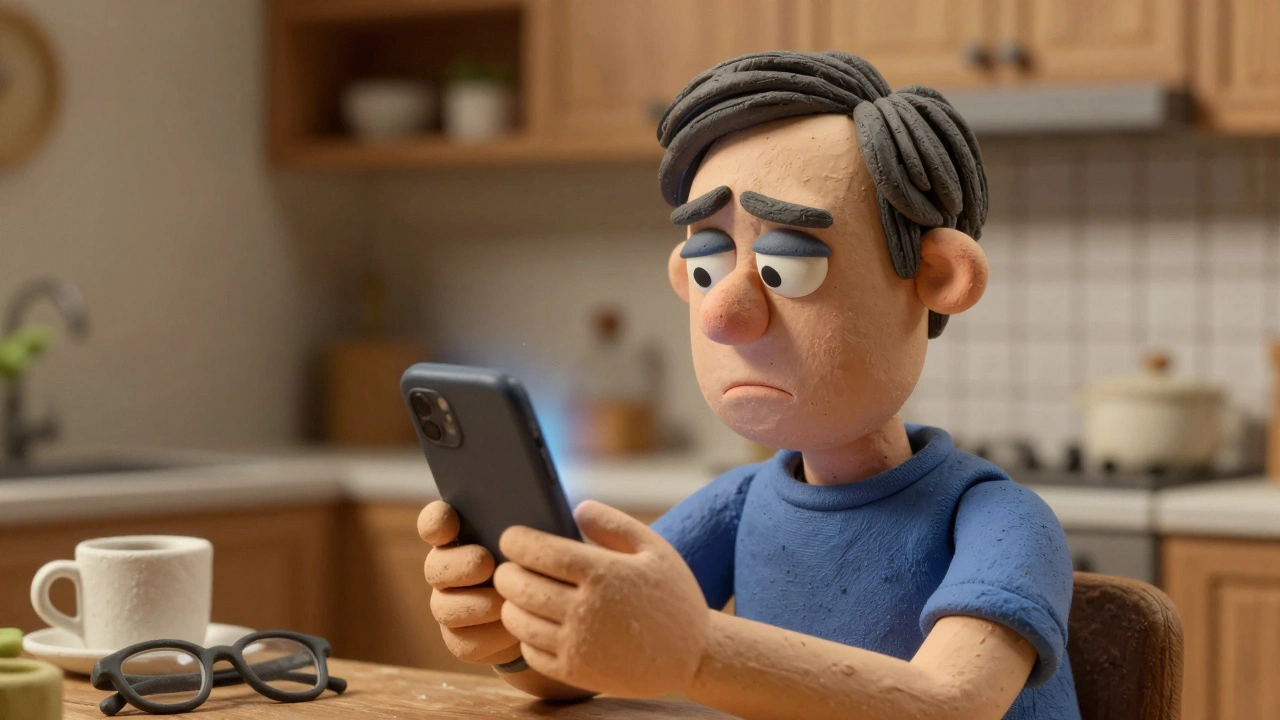
By the time you hit your mid-40s, you might start holding your phone farther away to read text. Or you’re squinting at the menu at dinner. Maybe you’ve started keeping a pair of glasses on your nightstand just to check the time. If this sounds familiar, you’re not alone. Presbyopia is the reason-and it’s happening to nearly everyone.
This isn’t a disease. It’s not caused by too much screen time or poor lighting. It’s not something you can fix with eye exercises or supplements. Presbyopia is simply your eyes aging. The lens inside your eye, which used to bend easily to focus on close objects, has slowly hardened over the years. By age 45, most people lose about half their ability to focus up close. By 60, it’s nearly gone.
What’s Actually Happening Inside Your Eye?
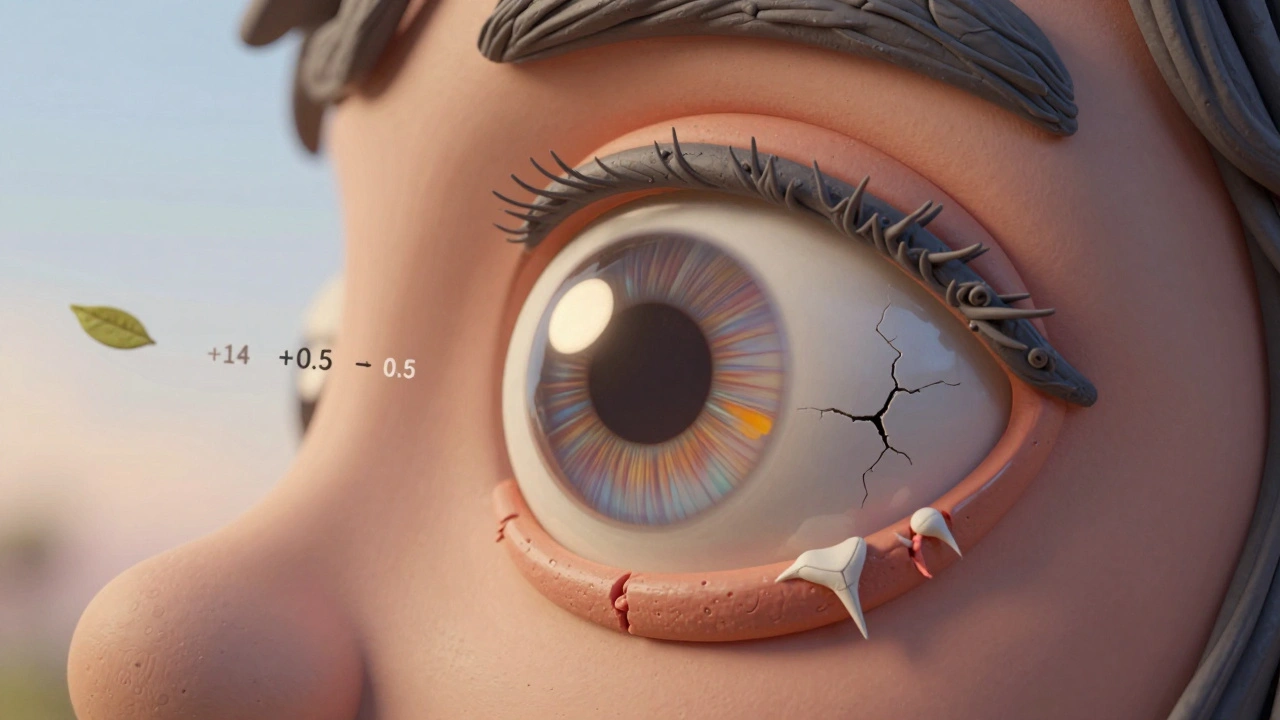
Your eye’s lens works like a flexible camera lens. When you look at something nearby, tiny muscles around the lens contract, making it thicker and more curved to bend light onto the retina. This is called accommodation. At age 10, your lens can adjust by about 14 diopters-meaning you can focus on something as close as 7 centimeters from your eye. By age 60, that ability drops to just 0.5 diopters. Your near point-the closest distance you can focus-moves from 7 cm to over 100 cm. That’s why you’re holding your book at arm’s length.
This change isn’t sudden. It’s gradual. You might not notice it until you’re trying to read small print on a pill bottle or your phone’s settings menu. The first sign? Eye strain after reading for 10 minutes. Then headaches. Then the need to turn up the brightness or use brighter lighting. By age 50, most people need at least +1.50 diopters of correction. By 65, many need +2.50 to +3.00.
Reading Glasses: The Simple Fix That Works
For many, reading glasses are the easiest answer. You can buy them off the shelf at any pharmacy, grocery store, or online for under $20. They come in strengths from +0.75 to +3.50 in 0.25-diopter steps. The key? Getting the right power.
Most people start with +1.00 or +1.25. If you’re holding your phone 40 cm away and it’s still blurry, you might need +1.50. If you’re holding it 50 cm away and still struggling, try +2.00. But here’s the catch: over-the-counter readers are the same power in both lenses. If you have different vision in each eye-or if you’re nearsighted and need distance correction too-they won’t work well. About 35% of people buy the wrong strength, according to Optometry Times, leading to eye fatigue and headaches.
They’re perfect for occasional use: reading a label, checking a text, flipping through a magazine. But if you’re switching between your computer screen and the doorbell camera constantly, you’ll find yourself constantly taking them off and putting them back on. That’s where progressives come in.
Progressive Lenses: The Seamless Alternative
Progressive lenses are the most popular prescription option for people who need correction for both near and distance vision. Unlike bifocals, which have a visible line separating near and far zones, progressives blend the power gradually across the lens. One part lets you see far away, another lets you read, and the middle handles your computer screen.
They’re more expensive-$250 to $450 for a pair with good quality lenses-and they require an adjustment period. Most people need 2 to 4 weeks to get used to them. During that time, you might feel dizzy, have trouble walking down stairs, or notice blurry spots on the sides of your vision. That’s normal. The trick? Move your head, not just your eyes. To look at your computer, lower your gaze. To see across the room, look straight ahead.
Not all progressives are the same. Newer designs like Essilor’s Eyezen 2.0 have wider near zones, making it easier to read without moving your head as much. The corridor length-the vertical path between distance and near power-matters too. Shorter corridors (12mm) are better for smaller frames but harder to adapt to. Longer ones (16mm) are easier but require bigger frames.
Still, even the best progressives aren’t perfect. About 25% of first-time wearers report peripheral distortion. And only 60% of users achieve truly sharp near vision without compromise, according to ophthalmologist Dr. George Witkin.
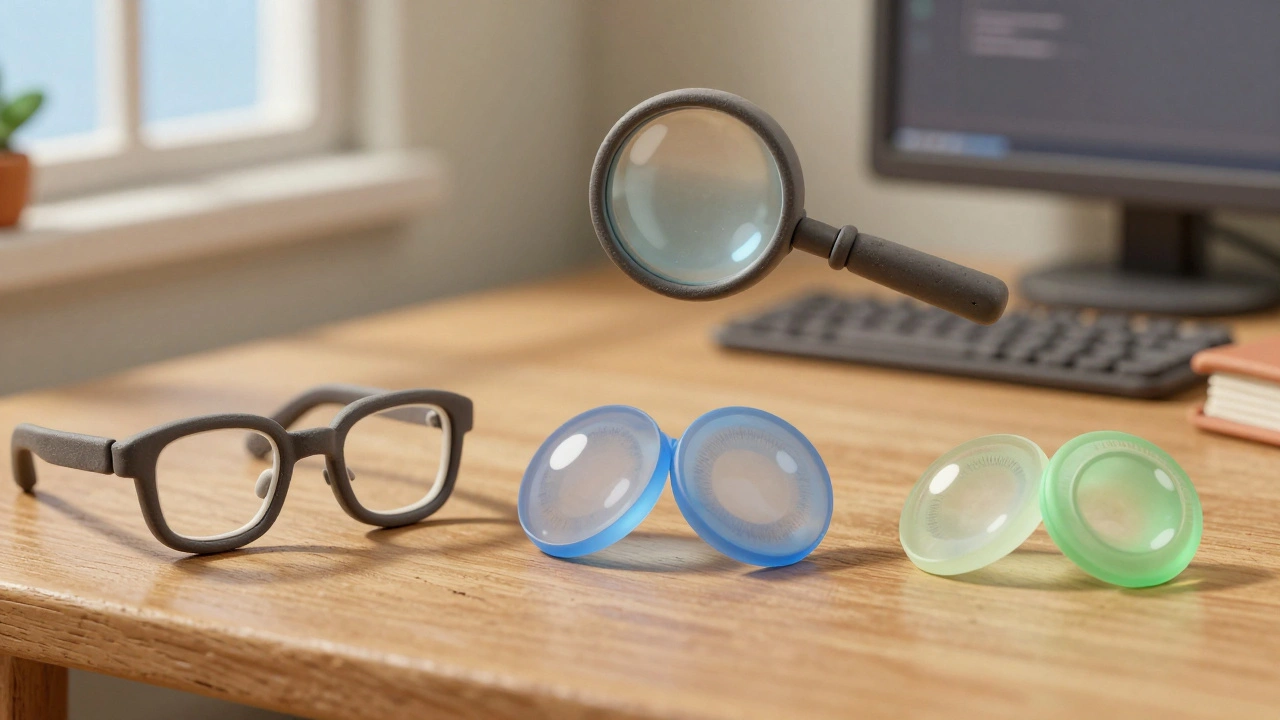
Other Options: Contacts, Surgery, and New Tech
If you hate wearing glasses, you have other choices.
Monovision contacts correct one eye for distance and the other for near. About 80% of people adapt to them, but 15% lose depth perception, making driving at night or playing sports tricky. It’s a trade-off.
Monovision LASIK does the same thing surgically. It costs $2,000 to $4,000 per eye. Satisfaction rates are high-85%-but 10-15% need a retreatment within five years. Dry eyes are common (35% of cases), and the correction isn’t reversible.
Refractive lens exchange replaces your natural lens with a multifocal artificial one-same as cataract surgery. It’s permanent. You’ll never get presbyopia again. But you’ll pay $3,500 to $5,000 per eye. And you might see halos at night or have reduced contrast sensitivity. Endophthalmitis, a serious infection, is rare-0.04%-but it’s still a risk.
Newer options are emerging. Johnson & Johnson’s Acuvue Oasys Multifocal contacts, approved in early 2023, have a 89% success rate in trials. Presbia’s Flexivue Microlens, a tiny implant placed in the cornea, gives 20/25 near vision in 78% of patients after a year. And researchers are testing eye drops like VP-025 that temporarily restore focusing power for up to 6 hours. These aren’t widely available yet, but they’re coming.
What Experts Say-and What You Should Do
Dr. Emily Chew from the National Eye Institute says it plainly: “No amount of eye exercises or dietary changes can prevent presbyopia-it’s as inevitable as gray hair.”
That means you can’t stop it. But you can manage it well.
The American Academy of Ophthalmology recommends a full eye exam at age 40. That’s not just to check for presbyopia. It’s to catch glaucoma, macular degeneration, and diabetic retinopathy early. Many of these conditions have no symptoms until it’s too late.
If you’re noticing trouble reading, don’t wait. Get your eyes checked. A proper exam includes cycloplegic refraction-drops that relax your eye muscles to measure your true focusing ability. Without it, your prescription could be off by 0.25 to 0.50 diopters. That’s enough to cause daily strain.
And if you’re thinking about surgery? Talk to a specialist. Understand the risks. Know that no solution is perfect. Even the best lenses have trade-offs.
Real People, Real Experiences
On Reddit, users share their stories:
- “First noticed it reading a restaurant menu at 42. Thought I was just tired. Turns out, I needed +1.25.”
- “Went from readers to progressives. Took three weeks. Now I can’t believe I ever lived without them.”
- “Bought cheap readers off Amazon. Got headaches every day. Went to the optometrist, got a proper pair-life changed.”
On Trustpilot, Zenni Optical’s progressive lenses get 4.3 out of 5 stars. The most common complaint? “Headaches at first.” The most common praise? “Worth the wait.”
One graphic designer, 52, switched to occupational progressives with a 14mm corridor. Now she can see her computer screen clearly without moving her head, and still read a book without switching glasses. She calls it “the best $300 I ever spent.”
What’s Next?
By 2030, over 2.1 billion people worldwide will have presbyopia. That’s nearly a quarter of the global population. The market for corrective lenses is growing fast-projected to hit $20 billion by 2030. But the core truth hasn’t changed: your eyes are aging, and that’s okay.
You don’t need to fight it. You just need the right tools. Whether it’s a $10 pair of readers for quick tasks, or a custom progressive lens for daily life, there’s a solution that fits your lifestyle. And with new tech on the horizon, the future of near vision correction is getting better-not more complicated.
The goal isn’t to go back to how you saw at 25. It’s to see clearly now, without pain, without strain, without frustration. That’s possible. And it’s simpler than you think.
Is presbyopia the same as farsightedness?
No. Farsightedness (hyperopia) is caused by the shape of your eyeball being too short, which makes it hard to focus on close objects even when you’re young. Presbyopia is caused by the lens inside your eye hardening with age. You can be farsighted and develop presbyopia later-but they’re different problems with different causes.
Can eye exercises or supplements prevent presbyopia?
No. Despite claims online, there’s no scientific evidence that eye exercises, vitamins, or diets can stop or reverse presbyopia. The lens hardens due to natural aging, not muscle weakness. The National Eye Institute confirms this: it’s as inevitable as gray hair. Spending money on unproven remedies won’t help-get a proper eye exam instead.
Why do my reading glasses give me headaches?
Headaches from reading glasses usually mean the power is too strong or too weak, or the lenses aren’t aligned with your pupils. Over-the-counter readers have the same power in both eyes, so if your eyes need different corrections, they’ll strain. Poor lens quality can also cause distortion. If you’re getting headaches, get a professional prescription-even if you only need them for reading.
How often do I need to update my reading glasses?
Your near vision needs will change every 2 to 3 years after age 45. Most people need to increase their add power by +0.25 to +0.50 diopters every few years until around age 65. Don’t wait until you’re struggling-get your eyes checked every 1 to 2 years after 40 to stay ahead of the changes.
Are progressive lenses worth the cost?
If you’re switching between reading, computer work, and distance vision often-yes. They eliminate the need to carry multiple pairs of glasses. The initial cost is higher, but the convenience and seamless vision make them worth it for most people. The key is getting them from a reputable provider who takes precise measurements. Cheap progressives with poor fitting will frustrate you. Invest in quality.
Should I get surgery for presbyopia?
Only if you’re fully informed and have realistic expectations. Surgery like refractive lens exchange or LASIK monovision can reduce your dependence on glasses, but they’re not perfect. You might still need reading glasses for fine print. Risks include dry eyes, halos at night, and the need for retreatment. Most people do better with lenses. Talk to a specialist and try contact lenses first before committing to surgery.
David Brooks
December 8, 2025 AT 02:25OMG I JUST REALIZED I’VE BEEN HOLDING MY PHONE LIKE A FREAKIN’ TOWER OF PISA SINCE I TURNED 43. I THOUGHT I WAS JUST GETTING OLD, BUT NOW I KNOW IT’S MY LENS TURNING INTO A ROCK. THANKS FOR THIS. I FEEL LESS ALONE.
Jennifer Anderson
December 8, 2025 AT 12:37so i got those $8 readers from walmart and wow did i regret it. got headaches like clockwork. went to the doc, got a real prescrption for +1.50 and now i can read my texts without squinting like a pirate. best 20 bucks i ever spent (even if the glasses look like they’re from 1997).
Sadie Nastor
December 9, 2025 AT 11:12i’ve been wearing progressives for 6 months now 😊 and honestly? i cried the first time i saw my cat’s face without switching glasses. it’s weird at first, like your brain is lagging, but after two weeks? magic. also, i got the short corridor ones for my small frames and it worked. don’t be scared.
Sangram Lavte
December 9, 2025 AT 22:37in india, most people just use reading glasses for 10 rupees. no one talks about progressives or surgery. we just adapt. i’ve been using +2.00 for five years. no headaches, no drama. sometimes the simplest solution is the right one.
Kurt Russell
December 11, 2025 AT 02:30if you’re over 45 and still not wearing glasses, you’re not being cool-you’re being dumb. your eyes are not a battery you can recharge with kale. get checked. get the right power. don’t wait until you’re reading the microwave manual with a magnifying glass. your future self will thank you.
Stacy here
December 12, 2025 AT 22:32the real conspiracy? big optics doesn’t want you to know that eye drops are coming. VP-025 is already in phase 3 trials. in 2 years, you’ll be able to just squirt your eyes and read the newspaper again. they’re selling you $400 lenses because they’re making billions. don’t be their cash cow.
Helen Maples
December 14, 2025 AT 10:16if you're getting headaches from over-the-counter readers, stop blaming your eyes. blame your laziness. you didn't get a proper refraction. you didn't check for astigmatism. you didn't measure pupillary distance. this isn't a lifestyle choice-it's a medical necessity. get it done right or suffer.
Ted Rosenwasser
December 14, 2025 AT 15:16progressive lenses are for people who can’t commit to a lifestyle. real men use bifocals. real women wear readers for reading and sunglasses for distance. stop paying for ‘seamless’ marketing nonsense. the line is a feature, not a flaw. also, your 14mm corridor is probably wrong. you need at least 16mm if you’re not a 22-year-old with 20/10 vision.
Ashley Farmer
December 16, 2025 AT 06:01i just wanted to say thank you for writing this without making us feel broken. i’m 47 and i used to hate that i needed glasses. now i see it like gray hair-it’s just part of being alive. i got my progressives last month and i feel like i’ve been given back my mornings.
Nancy Carlsen
December 16, 2025 AT 15:11my mom in california got presbyopia at 41. she thought it was stress. then she cried because she couldn’t read her granddaughter’s drawing. now she has custom progressives and sends me photos of her holding books like a trophy. i love that she didn’t give up on seeing the world clearly.
Kyle Flores
December 17, 2025 AT 14:07monovision contacts worked for me for 3 years. then i started driving at night and suddenly everything looked like a blurry halo party. i went back to readers. not glamorous, but safe. also, i don’t miss the daily hassle of putting in contacts. sometimes the dumb solution is the smart one.
Nicholas Heer
December 17, 2025 AT 22:22they’re hiding the truth. presbyopia isn’t aging-it’s glyphosate. it’s the 5G towers. it’s the FDA letting big pharma poison our lenses with artificial sweeteners in soda. i’ve been eating organic kale for 10 years and still got +2.50. they don’t want you to know this. but now you do.
Oliver Damon
December 18, 2025 AT 03:04what fascinates me is how we’ve normalized visual compromise. we accept that seeing clearly at 50 requires tech, money, and adjustment. but we don’t ask why our biology evolved to fail this way. is it a flaw? or a design feature? if our eyes were meant to last 80 years, why does the lens harden at 45? maybe it’s not about fixing our eyes-but rethinking how we live with them.
Ryan Sullivan
December 18, 2025 AT 07:30the author writes like a pharmaceutical rep. ‘new tech is coming’-sure, but at $5,000 per eye? the real solution is still the $10 reader. stop overcomplicating it. your eyes aren’t a Tesla. they’re a pair of old binoculars that need a lens change. stop selling dreams. sell practicality.