
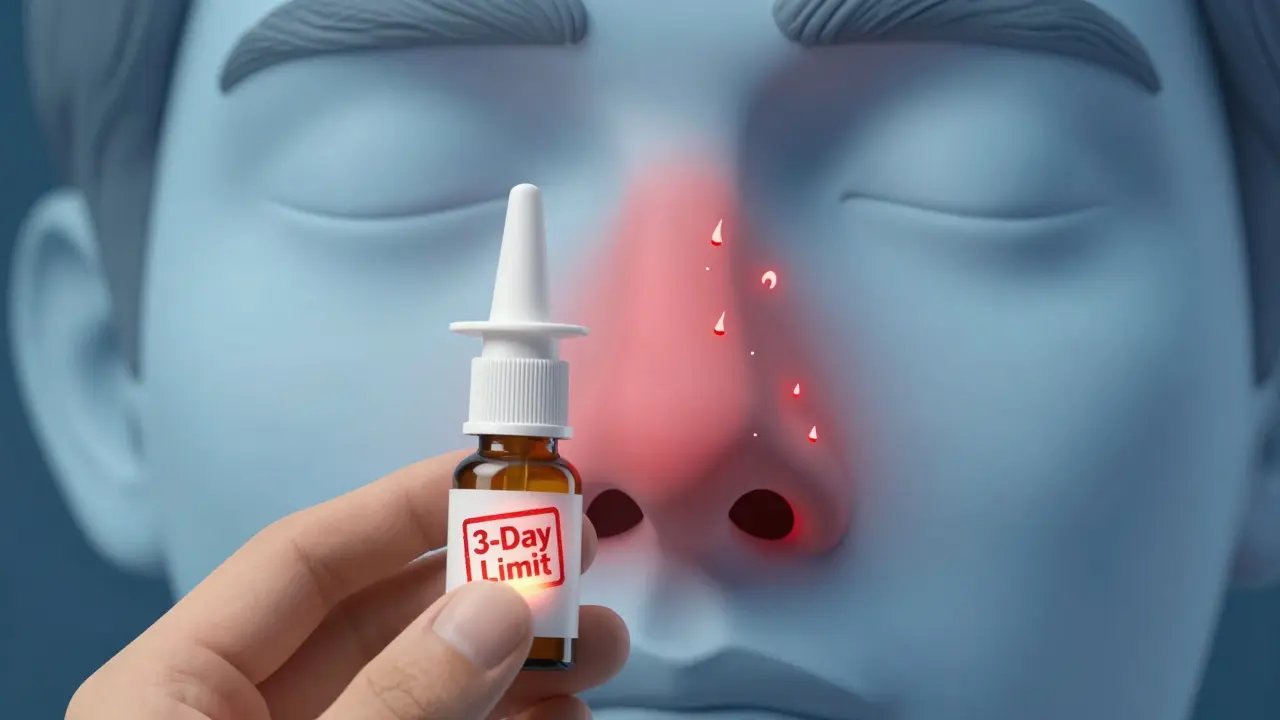
Most people reach for an OTC nasal spray when their nose is clogged - maybe from a cold, allergies, or sinus pressure. It feels like magic: one spray, and suddenly you can breathe again. But here’s the catch - if you use it for more than three days, you’re not fixing your nose. You’re setting it up to fail.
Why Your Nose Gets Worse After the Spray
It sounds backwards, but it’s real. You use a decongestant spray like Afrin or Neo-Synephrine to unblock your nose. It works fast - within minutes. But after 8 to 12 hours, the effect wears off. And instead of staying clear, your nose gets even more swollen than before. This isn’t your cold coming back. It’s something called rhinitis medicamentosa - or rebound congestion. This happens because these sprays contain chemicals like oxymetazoline or phenylephrine. They shrink blood vessels in your nasal lining, which reduces swelling and opens your airway. But when you use them for more than three days straight, your body starts to fight back. The blood vessels become oversensitive. They dilate too much when the drug leaves your system. Your nose isn’t congested because of a virus or allergy anymore. It’s congested because the spray itself made it that way. Studies show this isn’t rare. About 1 in 50 people who use these sprays regularly end up with rebound congestion. And it doesn’t take long - some people see symptoms after just 72 hours. The worst part? Once it starts, it can last for weeks. You feel like you’re stuck in a loop: spray → relief → congestion → spray again.What’s in These Sprays - And Why It Matters
Not all nasal decongestants are the same. The most common ones you’ll find on the shelf are:- Oxymetazoline (Afrin, Otrivin) - 0.05% concentration, lasts 8-12 hours
- Phenylephrine (Neo-Synephrine) - 0.25% concentration, shorter duration
- Xylometazoline (Otrivin, some international brands)
- Naphazoline (Privine)
What Rebound Congestion Feels Like
You might think your allergies are getting worse. Or that your cold is turning into a sinus infection. But if you’ve been using the spray daily for more than three days, here’s what’s really happening:- Your nose feels stuffy again - even if you’re not sick
- You need to spray more often to get the same relief
- You wake up congested, even though you sprayed before bed
- You feel like you can’t breathe unless you use the spray
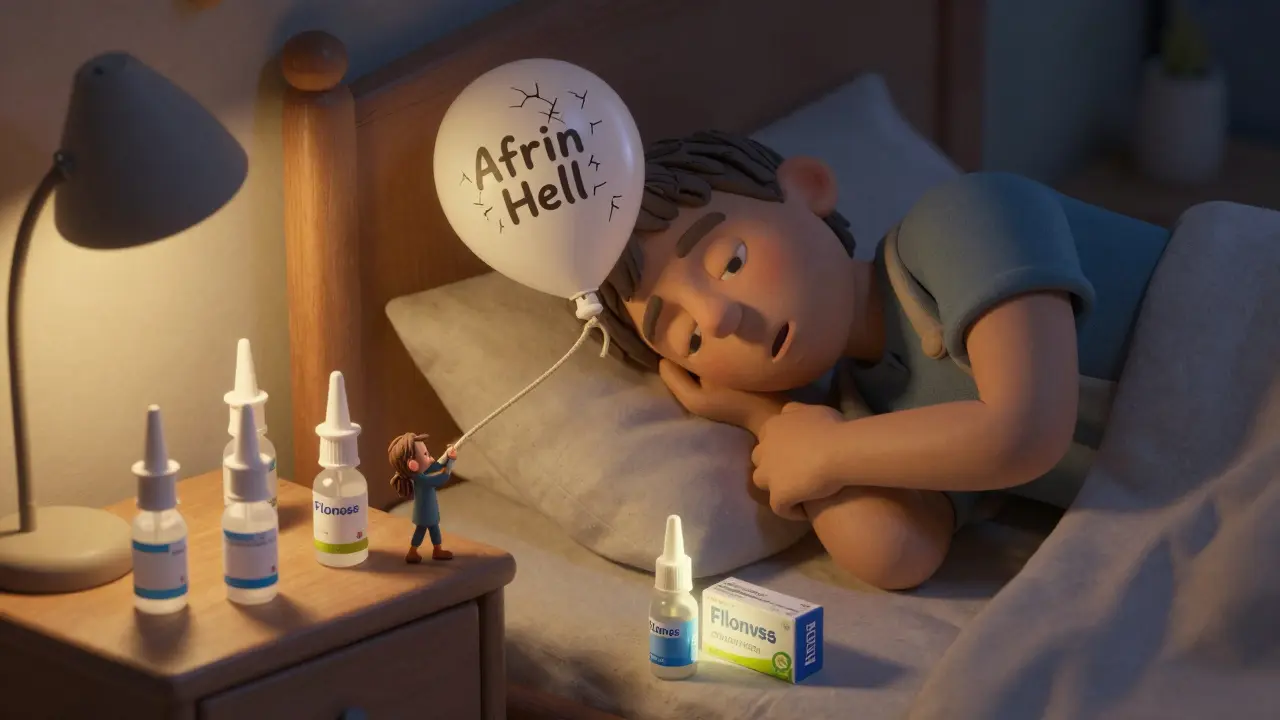
What to Use Instead
You don’t have to suffer. There are safer, long-term options that won’t trap you in a cycle:- Saline nasal sprays - Just salt and water. No chemicals. No rebound. Safe to use as often as you need. Great for daily moisture, especially in dry climates or during winter.
- Fluticasone (Flonase Sensimist) - An OTC steroid spray. Takes 3-7 days to kick in, but once it does, it reduces inflammation at the source. No dependency. No rebound. Ideal for allergies or chronic congestion.
- Ipratropium bromide (Atrovent) - Used for runny nose, not stuffiness. Won’t help with congestion, but great if you’re dripping constantly.
- Oral decongestants - Like pseudoephedrine (Sudafed). Works systemically, so it doesn’t cause nasal rebound. But it can raise blood pressure and cause jitters. Avoid if you have heart issues or high blood pressure.
How to Quit Safely
If you’ve been using a decongestant spray for more than three days, don’t just stop cold turkey. That’s when the rebound hits hardest. Here’s a better plan:- Start using a fluticasone nasal spray (like Flonase) - once daily, even if you’re still using the decongestant.
- Reduce your decongestant spray by one spray per day every 48 hours. So if you were using it 4 times a day, go to 3, then 2, then 1.
- Use saline spray 4-6 times a day to soothe your nasal lining and flush out irritants.
- Be patient. It can take 7-21 days to fully recover. Your nose will feel worse before it gets better.

Why People Keep Using Them
It’s not just ignorance. It’s human nature. These sprays are everywhere. Easy to buy. Fast relief. And when you’re struggling to breathe, it’s hard to think ahead. Plus, the packaging doesn’t scream “danger.” The warning label says “do not use more than 3 days,” but it’s small print. Most people don’t read it - or forget after day two. A 2023 Cleveland Clinic survey found that 38% of users go past the 3-day limit. And 28% of adults have experienced rebound congestion at least once. That’s nearly 1 in 4. The market is huge - over $1.2 billion in the U.S. alone. Companies make money off repeat users. But your nose doesn’t.When It’s Okay to Use Them
Decongestant sprays aren’t evil. They’re useful - if used right. Use them only for:- Acute cold or sinus infection (3-5 days max)
- Severe nasal blockage before a flight or important meeting
- Short-term relief while waiting for a steroid spray to work
- Allergies (use steroids instead)
- Chronic congestion
- Everyday use to “keep your nose clear”
What to Do Next
If you’re currently using a decongestant spray daily:- Check the label. What’s the active ingredient?
- Count how many days you’ve used it. If it’s 4 or more, start tapering now.
- Buy a saline spray and a fluticasone spray. Start both today.
- Write down your daily spray count. Use a phone note or calendar.
Can I use OTC nasal sprays every day for allergies?
No. Daily use of decongestant sprays like Afrin for allergies will cause rebound congestion. For allergies, use an OTC steroid spray like Flonase or Nasacort instead. These reduce inflammation over time without causing dependency. Saline sprays are also safe for daily use.
How long does rebound congestion last after stopping the spray?
It usually lasts 7-21 days with proper care - using saline and steroid sprays. If you stop cold turkey, it can drag on for 4-6 weeks. The key is to start a steroid spray before you quit the decongestant. This helps your nasal lining heal while you wean off.
Is Afrin more dangerous than other nasal sprays?
Afrin (oxymetazoline) is one of the most common causes of rebound congestion because it’s widely used and heavily marketed. But it’s not more dangerous than other decongestant sprays like Neo-Synephrine or Otrivin. All of them carry the same risk if used beyond three days. The active ingredient matters more than the brand name.
Can rebound congestion cause permanent damage?
Yes, with long-term misuse - especially over 6 months - nasal tissues can thin, scar, or even develop perforations in the septum. Chronic inflammation from repeated rebound can also lead to lasting sinus problems. Most cases reverse with proper treatment, but early intervention is critical.
Are there any OTC nasal sprays that don’t cause rebound?
Yes. Saline sprays (saltwater) cause no rebound. OTC steroid sprays like Flonase, Nasacort, and Rhinocort also don’t cause rebound. They work by reducing inflammation, not by shrinking blood vessels. They take days to work, but they’re safe for daily, long-term use.
Isabella Reid
January 16, 2026 AT 21:58I used to be that person who reached for Afrin like it was candy. Then I woke up one morning and couldn’t breathe without it. Took me 3 weeks to quit. Saline spray + Flonase saved my nose. Don’t wait until you’re in ‘Afrin hell’ like some Reddit guy said. Just start tapering today.
It’s not even that hard. You just have to care enough to stop being lazy about your breathing.
swarnima singh
January 17, 2026 AT 09:19sooo... u mean like... these sprays r like crack for your nose? 😭 i thought i was just allergic to everything. turns out i was just addicted. why does no one tell u this?? my nose feels like it’s been betrayed by capitalism.
kanchan tiwari
January 17, 2026 AT 16:42THIS IS A BIG PHARMA SCAM. THEY KNOW THIS HAPPENS. THEY PUT THE WARNING IN 5PT FONT SO YOU DON’T SEE IT. THEY WANT YOU TO BUY MORE. THEY’RE MAKING BILLIONS OFF YOUR BROKEN NOSE. THE GOVERNMENT IS IN ON IT. I SAW A VIDEO ON TIKTOK ABOUT IT. THEY’RE LYING TO YOU.
Kasey Summerer
January 17, 2026 AT 23:46So let me get this straight… you’re telling me the thing that made me feel like a god for 8 hours… is the reason I now feel like a dying fish? 😂
Thanks for the reality check, I guess. Also, why is Flonase so expensive?? $40 for a bottle that takes a week to work? Like, I’ll wait… but my bank account won’t.
Bobbi-Marie Nova
January 19, 2026 AT 05:50OMG YES. I used to be the girl who’d spray 5 times a day. Then I started using saline before bed and Flonase in the morning. Didn’t feel amazing at first… but now I can actually smell my coffee again. And I didn’t cry during a Zoom meeting because I couldn’t breathe. Small wins, people.
It’s not sexy, but your nose deserves kindness, not chemicals.
john Mccoskey
January 20, 2026 AT 18:00Let’s be real-this isn’t about nasal physiology. It’s about the collapse of personal responsibility in modern healthcare. People don’t read labels because they’ve been conditioned to expect instant gratification from everything. You want relief? Fine. But you also want to be told it’s safe, convenient, and consequence-free. That’s not medicine. That’s consumer fantasy. The body isn’t a vending machine. You don’t insert a dollar and get a perfectly functioning nasal passage. You insert a vasoconstrictor and you get a biological rebellion. The fact that this is even a conversation is evidence of a society that has outsourced basic self-care to pharmaceutical marketing departments. And now we’re surprised when our sinuses revolt? Wake up.
And yes, oxymetazoline is still the worst offender. Not because it’s uniquely toxic-but because it’s the most widely abused. The rest are just accomplices.
Allen Davidson
January 22, 2026 AT 16:36I’ve helped 3 friends quit Afrin addiction. It’s brutal. But here’s the trick: don’t quit cold turkey. Start the steroid spray on day one. Even if you’re still using the decongestant. That’s the key. The steroid heals the lining while you taper. Saline keeps it moist. And yes, it sucks for the first week. But you’ll thank yourself in month two.
Also-stop calling it ‘just a stuffy nose.’ It’s a dependency. Treat it like one.
Ryan Hutchison
January 23, 2026 AT 23:26Y’all are overcomplicating this. In my country, we just use ephedrine nasal drops. Works better, lasts longer, and no one’s crying about rebound. Why? Because we don’t have these stupid 3-day rules. You use it when you need it. End of story. Your nose isn’t a fragile flower. It’s a valve. Open it. Close it. Deal with it.
Stop listening to medical blogs. Learn to breathe on your own.
Samyak Shertok
January 25, 2026 AT 09:57Wait, so the whole ‘don’t use it longer than 3 days’ thing… is just a suggestion? Like, if I use it for 4 days, am I a bad person? Or is this just another way to make us feel guilty for wanting to breathe? I mean, if the spray works, why not use it? Who decided 3 days is magic? Some guy in a lab coat with a clipboard? I’m not buying it.
Also, why is Flonase so expensive? Did the government privatize my sinuses?
Joie Cregin
January 27, 2026 AT 07:49I used to think my nose was broken. Turns out, I was just using it wrong. I started with saline sprays-just plain saltwater-and honestly? It felt like a hug for my sinuses. Then I added Flonase. Took a week, but now I wake up and breathe like a normal human. No drama. No panic. No spray addiction.
It’s not glamorous. But your nose isn’t a machine that needs a power surge. It’s tissue. It needs rest. And sometimes… a little TLC.
Also, I cried when I finally smelled my own shampoo again. That’s how bad it got.
Jody Fahrenkrug
January 28, 2026 AT 02:10Just stopped using Afrin yesterday. Day 2 of withdrawal and I feel like I’m suffocating. But I’m sticking with Flonase and saline. It’s rough. But I’d rather feel like a zombie for two weeks than be addicted forever. Thanks for the post-needed this.