
When your bones start to weaken without warning, even a minor stumble can lead to a broken hip, spine, or wrist. This isn’t just aging-it’s osteoporosis, a silent disease that affects nearly 10 million Americans and leaves another 44 million with low bone density. It doesn’t hurt until it breaks. And once it does, recovery is slow, expensive, and often life-changing.
What Exactly Is Osteoporosis?
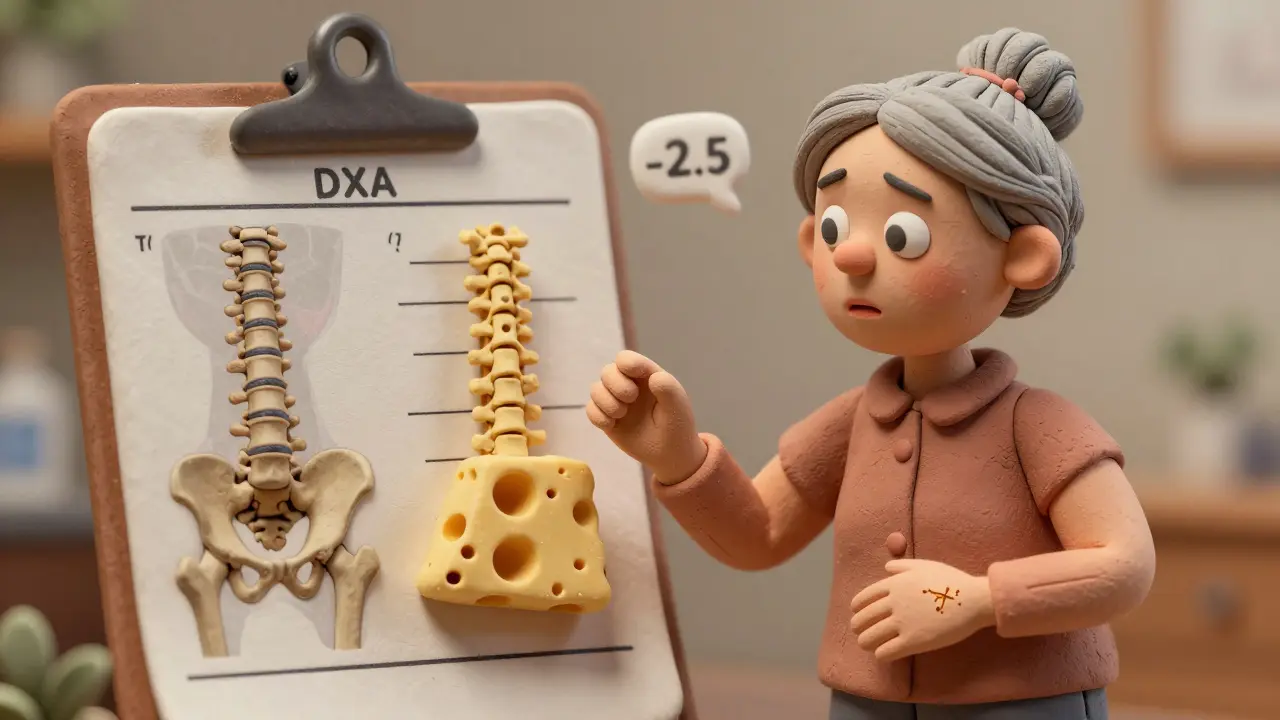
Osteoporosis means porous bones. Your skeleton is made of living tissue that constantly renews itself-old bone breaks down, new bone forms. With osteoporosis, this balance tips. Bone breaks down faster than it rebuilds. The inside of your bones starts looking like Swiss cheese instead of a strong honeycomb. That’s why a fall from standing height can cause a fracture.
It’s not just older people. Women after menopause are at highest risk because estrogen drops sharply, and estrogen helps protect bone. Men get it too, but less often. Other risk factors include being underweight, smoking, long-term steroid use, and having a family history. Most people don’t know they have it until they break a bone. That’s why bone density scans are so important.
How Doctors Measure Bone Loss
The gold standard test is a DXA scan-dual-energy X-ray absorptiometry. It’s quick, painless, and uses less radiation than a chest X-ray. It measures bone density in your hip and spine, then compares it to healthy young adults. The result? A T-score.
- T-score above -1: normal bone density
- T-score between -1 and -2.5: osteopenia (low bone mass)
- T-score at or below -2.5: osteoporosis
Doctors also use the FRAX tool to estimate your 10-year risk of a major fracture. If your risk is over 20% for any major fracture or 3% for a hip fracture, treatment is usually recommended-even if your T-score is only in the osteopenia range.
Bisphosphonates: The First-Line Treatment
If you’re diagnosed with osteoporosis, your doctor will likely start you on a bisphosphonate. These are the most commonly prescribed osteoporosis drugs in the U.S., making up about 65% of all prescriptions. They work by slowing down the cells that break down bone-osteoclasts. By doing this, they help preserve bone density and cut fracture risk.
There are two types: non-nitrogen and nitrogen-containing. The nitrogen ones are stronger and preferred. These include:
- Alendronate (Fosamax)
- Risedronate (Actonel)
- Ibandronate (Boniva)
- Zoledronic acid (Reclast, Zometa)
Alendronate is the most studied. In the Fracture Intervention Trial, it reduced spine fractures by 48% and hip fractures by 51% over three years. Zoledronic acid, given as a yearly IV infusion, cuts hip fracture risk by 41% in high-risk patients.
How to Take Bisphosphonates Correctly
Oral bisphosphonates are cheap-often $20 to $40 a month as generics-but they’re easy to mess up. If you don’t take them right, they won’t work, and they can hurt you.
Here’s how to do it:
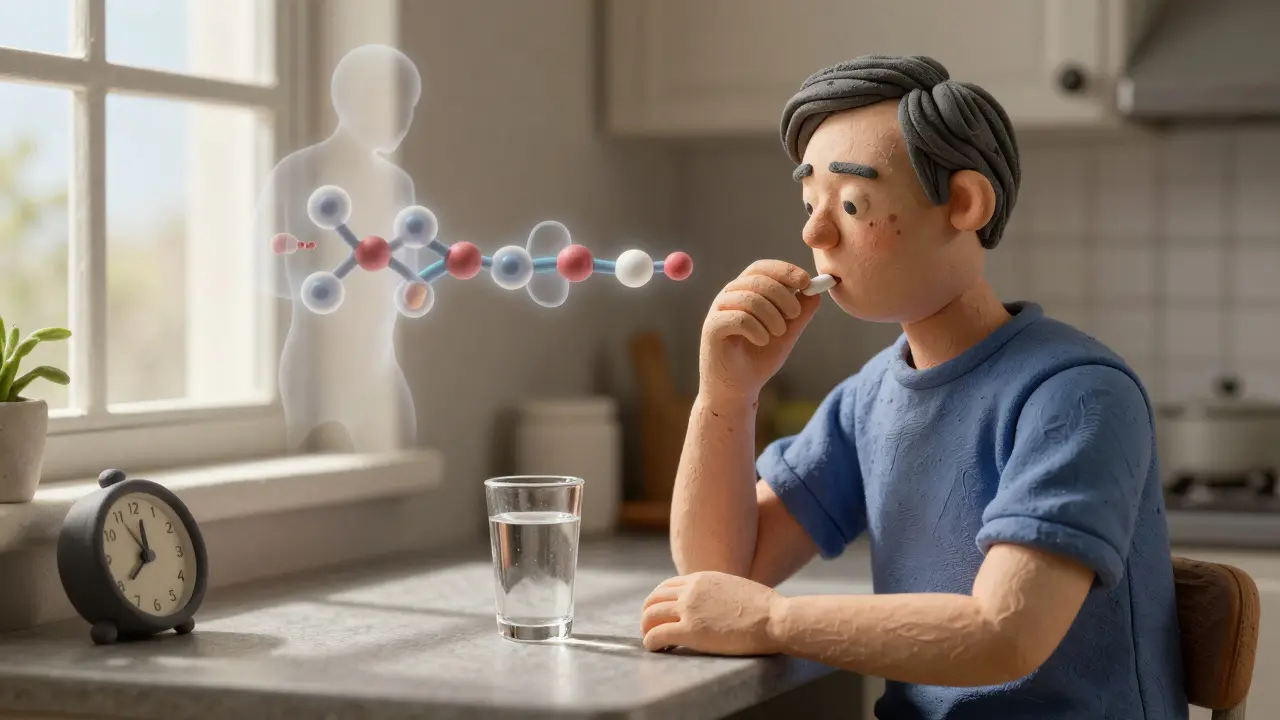
- Take it first thing in the morning, on an empty stomach.
- Swallow it with a full glass of plain water (8 ounces).
- Stay upright-stand or sit-for at least 30 to 60 minutes after taking it.
- Don’t eat, drink (except water), or take other meds during that time.
Violate these rules? You risk severe heartburn, esophageal irritation, or even ulcers. That’s why many people switch to the yearly IV version. No daily pills. No waiting around after meals. Just a 15-minute infusion once a year.
Side Effects and Risks
Most people tolerate bisphosphonates fine. But about 10-15% get stomach upset with oral forms. Rare but serious risks exist too:
- Atypical femoral fractures: A tiny crack in the thigh bone, usually after years of use. Happens in about 3-5 cases per 10,000 patient-years.
- Osteonecrosis of the jaw: Bone death in the jaw, mostly in people getting high-dose IV bisphosphonates for cancer. For osteoporosis patients, it’s extremely rare-0.01% to 0.04%.
The FDA requires black box warnings for these risks. But here’s the thing: the risk of breaking a hip or spine without treatment is far higher than the risk of these rare side effects.
When to Stop: The Drug Holiday
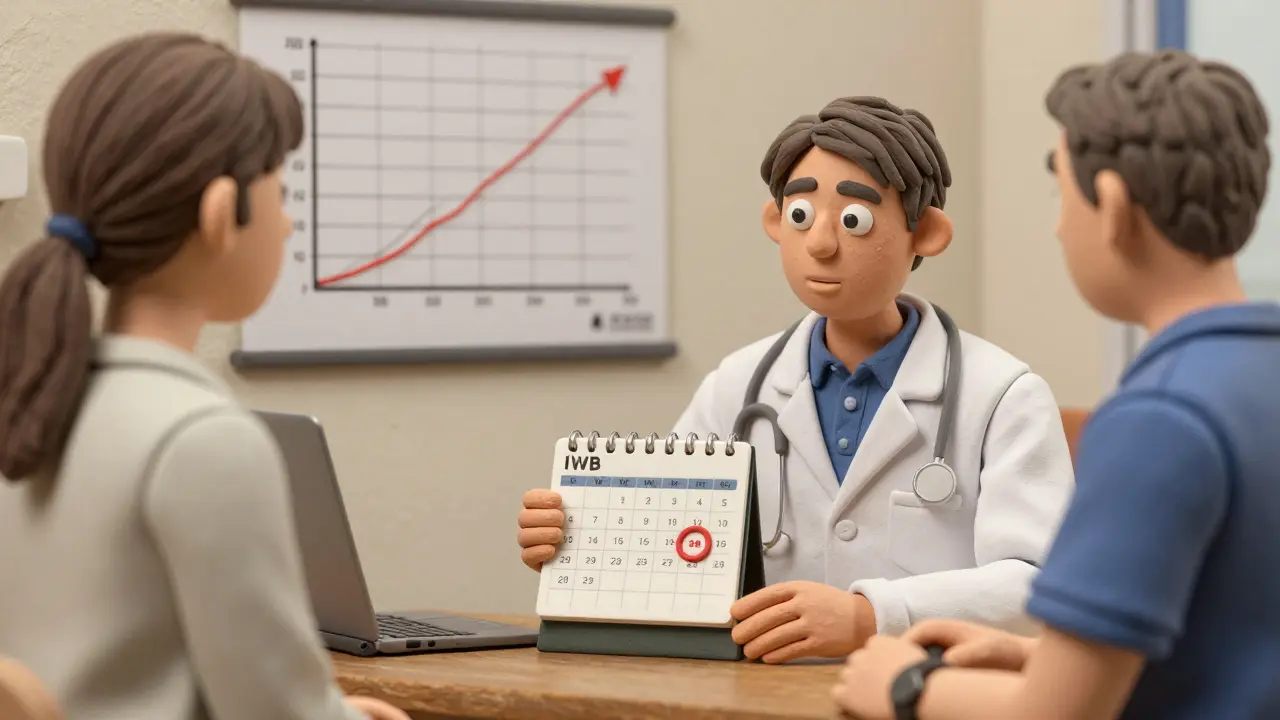
Long-term use isn’t always better. After 3 to 5 years, many doctors recommend a “drug holiday”-pausing the bisphosphonate. Why? Because the drug stays in your bones for years. Your body keeps using it, even after you stop taking it.
For low-risk patients (no prior fractures, T-score above -2.5, stable bone density), stopping for 2-3 years is safe. You’ll still have protection. But if you’re high-risk-say, you broke a spine already-you might need to keep going.
Doctors monitor you with repeat DXA scans every 1-2 years during treatment. If bone density drops or you have a new fracture, they’ll restart the medication.
Alternatives to Bisphosphonates
Bisphosphonates aren’t the only option. But they’re the most cost-effective. Here’s how others stack up:
| Treatment | How It Works | How Often | Fracture Risk Reduction | Cost (Monthly) | Key Limitations |
|---|---|---|---|---|---|
| Bisphosphonates (e.g., alendronate) | Slows bone breakdown | Daily to yearly | 40-50% | $20-$150 | GI side effects, rare jaw/thigh fractures |
| Denosumab (Prolia) | Blocks bone-resorbing cells | Every 6 months | 68% (spine) | $1,200 | Must keep taking it-stopping causes rapid bone loss |
| Teriparatide (Forteo) | Builds new bone | Daily injection | 65-70% (spine) | $1,800 | Only 2 years max, expensive, requires refrigeration |
| Romosozumab (Evenity) | Builds bone + slows loss | Monthly injection | 73% (spine) | $1,800 | Cardiovascular risk warning, limited to 12 months |
Denosumab works better than bisphosphonates for some people, but if you stop it, your bone density plummets-and so does your fracture risk, especially in the spine. Teriparatide and romosozumab are powerful, but they’re expensive and meant for short-term use. Bisphosphonates still win for most people because they’re proven, affordable, and flexible.
What Patients Say
On review sites, alendronate has a 5.4 out of 10 rating. Some users say it saved them: “Prevented another fracture after my hip break.” Others say, “I couldn’t handle the stomach pain.”
One Reddit user switched from daily pills to yearly IV infusions after severe esophageal pain. “The infusion was a breeze. No more waiting around after breakfast.”
But the biggest worry among patients? “When do I stop?” A MyOsteoHealth post asked: “If I take a drug holiday, will my bones start crumbling again?”
That’s why follow-up care matters. Your doctor doesn’t just hand you a script and send you on your way. They track your bone density, your fractures, your lifestyle. You need to stay in the conversation.
What You Can Do Right Now
If you’re over 50 and have risk factors-family history, low body weight, steroid use, or a past fracture-ask for a bone density scan. Don’t wait for a fall.
Get enough calcium (1,200 mg/day) and vitamin D (800-1,000 IU/day). Walk daily. Cut smoking. Limit alcohol. Strength training helps more than you think.
If you’re on a bisphosphonate, take it exactly as instructed. Don’t skip doses. Don’t lie down after taking it. If you’re having side effects, talk to your doctor. There’s usually another option.
Osteoporosis isn’t a death sentence. It’s a manageable condition. The right treatment, combined with smart habits, can keep you walking, bending, and living without fear of breaking.
Can osteoporosis be reversed?
Osteoporosis can’t be fully reversed, but it can be significantly improved. Medications like bisphosphonates and teriparatide can increase bone density by 5-13% over a few years. With treatment, many people stabilize their bone loss and reduce fracture risk by half. Lifestyle changes-exercise, calcium, vitamin D-support this process. The goal isn’t to return to youthful bone density, but to reach a level where fractures are unlikely.
How long should I take bisphosphonates?
Most people take bisphosphonates for 3 to 5 years, then take a break-called a drug holiday-unless they’re at high risk for fractures. After 5 years, your bone still holds onto the drug, so protection continues. If your bone density stays stable and you haven’t had a fracture, you might stay off the medication for 2-3 years. Your doctor will monitor you with bone scans. If your T-score drops or you break a bone, you’ll restart treatment.
Are there natural alternatives to bisphosphonates?
No natural supplement can replace bisphosphonates for treating osteoporosis. Calcium and vitamin D are essential, but they don’t stop bone loss on their own. Supplements like strontium, collagen peptides, or magnesium may support bone health, but none have been proven to reduce fracture risk like FDA-approved medications. Relying only on natural remedies puts you at serious risk of breaking a bone. Always talk to your doctor before stopping prescribed treatment.
Why do I need to sit up for 30 minutes after taking alendronate?
Oral bisphosphonates can irritate your esophagus if they sit there too long. Sitting or standing upright helps the pill move quickly into your stomach. Lying down increases the chance the drug sticks to your throat, causing ulcers or inflammation. You also can’t eat or drink anything else (except water) for 30-60 minutes because food and other meds interfere with absorption. Following these steps isn’t optional-it’s what makes the drug work and keeps you safe.
Can men get osteoporosis?
Yes. About 2 million American men have osteoporosis, and another 12 million have low bone density. Men over 70 are at higher risk, especially if they’ve had prostate cancer treatment, long-term steroid use, or low testosterone. Men are less likely to get screened, but they’re just as vulnerable to fractures. A broken hip in a man carries a higher risk of death within a year than in a woman. Men should get tested if they have risk factors or have broken a bone after age 50.
Vicki Yuan
January 5, 2026 AT 12:09I was diagnosed with osteopenia last year after a wrist fracture from tripping over my dog. I started on alendronate and followed every rule-morning fasting, upright for an hour, no coffee till noon. It’s annoying, but worth it. My last DXA showed a 7% increase in hip density. I’m not letting this disease steal my independence.
Also, if you’re on it, please don’t skip doses. I saw a friend go off because of heartburn and ended up with a vertebral compression. Don’t be that person.
And yes, calcium and D3 matter, but they’re the foundation, not the whole house. You still need the drug.
Uzoamaka Nwankpa
January 6, 2026 AT 12:34They tell you to take this pill like it’s a religious ritual. But what about the people who can’t afford the scans? Or the ones who live in places where a doctor won’t even look at you unless you’re dying? I’ve seen grandmothers in Nigeria break their hips and just lie there for weeks because no one has a DXA machine nearby. This is a rich person’s disease to treat.
Angie Rehe
January 7, 2026 AT 02:07Let me be blunt: bisphosphonates are not a cure, they’re a band-aid on a hemorrhage. The pharmaceutical industry has turned osteoporosis into a profit engine. You’re being sold fear. The real issue? Chronic inflammation, vitamin K2 deficiency, and gut dysbiosis. No one talks about this because Big Pharma doesn’t patent broccoli.
And don’t get me started on the ‘drug holiday’-that’s just a marketing ploy to reset your prescription cycle. The drug stays in your bone matrix for decades. You’re not ‘giving your body a break,’ you’re just waiting for the next billing cycle.
Denosumab? That’s a biologic. It’s a monoclonal antibody. It’s not ‘just a pill.’ It’s immunosuppressive. You think your immune system doesn’t care that you’re blocking RANKL? Wake up.
Enrique González
January 7, 2026 AT 21:57I’m 62, had a vertebral fracture at 58. Took Fosamax for 4 years, then switched to the yearly Reclast infusion. Best decision I ever made. No more lying awake wondering if I swallowed the pill right. No more acid reflux. Just one trip to the clinic, sit back, relax, and they hook me up. I’ve been on it for 5 years now, no side effects. My T-score went from -3.1 to -1.9. I’m walking again. I’m gardening. I’m alive.
Don’t let fear of side effects keep you from living. The fracture is what kills you.
josh plum
January 8, 2026 AT 16:56So let me get this straight-you’re telling me to take a drug that can cause my thigh to snap like a twig, or my jaw to rot off, just so I don’t break a hip? And you call this medicine? This is a scam. The FDA’s black box warning says it all. They know. They’ve known for years. They just don’t care as long as the prescriptions keep rolling in.
And don’t even get me started on the ‘drug holiday.’ That’s not science-that’s corporate math. They want you to come back in 3 years so they can sell you another round. I’ve seen too many people get stuck in this cycle. It’s not treatment. It’s a treadmill.
My cousin took it for 7 years. Got an atypical femur fracture. Now he’s in a wheelchair. Who’s to blame? The doctor? The pill? Or the system that sold him this lie?
John Ross
January 10, 2026 AT 07:53From a clinical perspective, the bisphosphonate class remains the most robustly validated first-line intervention for postmenopausal osteoporosis, with Class I evidence from multiple RCTs demonstrating fracture risk reduction across vertebral, nonvertebral, and hip endpoints.
That said, the pharmacokinetic profile of nitrogen-containing bisphosphonates-particularly their high affinity for hydroxyapatite and prolonged skeletal half-life-supports the rationale for therapeutic interruption after 3–5 years in low-to-moderate risk cohorts, as per NOF and ISCD guidelines.
What’s often overlooked is the importance of monitoring serum CTX and PINP during drug holidays to assess bone turnover. A rising CTX with stable BMD may indicate subclinical resorption, signaling a need for re-initiation before fracture occurs.
And yes, denosumab has superior efficacy, but its rebound effect upon discontinuation is clinically significant-up to 7% BMD loss in 12 months. That’s not a minor risk. It’s a therapeutic trap.
Clint Moser
January 10, 2026 AT 15:14wait so u mean to tell me that this drug stays in my bones for YEARS?? like… forever?? but the docs say its safe?? what if its slowly poisoning me?? i read on a forum that the fda banned these in europe because they cause bone necrosis and people started dying from it but the usa lets it slide because big pharma owns congress??
and why do they make you sit up for 30 min?? what if i have back pain?? is that my fault??
also i think they’re hiding something about the jaw thing. my uncle had his tooth pulled and his jaw just… melted. they said it was ‘osteonecrosis’ but no one told him about the pill before. i think its a coverup.
Ashley Viñas
January 12, 2026 AT 13:06It’s honestly embarrassing how many people treat osteoporosis like a lifestyle choice. You can’t ‘eat more kale’ and fix a T-score of -3.5. This isn’t about organic food or yoga-it’s about science, adherence, and responsibility. If you’re over 50, have a family history, or took prednisone for more than 3 months, you owe it to yourself to get scanned.
And if you’re skipping your bisphosphonate because it’s ‘too inconvenient’? That’s not laziness. That’s negligence. You’re gambling with your mobility, your independence, your dignity.
There’s no shame in needing medication. There’s shame in pretending you don’t.
Also, if you’re on alendronate and you’re still drinking orange juice after taking it? Please stop. You’re not helping anyone.
Brendan F. Cochran
January 13, 2026 AT 20:33My grandma took that stuff and ended up in a nursing home. She was fine before. Now she can’t walk. I think the doctors are just trying to sell pills. America’s got a pill problem. We don’t need more drugs. We need to eat real food, lift heavy stuff, and stop being weak. I don’t take any meds. I’m 68 and I still do push-ups. You should too.