
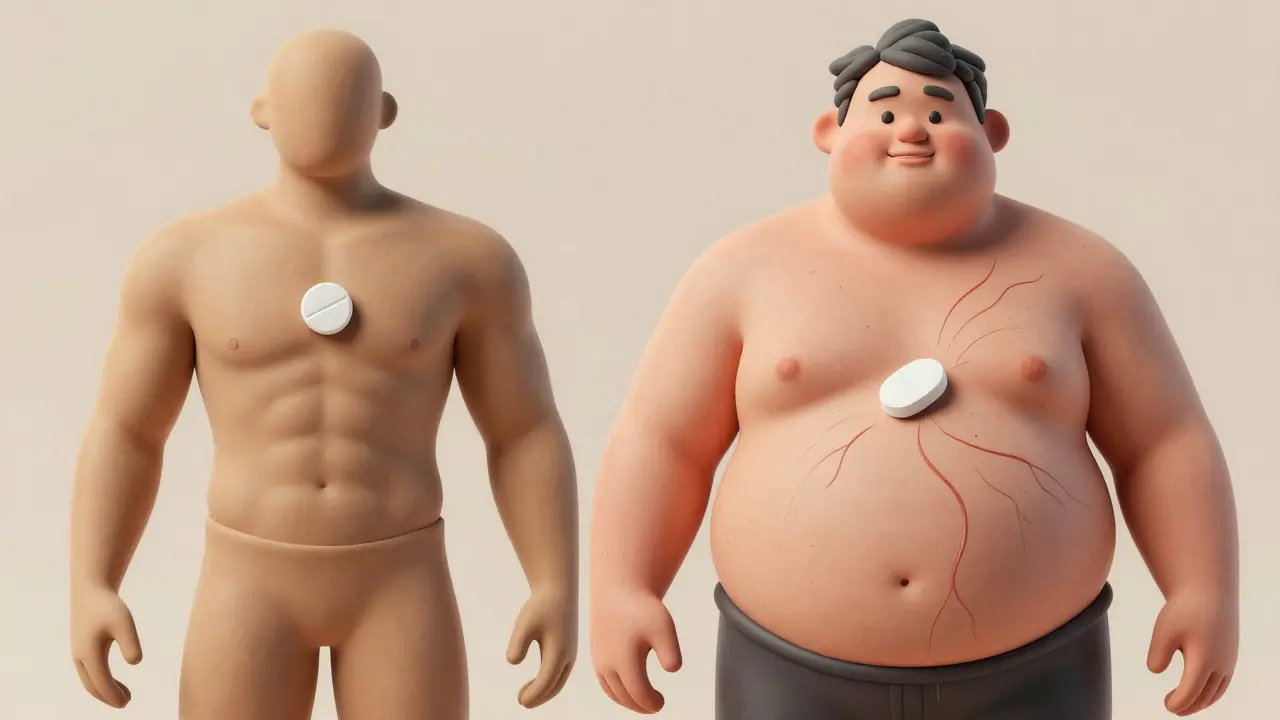
Obesity Medication Dosing Calculator
Calculate Your Adjusted Body Weight
Obesity changes how medications work in your body. This tool calculates your adjusted body weight (AdjBW) to help determine the correct medication dose based on body composition.
Your Body Weight Metrics
Calculations based on obesity dosing guidelines
When someone has obesity, their body doesn’t just carry extra weight - it changes how medicines work. A standard dose that works perfectly for a person with average body composition might be too low, too high, or completely ineffective in someone with obesity. This isn’t just a theoretical concern. In real hospitals, patients with a BMI over 30 are getting the wrong doses more often than not - and the consequences can be serious.
Why Standard Doses Fail in Obesity
Most drug dosing guidelines were built on data from people with normal weight. But obesity changes how drugs move through the body. Think of it like this: if you pour water into a sponge versus a glass, the same amount behaves differently. The same is true for drugs in fat versus muscle.
Obesity increases fat tissue, which can hold onto lipophilic (fat-loving) drugs like diazepam or fluoxetine. This means those drugs spread out more, lowering their concentration in the blood. On the other hand, water-soluble drugs like antibiotics (cefazolin, vancomycin) don’t mix well with fat. They stay in the blood and fluids, but obesity also increases blood volume and kidney function, causing these drugs to clear faster. So, a 1-gram dose of cefazolin that works for a 70kg person might be completely washed out of a 120kg person’s system before it can do its job.
Studies show that 21% to 37% of obese patients on standard doses experience treatment failure - infections don’t clear, blood clots form, or seizures aren’t controlled. Meanwhile, some drugs build up to toxic levels. Voriconazole, an antifungal, hits supratherapeutic levels in nearly 4 out of 10 obese patients when dosed by total body weight.
Lean Body Weight vs. Total Body Weight: What’s the Difference?
The key to better dosing is using the right weight metric. Total body weight (TBW) is what the scale says. But it doesn’t tell you how much of that weight is muscle, bone, or fat. That’s why doctors now use adjusted or lean body weight.
Lean body weight (LBW) estimates the weight of everything except fat. Ideal body weight (IBW) is a calculated number based on height and gender. Adjusted body weight (AdjBW) is a middle ground: AdjBW = IBW + 0.4 × (TBW − IBW). This formula gives more weight to lean tissue while accounting for excess fat.
For example, a 110kg woman who is 5’5” has an IBW of about 60kg. Her AdjBW would be 60 + 0.4 × (110 − 60) = 80kg. For many antibiotics, this 80kg number is what’s used to calculate the dose - not the full 110kg.
Why does this matter? A 2023 UCSF study found that giving standard 1g doses of ceftriaxone to obese patients led to subtherapeutic levels in 63% of cases. When they switched to 2g doses based on AdjBW, that dropped to under 10%. That’s not a small tweak - it’s the difference between healing and worsening infection.
Drug-Specific Dosing Rules You Need to Know
Not all drugs behave the same. Some have clear, evidence-backed rules. Others are still a guessing game.
- Antibiotics: Ceftriaxone and cefazolin need at least 2g for patients with BMI >30. Vancomycin requires higher loading doses and frequent TDM (therapeutic drug monitoring). Tigecycline dosing is weight-independent - 100mg loading, then 50mg every 12 hours - regardless of weight. Colistin is capped at 360mg daily (CBA) to avoid kidney damage, using IBW.
- Blood thinners: Enoxaparin dosing isn’t linear. For BMI 40-49.9, 40mg twice daily works. For BMI ≥50, 60mg twice daily is needed. Fixed 40mg doses in very obese patients leave 21% with under-dosed anti-Xa levels, raising clot risk.
- Beta-blockers: Carvedilol has a dangerous cliff at 85kg: 50mg if under, 100mg if over. That sudden jump causes 32% more variability than continuous dosing. Metoprolol, by contrast, uses 5mg per kg up to 200kg - smoother and safer.
- Anticoagulants: Apixaban’s dose doesn’t change with weight, but studies show 47% higher bleeding risk just above the 85kg threshold due to dosing discontinuity.
These aren’t suggestions - they’re backed by clinical outcomes. Stanford Health Care reduced supratherapeutic voriconazole levels from 39% to 12% just by switching to AdjBW dosing. That’s a 69% drop in toxicity risk.

Therapeutic Drug Monitoring: The Missing Piece
For many drugs, especially in obesity, you can’t just guess. You need to measure.
Therapeutic drug monitoring (TDM) means checking actual drug levels in the blood. It’s routine for vancomycin, aminoglycosides, and voriconazole - and it’s critical in obese patients. The Infectious Diseases Society of America (IDSA) says TDM isn’t optional here; it’s essential.
At Mayo Clinic, adding TDM alerts to their electronic health record cut subtherapeutic vancomycin levels from 31% to 9%. It also shortened hospital stays by over two days. That’s not just better care - it’s cheaper care.
But here’s the problem: only 37% of U.S. hospitals have formal obesity dosing protocols. And 63% of pharmacists say they lack institutional support for TDM programs. Without access to blood tests, even the best dosing formulas are just paper rules.
Why So Many Errors Happen
It’s not that doctors are careless. It’s that the system is broken.
A 2021 University of Michigan study found 43% of internal medicine residents were confused about when to use TBW, IBW, or AdjBW. One patient with BMI 52 got a massive overdose of enoxaparin because the team used TBW instead of AdjBW. They developed heparin-induced thrombocytopenia - a life-threatening clotting disorder.
Pharmacists report 68% more dosing errors in obese patients than in normal-weight ones. Why? Because the rules are inconsistent, the tools are outdated, and the training is minimal. Most pharmacy schools still teach weight-based dosing as if everyone weighs 70kg.
Even drug labels are behind. Only 18% of FDA-approved drug labels include specific guidance for obesity. The rest? “Use with caution.” That’s not a dose - it’s a warning.
What’s Changing - And What’s Coming
Change is happening, but slowly.
In 2024, the FDA updated its guidance to require obesity subgroup analysis in clinical trials - especially for patients with BMI ≥50. Before this, only 4% of trials included people with BMI over 45. That’s like testing a car on flat roads and calling it safe for mountain driving.
The NIH just funded a $4.7 million study tracking 500 obese patients over five years to map how drugs behave across different body types. That’s a big step.
Tools are improving too. DoseMe, an Australian-developed software, uses Bayesian modeling to predict drug levels based on weight, kidney function, and genetics. It’s now used in 83% of U.S. academic medical centers. Lexidrug and MediCalc offer quick calculators for IBW and AdjBW. But adoption outside hospitals? Still low.
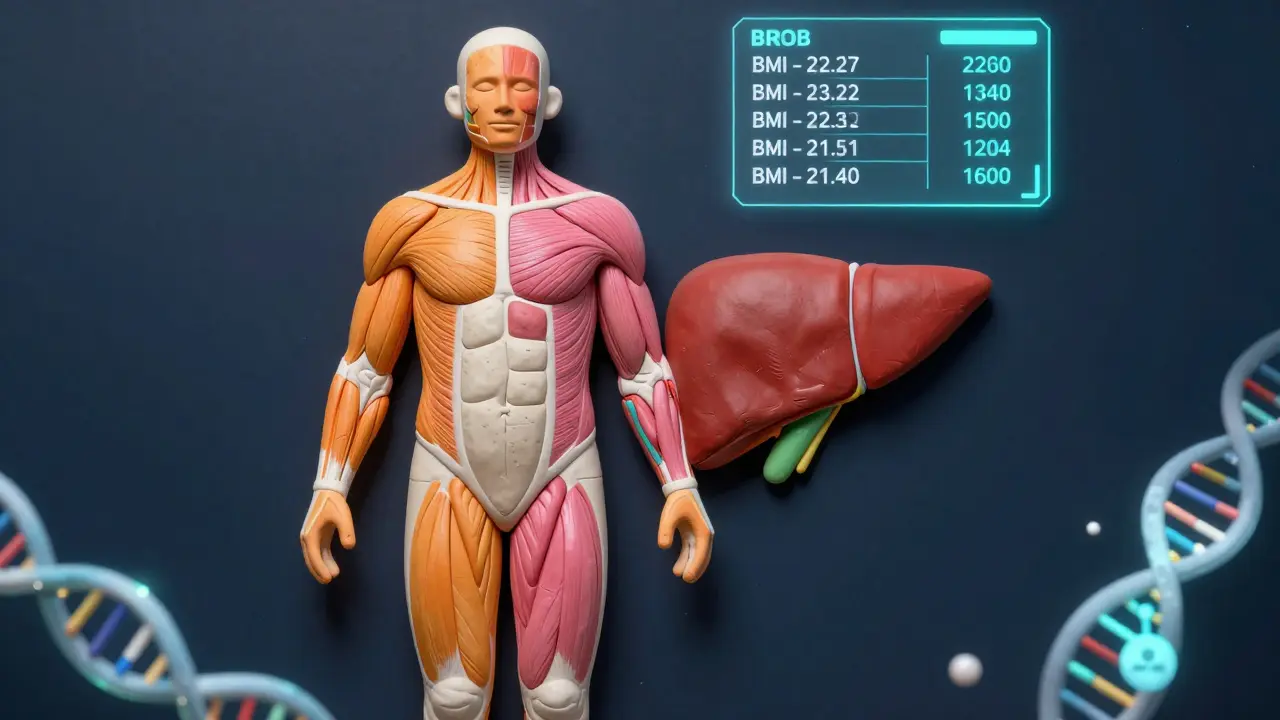
Future dosing won’t just be about weight. It’ll be about body composition - muscle mass, fat distribution, liver function. Dr. Joseph Barletta predicts that within five years, pharmacogenomics and body scans will combine to create truly individualized doses. Imagine a scan that tells your doctor exactly how much of a drug your liver can handle - not based on your BMI, but on your real biology.
What You Can Do Right Now
If you’re a patient with obesity:
- Ask: “Is this dose based on my total weight or my lean body weight?”
- Request TDM for critical drugs like vancomycin, voriconazole, or aminoglycosides.
- Keep a record of your height and weight - and bring it to every appointment.
If you’re a provider:
- Use AdjBW for antibiotics and anticoagulants.
- Never use TBW for vancomycin or voriconazole in obese patients.
- Advocate for TDM access in your hospital.
- Learn the formulas: IBW (men) = 50kg + 2.3kg per inch over 5ft; IBW (women) = 45.5kg + 2.3kg per inch over 5ft.
The tools exist. The data is clear. What’s missing is consistent application. Obesity isn’t a niche issue - nearly 40% of U.S. adults have it. If we keep dosing them like average-weight people, we’re not just under-treating - we’re putting them at risk.
Brandon Shatley
March 23, 2026 AT 22:48man i never thought about how fat changes how drugs work. i got my antibiotics last year and they just gave me the same dose as my buddy who weighs 150. turns out i was underdosed and the infection came back. dumb system.
also why do we still use bmi? it's not even accurate. i got a 32 but my muscle is crazy high. just sayin'
Blessing Ogboso
March 25, 2026 AT 21:29as someone from nigeria where obesity is still stigmatized but growing fast, i find this article so important. in our clinics, we often use total body weight because it's easier. but i've seen patients with diabetes and infections not respond because the dose was wrong. we need training. we need tools. this isn't just a u.s. problem - it's global. if we don't fix dosing for larger bodies, we're leaving half the world behind. let's not wait for a crisis to act.
also, lean body weight isn't just a number - it's dignity.
Jefferson Moratin
March 26, 2026 AT 04:35The underlying epistemological flaw in contemporary pharmacology lies in its ontological assumption that the human body is a static, homogenous vessel for drug delivery. Obesity, far from being a pathological deviation, is a physiological variable - one that fundamentally alters pharmacokinetic and pharmacodynamic parameters. To persist in using weight-based dosing norms derived from a normative sample of 70kg individuals is not merely negligent - it is a form of epistemic violence against non-normative bodies.
AdjBW is not a compromise. It is a necessary recalibration of a broken paradigm. The fact that 63% of hospitals lack formal protocols reveals not ignorance, but institutional inertia - a failure of moral imagination.
Caroline Dennis
March 27, 2026 AT 03:05TDM is non-negotiable in obese patients. Period.
Vancomycin AUC/MIC? You need the data. Guessing with TBW = bad outcomes. AdjBW + TDM = 90%+ therapeutic levels. It's not magic - it's science. If your hospital doesn't have a protocol, advocate. Push. Demand it. This isn't optional - it's standard of care. Stop letting patients get sicker because of outdated charts.
Zola Parker
March 27, 2026 AT 09:34soooo... you're saying fat people need more drugs? 😳
what's next? giving more insulin to diabetics? 😂
just sayin'... maybe we should just stop being fat? 🤔
florence matthews
March 29, 2026 AT 00:51love this so much. as a black woman who's been told "you're too big for this medicine" my whole life - this is validation. not just for me, but for my mom, my sister, my aunties. we've been ignored, dismissed, overdosed, underdosed. this isn't just about math - it's about being seen.
thank you for writing this. 🙏❤️
Kenneth Jones
March 29, 2026 AT 14:47Mihir Patel
March 31, 2026 AT 05:06bro this is wild. i got hospitalized last year with pneumonia. they gave me 1g ceftriaxone. i weighed 130kg. i got worse. then they switched to 2g. i walked out in 3 days.
my cousin? same thing. but they didn't change the dose. she died.
why is this not in every med school? why? why? why? 😭
Kevin Y.
April 1, 2026 AT 14:28This is an excellent, well-researched overview. I work in pharmacy and can confirm: the disconnect between guidelines and practice is staggering. Many clinicians still default to total body weight out of habit, not knowledge.
I’ve implemented AdjBW protocols in my department, and the reduction in therapeutic failure has been dramatic. The tools exist. The evidence is clear. The only barrier now is institutional willpower. Let’s keep pushing for change - one patient at a time.
Raphael Schwartz
April 2, 2026 AT 06:19so now we're giving extra drugs to fat people because they're too lazy to lose weight? great. next we'll pay them to not eat. this is socialism. the system is broken because we're coddling bad choices. fix the person, not the dose.
Marissa Staples
April 4, 2026 AT 03:01I wonder if this is why my grandma’s heart meds never seemed to work. She was overweight, but they never adjusted anything. She passed last year. I never asked. Now I wish I had.
Just… makes me sad.
Rachele Tycksen
April 4, 2026 AT 19:14cool article. i read like half. but hey, at least they didn't say "just lose weight" so that's something? 🤷♀️
Grace Kusta Nasralla
April 6, 2026 AT 12:44you know… i used to think this was just about math. but now i realize - it’s about who we decide is worth the effort. if you’re thin, they test you, adjust you, monitor you. if you’re fat? "use with caution."
that’s not a warning. it’s a surrender.
Pat Fur
April 6, 2026 AT 21:30AdjBW isn’t perfect - but it’s the best we have until body composition scanners are in every ER.
And yes, TDM should be standard. Not "for high-risk cases." Standard. Period.
Also - stop calling it "obesity dosing." It’s just dosing. For humans.