
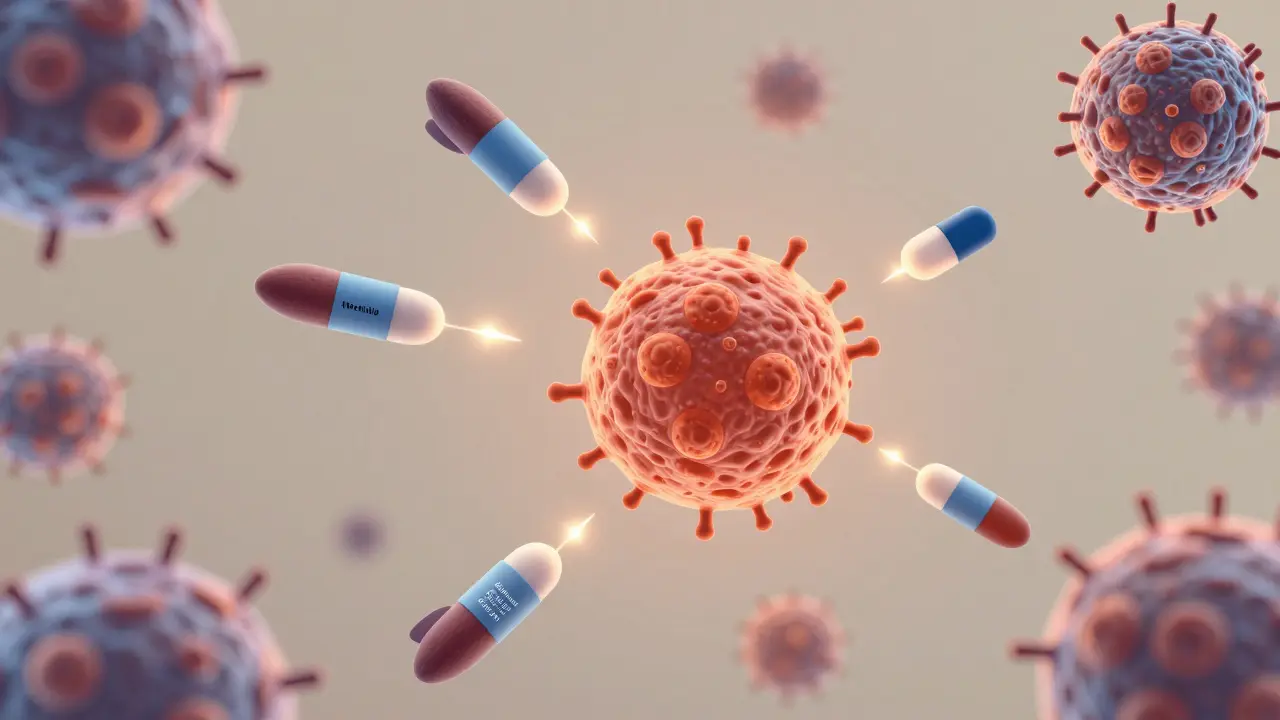
For decades, leukemia and lymphoma were treated with one main approach: chemotherapy. Harsh, broad-spectrum, and often debilitating, it attacked cancer cells but also tore through healthy tissue. Today, that’s changing. Targeted and cellular therapies are rewriting the rules of blood cancer treatment-offering more precision, fewer side effects, and in some cases, real chances for long-term remission or even cure.
How Targeted Therapies Work
Targeted therapies don’t just blast everything. They zero in on specific molecules that cancer cells rely on to grow and survive. Think of them like smart missiles instead of carpet bombs.
Take chronic lymphocytic leukemia (CLL) and small lymphocytic lymphoma (SLL). Before 2010, patients were stuck with chemo combinations that offered short-lived benefits and high toxicity. Now, drugs like ibrutinib (a BTK inhibitor that blocks a key protein in B-cell signaling) and venetoclax (a BCL-2 inhibitor that triggers cancer cell death) are standard. Ibrutinib is taken as a daily pill at 420 mg. Venetoclax starts low and ramps up over five weeks to 400 mg daily. Both are oral-no IV, no hospital stays.
The results? A 2025 study from the CLL Society found that patients on targeted therapies took nearly twice as long to develop Richter transformation-a dangerous leap into aggressive lymphoma-compared to those on older chemo regimens. Median time jumped from 2.2 years to 4.9 years. That’s not just a delay; it’s a shift in disease progression.
But targeted drugs aren’t perfect. Resistance builds. Many patients on ibrutinib see progression after 3-5 years. Those with del(17p) or TP53 mutations tend to respond poorly and relapse faster. That’s why combinations matter. Venetoclax paired with obinutuzumab or ibrutinib can create deep, fixed-duration remissions-meaning patients can stop treatment after 1-2 years and still stay in remission. This is a huge win over lifelong chemo.
Cellular Therapies: Rewiring the Immune System
If targeted therapies are precision tools, CAR T-cell therapy is a full-scale biological upgrade.
Here’s how it works: First, your T cells are pulled from your blood via a simple procedure called leukapheresis. Then, in a lab, scientists genetically tweak them to carry a special receptor-called a chimeric antigen receptor (CAR)-that lets them recognize and kill cancer cells expressing CD19, a protein found on most B-cell lymphomas and leukemias. The cells are multiplied, then infused back into you. It’s like giving your immune system a new set of eyes.
The first FDA-approved CAR T, tisagenlecleucel (Kymriah) (a CD19-targeted therapy for pediatric acute lymphoblastic leukemia), came in 2017. Since then, newer versions like axicabtagene ciloleucel (Yescarta) (a CAR T therapy for large B-cell lymphoma) and lisocabtagene maraleucel (Breyanzi) (a CAR T therapy with lower toxicity profile) have expanded the options.
The numbers speak for themselves. In a 2025 trial of LV20.19 CAR T therapy for relapsed mantle cell lymphoma, every single patient responded. Eighty-eight percent achieved complete remission. In another study, dual-target CAR T cells (hitting both CD19 and CD20) hit a 63.6% complete remission rate in patients who had failed multiple treatments.
And it’s not just for the last resort. ZUMA-7 data from ASH 2025 showed Yescarta, used as a second-line treatment for large B-cell lymphoma, led to a 42.6% four-year survival rate-far better than the old standard of salvage chemo and stem cell transplant.
The Trade-Offs: Cost, Toxicity, and Access
These therapies aren’t magic bullets. They come with serious trade-offs.
One major issue is toxicity. CAR T-cell therapy can trigger cytokine release syndrome (CRS)-a massive immune overreaction that causes fever, low blood pressure, and sometimes organ failure. Neurotoxicity, including confusion, seizures, or speech loss, affects 20-40% of patients. Both require intensive care unit-level monitoring. That’s why only certified centers can offer CAR T therapy. In Australia, fewer than 10 hospitals have full programs.
Then there’s the cost. A single CAR T infusion runs $373,000 to $475,000. Even targeted therapies aren’t cheap. Ibrutinib and venetoclax can cost $15,000-$25,000 per month out of pocket for uninsured patients. While Medicare and private insurers cover much of it, copays and deductibles still crush families. One hematologist in Adelaide told me: “We had a 72-year-old man with CLL. His daughter sold her car to cover the 12-month supply of venetoclax. He’s in remission. But how many can’t afford this?”
Manufacturing is another bottleneck. CAR T cells take 3-5 weeks to make. During that time, patients can deteriorate. Some die waiting. Newer “off-the-shelf” CAR T therapies (using donor cells) are in trials, but none are approved yet.

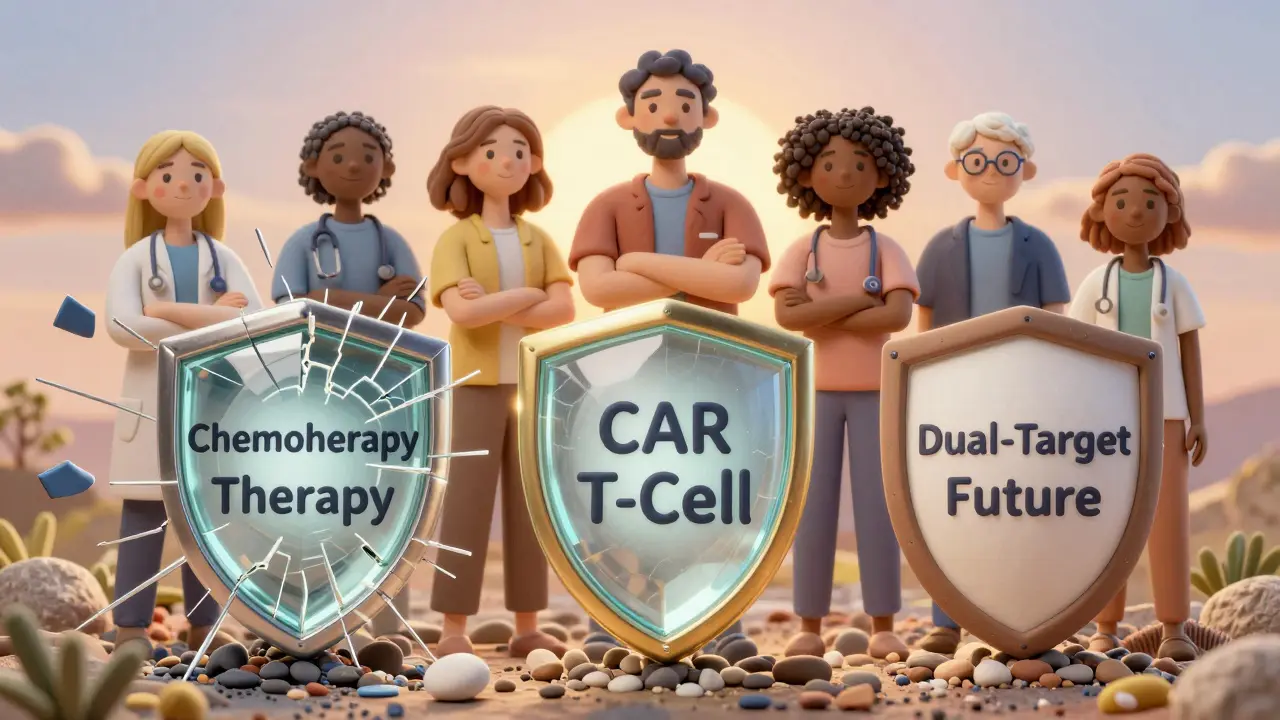
What’s Next: Dual Targets and Earlier Use
The next wave of therapies is already here. Companies like Kite (Gilead) are testing dual-target CAR T cells-KITE-363 and KITE-753-that attack both CD19 and CD20. Why? Because cancer cells sometimes drop CD19 to escape treatment. Hitting two targets at once reduces that risk. Early data suggests these dual-target therapies could be safer, with fewer severe side effects, and maybe even deliverable in outpatient settings.
Another shift? Moving CAR T earlier in treatment. In 2025, 68% of hematology experts predicted that by 2030, CAR T-cell therapy will be used as a first-line option for high-risk lymphoma patients-not just after everything else fails. That’s a massive change. It means we’re no longer treating these cancers as terminal diagnoses, but as chronic conditions we can control-or even cure.
Even the definition of “cure” is evolving. For some patients with CLL on venetoclax-ibrutinib combinations, deep molecular remissions last over a decade. We don’t yet call it a cure, but the outcome is close. For others, CAR T has erased detectable disease for five years or more.
Who Benefits Most?
Not everyone is a candidate. Targeted therapies work best for patients with specific mutations. BTK inhibitors shine in CLL with IGHV unmutated status. Venetoclax is powerful in those with BCL-2 overexpression. CAR T-cell therapy is reserved for those who’ve failed at least two prior lines of treatment-but that’s changing fast.
Patients with del(17p) or TP53 mutations still have poor outcomes with targeted drugs alone. For them, CAR T-cell therapy is often the best shot. The same goes for relapsed mantle cell lymphoma, where CAR T now outperforms stem cell transplants.
But access remains uneven. NCI-designated cancer centers in the U.S. have 89% adoption of CAR T. In Australia, only 32% of community oncology clinics can offer it. Rural patients often travel hundreds of kilometers for treatment. And while Australia’s PBS subsidizes targeted drugs, CAR T is still largely restricted to clinical trials or special access schemes.
What Patients Should Know
If you or a loved one is facing leukemia or lymphoma, here’s what matters:
- Ask for genetic testing. Mutations like del(17p), TP53, or IGHV status guide which therapy will work best.
- Targeted drugs aren’t forever. Fixed-duration regimens (like 1-2 years of venetoclax + ibrutinib) are now standard and offer a break from lifelong treatment.
- For relapsed disease, CAR T-cell therapy can be life-changing-but it’s not simple. Prepare for possible hospitalization, CRS, and neurotoxicity.
- Ask if you’re eligible for clinical trials. New therapies (like dual-target CAR T or oral BTK inhibitors with fewer side effects) are being tested now.
- Financial support exists. Patient assistance programs from drugmakers, nonprofits like the CLL Society, and hospital social workers can help with copays and travel.
Are targeted therapies better than chemotherapy for leukemia and lymphoma?
Yes, for most patients. Targeted therapies like BTK and BCL-2 inhibitors have higher response rates, fewer severe side effects, and longer progression-free survival compared to traditional chemo. They’re also oral, so patients avoid hospital visits. For example, in CLL, targeted therapy combinations have doubled the time before disease progression compared to chemoimmunotherapy.
Can CAR T-cell therapy cure lymphoma?
In some cases, yes. For patients with relapsed or refractory large B-cell lymphoma, CAR T-cell therapy like Yescarta has led to durable remissions lasting five years or more in nearly half of patients. While doctors don’t always say “cured,” many patients live without disease for over a decade after treatment. It’s the closest thing we have to a cure for advanced disease.
Why is CAR T-cell therapy so expensive?
It’s because each treatment is custom-made. Your T cells are collected, genetically modified in a lab, grown, tested, and shipped back to you. The process takes weeks, requires highly specialized facilities, and involves dozens of staff. Manufacturing one dose costs over $200,000 just in materials and labor. Add in clinical oversight, hospitalization, and managing side effects, and the total cost hits $400,000-$475,000.
Do targeted therapies work for everyone?
No. Some patients have genetic mutations-like del(17p) or TP53-that make them resistant to BTK inhibitors. Others develop resistance over time. That’s why combinations (like venetoclax + ibrutinib) are now preferred. For patients who fail multiple targeted drugs, CAR T-cell therapy is often the next step.
Is CAR T-cell therapy available in Australia?
Yes, but only at major cancer centers. In 2025, only about 10 hospitals in Australia offer CAR T-cell therapy. It’s covered by Medicare for approved indications, but access is limited by infrastructure. Many patients must travel interstate for treatment. Community oncologists often refer patients to these centers after other treatments fail.
Final Thoughts
The revolution in leukemia and lymphoma treatment isn’t coming-it’s already here. We’re no longer just extending life. We’re changing its course. Targeted therapies give patients control, with pills they can take at home. CAR T-cell therapy gives some a second chance at life after multiple relapses. The cost and complexity are real. The access gaps are unfair. But the science? It’s working.
For the first time, a young adult with relapsed lymphoma has a real shot at a normal life. An older man with CLL can stop treatment and live without constant infusions. These aren’t lab miracles. They’re happening now-in Adelaide, in Sydney, in Melbourne.
The future is clearer: earlier use of these therapies, smarter combinations, and eventually, off-the-shelf options. But for now, the message is simple: if you or someone you love has leukemia or lymphoma, ask about these treatments. They’re not just options. For many, they’re the only ones that matter.
Kenzie Goode
February 22, 2026 AT 20:00Just read this whole thing and I’m honestly crying. Not because it’s sad, but because for the first time, I feel like there’s real hope. My mom had CLL, and watching her go through chemo was like watching a storm tear through a house-no precision, just chaos. Now? She’s on venetoclax. No IVs. No hospital. Just a pill. And she’s been in remission for 5 years. This isn’t science fiction. It’s Tuesday in 2025.
Gabrielle Conroy
February 23, 2026 AT 21:04YES!! I’m a nurse in oncology, and I’ve seen the shift firsthand. The way patients light up when they realize they don’t have to be tethered to an IV pole for life? Priceless. And the fixed-duration combos? Game-changer. One patient told me, ‘I got to watch my daughter graduate.’ That’s not just treatment-that’s a life restored. Also, PLEASE ask about financial aid! Patient assistance programs are WAY more generous than people think. I’ve helped folks get 90%+ off. You’re not alone.
Also-CAR T is terrifying but magical. One guy I cared for had 3 relapses. After CAR T? Zero detectable disease. 4 years later. He’s hiking the Appalachian Trail. I cried. Again. 😭✨
Haley Gumm
February 24, 2026 AT 19:32Okay but let’s be real-this is why we need universal healthcare. The fact that someone had to sell their car to afford venetoclax? That’s not a medical issue. That’s a moral failure. And don’t get me started on how the U.S. lets drug companies charge $25k/month while other countries pay $2k. It’s obscene. But hey, at least we have the science, right? 😅
Spenser Bickett
February 25, 2026 AT 23:31Maranda Najar
February 26, 2026 AT 06:16Oh my GOD. I’ve been waiting for this. I’ve been waiting for someone to finally say it out loud: we are no longer just prolonging suffering-we are rewriting destiny. The way you described venetoclax + ibrutinib as ‘fixed-duration remission’? That’s the phrase that will change the world. Not ‘cure.’ Not ‘remission.’ But ‘fixed-duration.’ Because it implies control. Agency. A finite battle, not an endless war. I’ve lost three friends to this disease. One of them died waiting for CAR T because the lab took six weeks. Six weeks. A human lifetime. And now? We’re talking about off-the-shelf versions. I’m not just hopeful. I’m trembling.
And the dual-target CAR T? That’s not science. That’s poetry. Cancer tries to hide. We give the immune system two eyes. Two weapons. Two chances. That’s not treatment. That’s a declaration of war. And we’re winning.
For the first time in my life, I believe in miracles. Not the kind you pray for. The kind you engineer.
Thank you. From the bottom of my shattered heart.
Christopher Brown
February 28, 2026 AT 00:47Shalini Gautam
March 1, 2026 AT 16:11John Smith
March 1, 2026 AT 20:45Natanya Green
March 2, 2026 AT 00:34Sanjaykumar Rabari
March 2, 2026 AT 21:14