
MedWatch Reportable Event Checker
This tool helps you determine if your experience qualifies as a reportable adverse event to FDA MedWatch.
Reportable Adverse Event Criteria
According to FDA guidelines, a serious adverse event is any reaction that:
Every year, millions of people in the U.S. take prescription drugs, over-the-counter medicines, or use medical devices like glucose monitors or insulin pumps. Most of the time, these products work as intended. But sometimes, something goes wrong. A rash appears out of nowhere. A heart rhythm changes. A device fails during use. When that happens, you might wonder: Who do I tell? The answer is simple: FDA MedWatch is the official system for reporting side effects and adverse reactions to the U.S. Food and Drug Administration. It’s not a hotline. It’s not a website you fill out once and forget. It’s a lifeline - and your report could help save someone else’s life.
What Exactly Is MedWatch?
MedWatch isn’t just a form. It’s the FDA’s primary safety reporting program for medical products. That includes everything from your daily blood pressure pill to a new CBD cream, from a pacemaker to a home blood sugar test kit. The FDA doesn’t wait for problems to become epidemics. It relies on people like you - patients, nurses, pharmacists, and caregivers - to spot early warning signs.
The system works because it’s built on two pillars: voluntary reports from the public and mandatory reports from companies. Drug makers, device manufacturers, and hospitals must report serious problems. But you? You’re not required to report. But if you do, you’re part of something bigger. In 2022, MedWatch received over 1.2 million reports. About 80% came from healthcare workers and companies. The other 20%? That’s you. And that’s where the real power lies.
What Counts as a Reportable Event?
Not every minor side effect needs to be reported. The FDA defines a serious adverse event as any reaction that:
- Causes death
- Is life-threatening
- Leads to hospitalization
- Results in permanent disability
- Causes birth defects
- Requires medical or surgical intervention to prevent permanent harm
For example: If you take a new antibiotic and develop severe diarrhea that lands you in the ER, that’s reportable. If your glucose meter gives a false reading and you almost pass out, that’s reportable. If your child develops a rare skin rash after using a new lotion, and it doesn’t go away after a week - that’s reportable.
Even if you’re not 100% sure it was the product’s fault, report it anyway. The FDA doesn’t need proof. They need patterns. One report might mean nothing. Ten reports about the same drug causing the same rare reaction? That’s a signal. And signals trigger investigations, label changes, or even recalls.
How to Report: Two Forms, Two Paths
There are two main ways to report - depending on who you are.
If You’re a Healthcare Professional
You’ll use Form FDA 3500. This form asks for:
- Your name, contact info, and professional role (doctor, nurse, pharmacist, etc.)
- The patient’s age, gender, and medical history (if you have it)
- The product name, brand, lot number, and expiration date
- When the reaction started and how it progressed
- Any treatments given and the outcome
- Whether you’ve reported it to the manufacturer
Most professionals complete this in 10 to 15 minutes. The online form is straightforward. You don’t need to be a medical expert to fill it out - you just need to know what happened. Many nurses and doctors say they appreciate the FDA’s acknowledgment letter after submitting. It’s a small thing, but it tells you: Your voice matters.
If You’re a Patient or Family Member
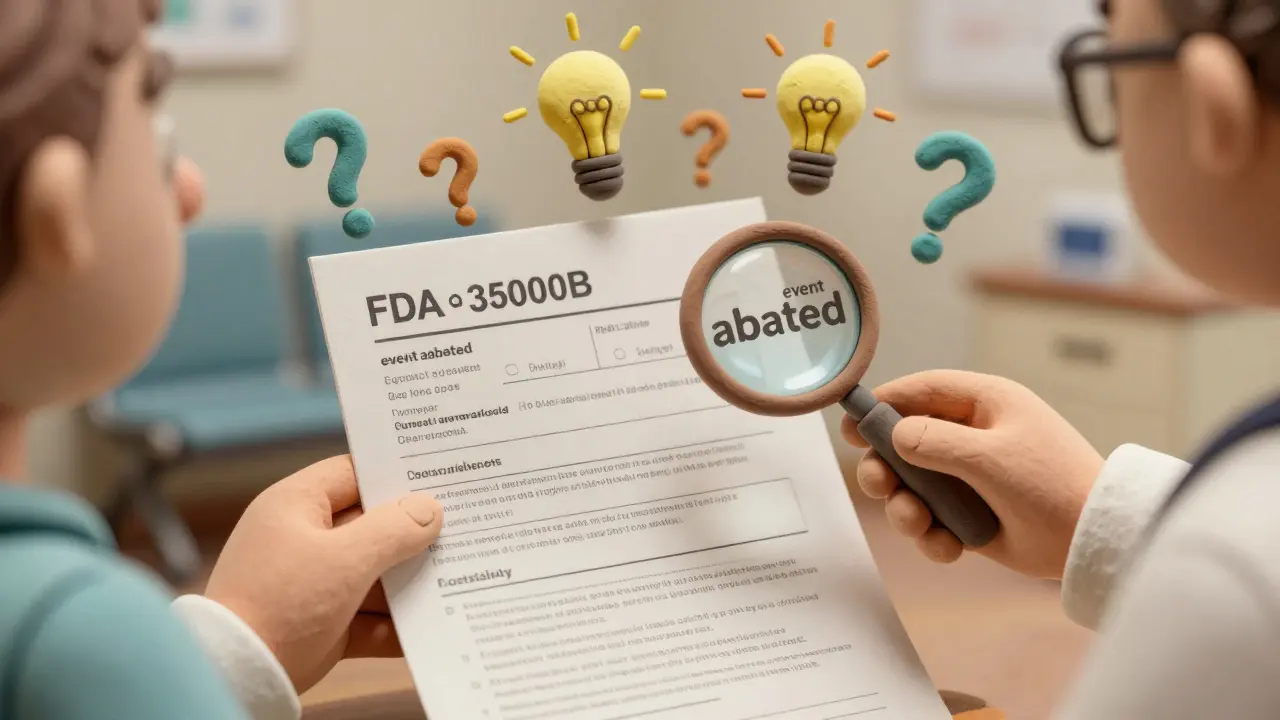
You’ll use Form FDA 3500B. This is the simplified version designed for people without medical training. It asks fewer questions and uses plain language - or at least, it tries to.
But here’s the catch: even the simplified form still uses terms like “event abated” or “dose frequency.” These aren’t everyday words. In a 2019 FDA study, 62% of patients said they needed help understanding at least three terms on the form.
That’s why the FDA says this clearly: “Take the form to your doctor.” You don’t need them to fill it out. But if you sit with them for 10 minutes, they can help you describe what happened in medical terms - and you’ll get a more complete report. You’re not asking them to report for you. You’re asking them to help you report better.
Where and How to Submit
You have three easy ways to submit:
- Online - Go to www.fda.gov/medwatch and click “Report a Problem.” The site was updated in 2021 with a cleaner layout, bigger buttons, and mobile-friendly design.
- By Phone - Call 1-800-FDA-1088. A live operator will guide you through the process. This is especially helpful if you’re unsure what to include.
- By Mail - Download and print Form FDA 3500 or 3500B, fill it out, and mail it to: MedWatch, HF-2, 5600 Fishers Lane, Rockville, MD 20857.
Online is fastest. Phone is easiest if you’re confused. Mail is good if you don’t have internet access.
There’s no deadline. Report as soon as you can. Even if it happened months ago. The FDA still wants to hear about it.
What Happens After You Submit?
Nothing dramatic. No one will call you back. No lawsuit will follow. But here’s what does happen:
- Your report gets added to a database with over 10 million entries since 1998.
- FDA analysts look for patterns - the same drug causing the same rare reaction across multiple reports.
- If a pattern emerges, the FDA may issue a safety alert, update the drug label, or require the manufacturer to run new studies.
- In rare cases, a product gets pulled from the market.
Dr. Janet Woodcock, former head of the FDA’s drug division, once said: “MedWatch reports are essential for identifying safety signals that may not have been evident during clinical trials.” Clinical trials involve thousands of people. Real life involves millions. And real life is where the hidden risks show up.
One famous example: In the early 2000s, reports of sudden heart rhythm problems linked to a popular allergy drug started piling up in MedWatch. The FDA reviewed the data, confirmed the risk, and added a black box warning - the strongest safety alert possible. That warning saved lives.
Why So Many Reports Go Unreported
Here’s the hard truth: experts estimate that only 1% to 10% of serious adverse events are ever reported. That means for every 100 people who have a bad reaction, 90 to 99 stay silent.
Why? Three big reasons:
- People don’t know they can report. Many assume it’s the doctor’s job - but doctors aren’t required to report. They’re encouraged, but not obligated.
- People think it won’t make a difference. “One report won’t change anything.” But it’s not about one. It’s about the next 100.
- It feels too complicated. The forms are intimidating. The language is technical. That’s why the FDA is working on AI tools to help patients fill them out - expected to launch by 2026.
But here’s the flip side: if you report, you’re not just protecting yourself. You’re protecting the next person who picks up that same pill, uses that same device, or applies that same cream.
What MedWatch Doesn’t Cover
MedWatch is broad - but not all-encompassing. It does NOT cover:
- Vaccines - Those go to the Vaccine Adverse Event Reporting System (VAERS).
- Animal drugs or products - Report those to the FDA’s Center for Veterinary Medicine.
- Tobacco products - Those are handled by the FDA’s Center for Tobacco Products.
If you’re unsure where to report, go to www.fda.gov/medwatch. There’s a handy “What to Report?” guide that walks you through the right channel.

How to Stay Informed After Reporting
Reporting is just the start. You should also stay updated. The FDA sends out safety alerts for drugs, devices, and cosmetics. You can sign up for free email alerts or RSS feeds directly from the MedWatch site. You’ll get notified if:
- A drug you take gets a new warning
- A batch of your insulin pump is recalled
- A new study shows a risk with a common OTC painkiller
It’s free. It’s simple. And it’s the best way to protect yourself long-term.
Final Thought: Your Report Matters More Than You Think
You might think: “I’m just one person. What difference can I make?”
Here’s what one nurse practitioner wrote after submitting a report about a device malfunction: “I got the acknowledgment letter. I didn’t expect it. But it made me feel like I wasn’t just a patient. I was part of the system.”
MedWatch isn’t perfect. The forms could be simpler. The language could be clearer. But it’s the only system that connects everyday people to the FDA’s power to change medicine. Every report adds a piece to a giant puzzle. And sometimes, that one piece is the one that stops a tragedy.
So if something went wrong - even if it happened weeks ago - take five minutes. Fill out the form. Your report might be the one that saves someone else’s life.
Do I need to be a doctor to report a side effect to MedWatch?
No. Anyone can report - patients, family members, caregivers, or even bystanders. The FDA encourages patients to report directly using Form FDA 3500B. You don’t need medical training. You just need to know what happened.
How long does it take to fill out a MedWatch form?
For healthcare professionals using Form FDA 3500, it usually takes 10 to 15 minutes. For patients using Form FDA 3500B, it can take 15 to 20 minutes, especially if you’re unsure about details. The online form saves time by auto-filling some fields if you’re logged in.
Will my report be kept confidential?
Yes. The FDA protects your personal information. Your name, address, and contact details are not made public. The agency uses your report for safety analysis only. You can choose to remain anonymous, but providing contact info helps if they need to follow up for more details.
Can I report a side effect from a supplement or CBD product?
Yes. MedWatch accepts reports for CBD-containing products, herbal supplements, and other unregulated substances that are marketed as dietary supplements. Even though these products don’t go through the same approval process as prescription drugs, the FDA still tracks their safety through MedWatch.
What if I report and nothing happens? Was it worth it?
Yes. One report might not trigger an immediate change, but it adds to the data pool. The FDA looks for trends - not single events. If 20 other people report the same issue with the same product, that’s when action happens. Your report is a vital piece of that puzzle.
Can I report a problem with a medical device like a hearing aid or insulin pump?
Absolutely. MedWatch covers all FDA-regulated medical devices, including glucose monitors, pacemakers, hearing aids, and even home-use devices like nebulizers. Report malfunctions, failures, or unexpected side effects - even if the device didn’t cause harm but could have.
Is there a time limit for reporting a side effect?
No. You can report a reaction weeks, months, or even years after it happened. The FDA still needs to know. Older reports help identify long-term risks or delayed side effects that clinical trials might miss.
Do I need to contact my doctor before reporting?
You’re not required to, but it’s strongly recommended. Your doctor can help you describe the event accurately, provide medical context, and confirm whether it was likely caused by the product. You can still report on your own - but with their help, your report is much more useful to the FDA.
What to Do Next
If you’ve ever had a bad reaction to a medication, device, or cosmetic - even if it seemed minor at the time - go to www.fda.gov/medwatch right now. Spend 10 minutes. Fill out the form. You won’t get a thank-you call. But you might just help prevent someone else’s hospital stay - or worse.
And if you’re a healthcare worker? Don’t wait for someone to ask you. If you see something unusual, report it. Your expertise is exactly what the system needs.
The system works because people like you care enough to speak up. Don’t stay silent. Your voice matters.
swati Thounaojam
January 8, 2026 AT 05:03i reported my kid’s rash from that new lotion last year. no one called. nothin’ changed. but i did it anyway. just in case.
Manish Kumar
January 8, 2026 AT 13:56you know what’s funny? we live in a world where you can track your dog’s location via app, but if your insulin pump glitches and nearly kills you, you gotta fill out a 20-minute form written by bureaucrats who think ‘abated’ is a word people use at breakfast. medwatch isn’t broken-it’s just designed by people who’ve never had to explain to their grandma why her blood pressure pill made her hallucinate pigeons.
Dave Old-Wolf
January 9, 2026 AT 13:06i had a bad reaction to a new OTC sleep aid last winter-sweating, heart racing, felt like i was gonna pass out. i didn’t know where to go, so i called my pharmacist. she walked me through the medwatch form on her phone while i sat on her couch. turned out, three other people had the same thing happen. now there’s a warning on the box. i didn’t think one report mattered… until it did.
Prakash Sharma
January 10, 2026 AT 10:32why should an indian patient waste time filling forms for a u.s. agency? we have our own health systems. this is american bureaucracy dressed up as ‘help.’ if you’re living here, fine. but don’t act like this is a global duty. focus on your own problems first.
Kristina Felixita
January 11, 2026 AT 04:13oh my gosh!! i just filled out the form!! after 3 years!! i was so scared it’d be too hard or they’d ignore me… but it was actually kinda soothing?? like, i finally did something right!! and the website looks so pretty now!! thank you, FDA!! you’re doing a great job!! 💖🙏
Joanna Brancewicz
January 13, 2026 AT 03:40the 20% public reporting rate is statistically significant for signal detection. low adherence skews risk-benefit profiles in post-marketing surveillance.
Ken Porter
January 14, 2026 AT 07:08why are we even talking about this? the government can’t even fix the VA. why should i trust them with my side effects? it’s a waste of time. just take the pill and shut up.
Annette Robinson
January 15, 2026 AT 05:23i’m a nurse, and i’ve submitted over 40 reports over the years. i never hear back. but i keep doing it. because one day, someone’s child might not get sick because of what we put in that database. it’s not about recognition. it’s about responsibility.
Luke Crump
January 17, 2026 AT 04:05you think medwatch saves lives? nope. it’s a PR stunt. the FDA doesn’t act on reports-they wait until a drug kills 50 people before they even blink. if you want real change, stop trusting systems built by lobbyists and start burning down the FDA building. then maybe they’ll listen.