
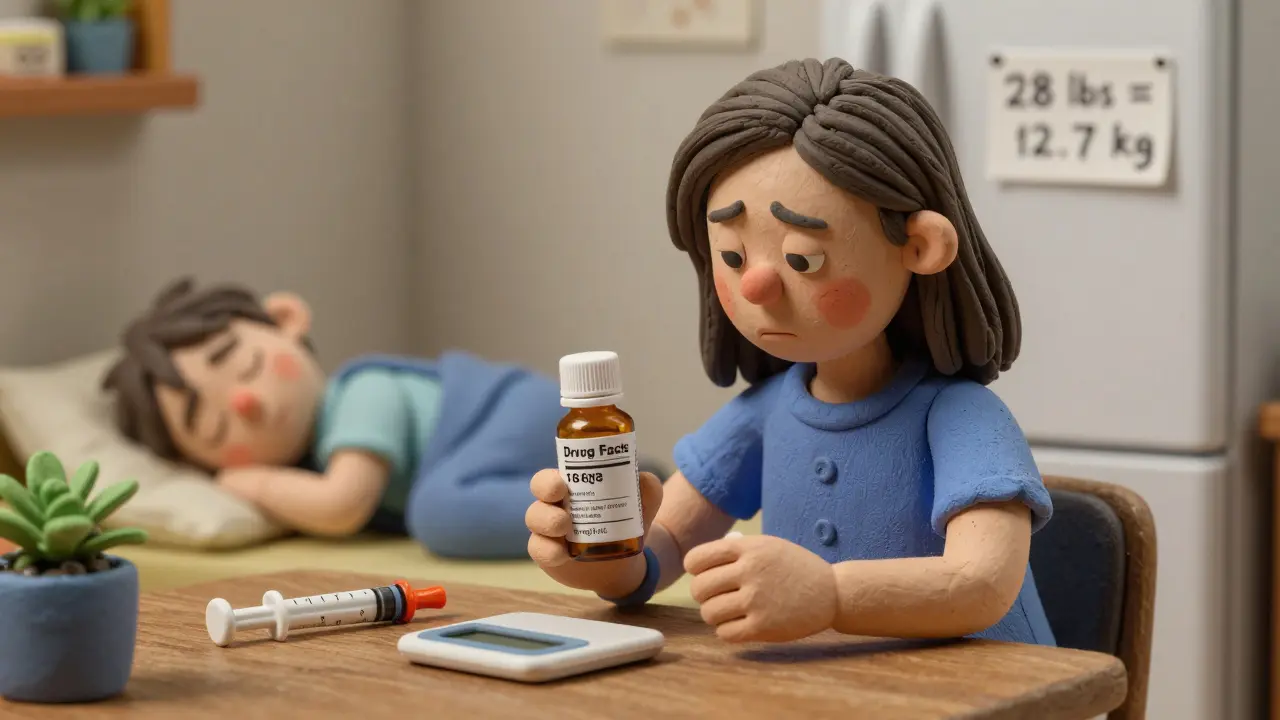
Every year, tens of thousands of children end up in emergency rooms because of medication mistakes. Most of these errors happen because parents are trying to follow the label - but the label doesn’t make sense. It’s not that the instructions are unclear. It’s that they’re confusing, inconsistent, and often outdated. The good news? You don’t need to be a doctor to get this right. You just need to know what to look for - and what to ignore.
Why Age Isn’t Enough
You’ve probably seen it: a bottle that says "For children 2-5 years: give 5 mL." It seems simple. But what if your 3-year-old weighs 50 pounds? Or your 5-year-old is tiny, at just 28 pounds? Age-based dosing assumes all kids the same age are built the same. They’re not.Weight is the real key. A child’s body processes medicine based on how much they weigh - not how many birthdays they’ve had. The American Academy of Pediatrics says weight-based dosing cuts errors by nearly 40%. That’s not a suggestion. It’s science. For example, acetaminophen (the main ingredient in Tylenol) is dosed at 10-15 mg per kilogram of body weight. A 10 kg child (about 22 pounds) needs half the dose of a 20 kg child (about 44 pounds). But if you just go by age, you might give them the same amount. That’s how overdoses happen.
What’s on the Label - And What It Really Means
Every children’s medicine bottle has a "Drug Facts" panel. It’s required by the FDA. Here’s what each part actually means:- Active ingredient: This tells you what’s in the medicine. Look for "acetaminophen" or "ibuprofen". Don’t assume "children’s cold medicine" is the same as "fever reducer". Some products mix multiple drugs - and that’s dangerous.
- Concentration: This is the most overlooked part. Look for numbers like "160 mg per 5 mL". That means every teaspoon (5 mL) has 160 mg of medicine. If you see "80 mg per 1 mL", that’s a different strength. Mixing them up can lead to a 3x overdose. Since 2011, the FDA required all children’s liquid acetaminophen to be standardized at 160 mg/5 mL. But older bottles still exist. Always check.
- Directions: These should list both age and weight ranges. If it only lists age, ask your pharmacist. If it lists weight, use it. Weight-based instructions will say something like "Give 0.5 mL per kg" or "For 10-15 kg: 3.75 mL".
- Warnings: These tell you what not to do. "Do not give to children under 2 years" means exactly that. "Do not exceed 5 doses in 24 hours" means exactly that. Skip this part at your risk.
How to Measure - The Right Way
The biggest mistake? Using a kitchen spoon.One teaspoon is 5 mL. One tablespoon is 15 mL. But household spoons vary wildly. A 2019 FDA study found 68% of dosing errors came from using spoons. A regular spoon might hold 8 mL. Another might hold 12 mL. That’s a 50% error right there.
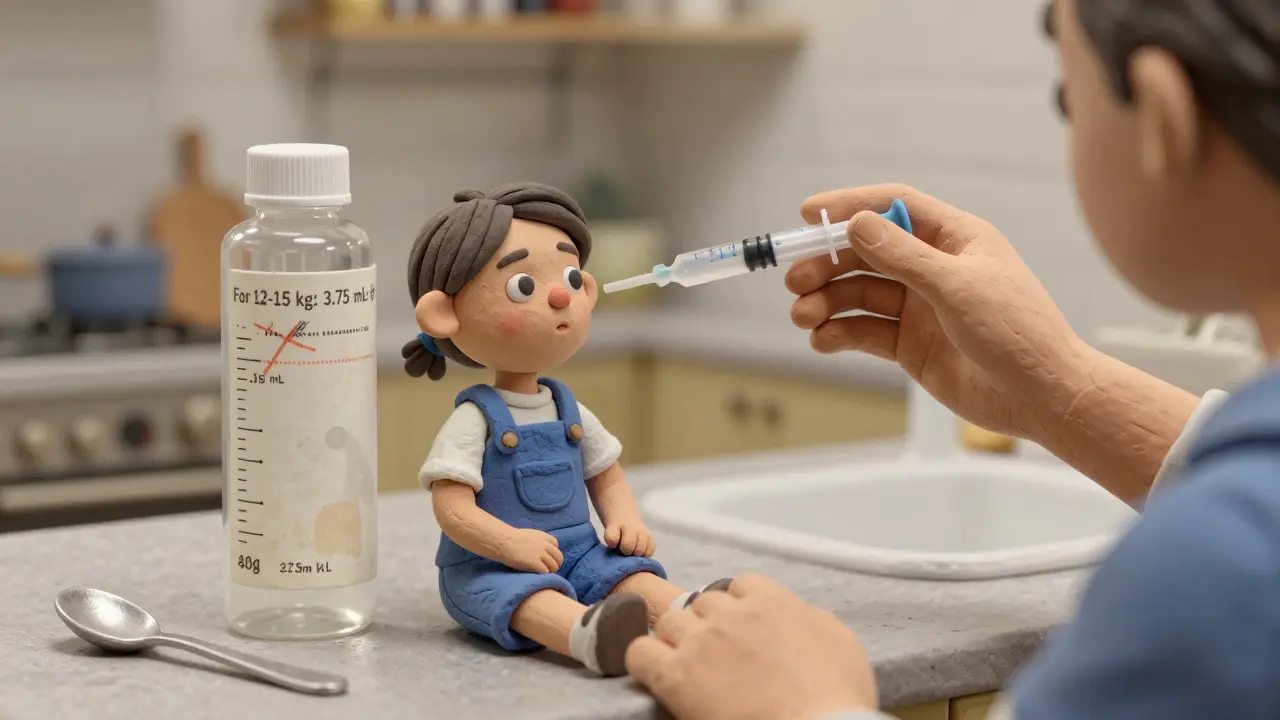
Use the tool that came with the medicine. It’s usually an oral syringe or a dosing cup. For babies and toddlers, use a syringe. It’s more accurate. Hold it at eye level. Read the measurement at the bottom of the curve (the meniscus). If you look down on it, you’ll over-dose by 18%. If you look up, you’ll under-dose by 23%.
Never, ever use a regular spoon - even if it says "teaspoon" on the label. That’s a trick. The label means 5 mL, not your spoon.
Weight Conversion: From Pounds to Kilograms
Most labels use kilograms (kg). Most scales in homes use pounds (lbs). You need to convert.1 kg = 2.2 lbs. So:
- 10 lbs = 4.5 kg
- 20 lbs = 9 kg
- 30 lbs = 13.6 kg
- 40 lbs = 18.2 kg
Do the math: divide pounds by 2.2. Round to the nearest tenth. A 35-pound child is 15.9 kg - so use 16 kg for dosing. You don’t need to be perfect. You need to be close.
Keep a note in your phone: "My child is 28 lbs = 12.7 kg." Update it every 6 months. Kids grow fast. So do their doses.
Common Medicines - Safe Doses
Here’s what you need to know for the two most common kids’ medicines:Acetaminophen (Tylenol)
- Dose: 10-15 mg per kg
- Every: 4-6 hours
- Max per day: 75 mg per kg (no more than 5 doses)
Example: A 15 kg child (33 lbs) gets 150-225 mg per dose. If the liquid is 160 mg/5 mL, that’s 4.7-7 mL. Round to 5 mL or 7.5 mL. Never go over 75 mg/kg in 24 hours.
Ibuprofen (Advil, Motrin)
- Dose: 5-10 mg per kg
- Every: 6-8 hours
- Max per day: 40 mg per kg
Example: A 20 kg child (44 lbs) gets 100-200 mg per dose. With 100 mg/5 mL liquid, that’s 5-10 mL. Never give more than 40 mg/kg in 24 hours.
Important: Never give ibuprofen to a child under 6 months without a doctor’s okay. Their kidneys aren’t ready.
When to Call the Doctor
For kids under 2 years old: always talk to a doctor before giving any medicine. Their liver and kidneys are still developing. A dose that’s safe for a 3-year-old might be dangerous for a 1-year-old.Also call if:
- The label says "consult a doctor" - even if your child seems fine
- Your child is under 10 kg (22 lbs)
- You’re unsure about the concentration
- You’ve given medicine before and aren’t sure if it was the right amount
Pharmacists are trained for this. They’ll help you read the label. They’ll show you how to use the syringe. They’ll write down the dose. And they’ll do it for free. Most pharmacies offer this service - even if you didn’t buy the medicine there.
What to Do If You’re Still Confused
You’re not alone. A 2022 survey found 75% of parents have given the wrong dose at least once. The most common mistakes:- Using a kitchen spoon (41%)
- Misreading "mL" as "tsp" (19%)
- Confusing infant drops (80 mg/1 mL) with children’s liquid (160 mg/5 mL) (15%)
- Double-dosing because they thought the medicine didn’t work (12%)
Here’s what works:
- Write down your child’s weight in kg and lbs. Keep it on your fridge.
- Use the syringe that came with the bottle. Never swap it.
- Check the concentration every time. Even if it’s the same brand.
- Ask the pharmacist: "What’s the right dose for my child’s weight?"
- Use the AAP’s free "Safe Dosage Calculator" app. It’s updated for 2026.
What’s Changing - And What You Should Know
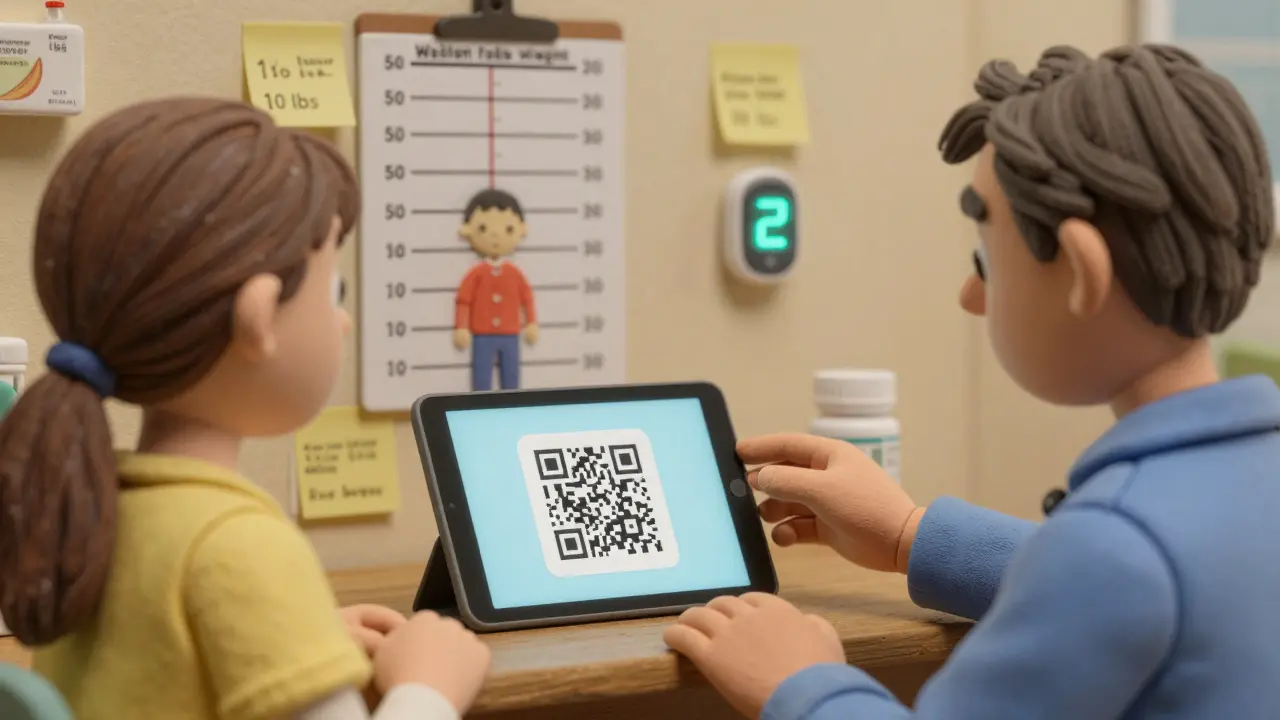
By the end of 2024, all children’s OTC medicine in the U.S. must list both weight and age on the label. That’s new. And it’s good. But don’t wait for it. Start now.Some brands are adding QR codes. Scan them, and you’ll get a video showing exactly how to measure. Walmart and CVS started testing this in 2023. It works. 87% of parents said it helped.
Smart bottle caps are coming. They record when the medicine was given. They send alerts if you give too much too soon. They’re still in testing. But they’re coming.
For now, the best tool you have is your brain - and a little patience. Read the label twice. Measure once. Use the right tool. And when in doubt - call your doctor.
Medication safety isn’t about being perfect. It’s about being careful. One extra minute reading the label can save a trip to the ER.
Can I use a kitchen spoon if I don’t have a syringe?
No. Kitchen spoons vary in size and are not accurate. A teaspoon from your kitchen might hold 6 mL instead of 5 mL, leading to a 20% overdose. Always use the syringe or dosing cup that came with the medicine. If you lost it, ask your pharmacy for a new one - they’ll give it to you for free.
What if my child’s weight isn’t listed on the label?
Find the closest weight range. If your child weighs 18 kg and the label lists 15-20 kg, use the 15-20 kg dose. If the label only gives age, and your child is outside the average weight for that age (e.g., a 4-year-old weighing 50 lbs), go by weight. When in doubt, call your pediatrician or pharmacist.
Is it safe to give acetaminophen and ibuprofen together?
Yes - but only if you’re careful. You can alternate them every 3 hours (e.g., acetaminophen at 12 PM, ibuprofen at 3 PM, acetaminophen at 6 PM). Never give them at the same time. Always write down the time and dose you give. Keep a log. Mixing them without tracking is how accidental overdoses happen.
Why do some children’s medicines have different concentrations?
Before 2011, infant drops were 80 mg/1 mL and children’s liquid was 160 mg/5 mL. That meant a 5 mL dose of children’s liquid had the same amount as 1 mL of infant drops. Many parents mixed them up, leading to overdoses. Since 2011, all liquid acetaminophen must be 160 mg/5 mL. But some older bottles still exist. Always check the concentration on the label - even if it’s the same brand.
How often should I update my child’s weight for dosing?
Every 3-6 months. Kids grow fast - especially under age 5. A child who weighed 15 kg at 18 months might weigh 18 kg at 3 years. That’s a 20% increase in dose. Don’t wait for a checkup. Weigh them at home. Keep a note in your phone. Use the same scale each time.
Camille Hall
February 7, 2026 AT 06:46Just wanted to say this post saved my life last winter when my toddler had a fever and I was terrified I’d give too much. I used the weight conversion chart and the syringe - no more guessing. Seriously, every parent should bookmark this. I printed it and taped it to the medicine cabinet.
Also, the part about not using kitchen spoons? Game changer. I used to think "a teaspoon is a teaspoon" - until I measured mine and it held 8 mL. Yikes.
Jonah Mann
February 8, 2026 AT 19:54omg yes!! i had no idea the concentration changed between infant drops and kids liquid… i gave my 11mo the wrong stuff once and panicked for 2 hrs. turned out it was fine but still… scary as hell. always check the mg/ml now. even if its the same brand. i keep a sticky note on the bottle now. lol.
THANGAVEL PARASAKTHI
February 10, 2026 AT 00:29As a pharmacist in India, I see this all the time. Parents give adult doses to kids because "it’s just a little less." Or they use a spoon because "the syringe broke."
We keep extra syringes at the counter. Free. No questions. Just hand them out. One mom cried because she’d been giving 2x the dose for 3 months. It’s not about blame. It’s about access. Make sure your pharmacy knows you need help reading labels. They’re trained for this.
Tricia O'Sullivan
February 11, 2026 AT 19:40Thank you for this meticulously researched and clearly articulated guide. The emphasis on weight-based dosing is not merely prudent - it is, in fact, a clinical imperative. I have reviewed the FDA guidelines referenced and concur entirely with the assertion that age-based recommendations are, in many cases, dangerously reductive. The statistical reduction in dosing errors through weight-centric protocols is both compelling and, frankly, ethically non-negotiable.
Additionally, the recommendation to utilize the provided measuring device - rather than household utensils - aligns precisely with WHO pediatric medication safety standards. Well done.
Scott Conner
February 12, 2026 AT 21:41wait so if my kid is 35 lbs that’s 15.9 kg so i round to 16kg? what if the label says 15-20kg and i’m right on the edge? do i go with the lower or higher? i’m so confused. also what if the syringe has 0.5ml marks but the dose is like 6.3ml? do i guess? this is harder than i thought.
Brandon Osborne
February 14, 2026 AT 10:44YOU PEOPLE ARE KILLING YOUR KIDS WITH THIS STUPID STUFF. I’VE SEEN IT. I’VE BEEN THERE. MY NEPHEW ALMOST DIED BECAUSE HIS MOM USED A SPOON AND THOUGHT "IT’S JUST A LITTLE MORE."
WHY AREN’T YOU LISTENING? THE FDA DIDN’T CHANGE THE LABELS JUST TO BE NICE. YOU THINK YOU’RE BEING CAREFUL? YOU’RE JUST LUCKY. EVERY TIME YOU DON’T USE THE SYRINGE, YOU’RE PLAYING RUSSIAN ROULETTE WITH YOUR CHILD’S LIVER.
STOP BEING LAZY. STOP USING SPOONS. STOP TRUSTING YOUR GUT. READ THE DAMN LABEL. TWICE.
Marie Fontaine
February 15, 2026 AT 17:22YESSSS this is so needed!! I used to think "it’s just Tylenol, how hard can it be?" until my kid got a fever and I panicked and gave him 2x because I thought "he’s not responding."
Now I have a sticky note on my fridge: "28 lbs = 12.7 kg" and I use the syringe like my life depends on it 😅
Also the AAP app is a GAME CHANGER. I swear by it. My sister just downloaded it and said "why didn’t anyone tell me about this before?!"
WE GOT THIS, PARENTS 💪❤️
Lyle Whyatt
February 16, 2026 AT 10:08Let me tell you, I’m from Australia, and we’ve got the same issues here - but with different brands and different concentration standards. The FDA guidelines are spot-on, but here, we have to navigate the TGA’s version, which is… not as clear. I’ve had to call three different pharmacies just to confirm the concentration on a bottle of ibuprofen because the label had a tiny font and no bolding.
And the part about the meniscus? Absolutely critical. I once under-dosed my daughter by 23% because I looked up at the syringe instead of eye-level. She didn’t get better. Took another 12 hours. Lesson learned. Now I take a picture of the syringe at eye level before I give it. Weird? Maybe. Safe? Definitely.
Also, QR codes on bottles? Brilliant. I scanned one last week - the video showed a kid using the syringe. It was so helpful. My 8-year-old even watched it with me. Now he helps me measure. It’s become a ritual. Weird, but kind of sweet.
Tatiana Barbosa
February 17, 2026 AT 08:12As a pediatric nurse, I can’t stress this enough: weight-based dosing isn’t a suggestion - it’s the gold standard. The AAP guidelines are evidence-based, period. But here’s the real issue: parents don’t know how to convert pounds to kg. They panic. They guess. They double-dose because they think "it didn’t work."
Pro tip: Use the calculator in the AAP app. It auto-converts. It even flags if you’re about to exceed the daily max. And yes, you can alternate acetaminophen and ibuprofen - but ONLY if you log it. Write it down. Use a calendar app. Set reminders. Because when you’re sleep-deprived, your brain turns to mush.
Also - never give ibuprofen under 6 months. Kidneys aren’t developed. I’ve seen renal failure from this. It’s preventable. Always ask your pharmacist. They’re your secret weapon.
Ken Cooper
February 17, 2026 AT 13:13so i just realized… i’ve been using the same syringe for 3 kids? is that okay? i mean it’s clean, right? but what if it’s worn out? does the measurement change? i think the tip got a little bent… should i get a new one? and what if the pharmacy doesn’t have extras? i’ve been using the old one for 4 years now. maybe i’m risking it? help.
MANI V
February 18, 2026 AT 00:02People are so careless. You think this is hard? My cousin gave her 1-year-old ibuprofen because she "thought it was for fever." It was for allergies. Kid ended up in ICU. That’s not an accident - that’s negligence. Labels are clear. If you can’t read them, maybe you shouldn’t be giving medicine. Or maybe get glasses. Or ask for help. But don’t risk a child’s life because you’re too lazy to read a bottle.
Sam Dickison
February 19, 2026 AT 21:26Just chiming in as a dad of three. The biggest thing I learned? Don’t trust the bottle after it’s been opened. I once reused a syringe from a different medicine - didn’t rinse it. Turned out the residual syrup messed with the dosage. My daughter had a weird reaction. We thought it was a virus. Turns out it was chemical cross-contamination.
Now I have a dedicated syringe for each kid. Color-coded. Labeled. Cleaned with hot water after each use. And I never, ever swap them between meds. Even if they’re the same brand. Even if it’s "just one time."
Also - the QR code thing? My kid’s pharmacy started doing it. I scanned it. It played a 90-second video with a nurse. I showed it to my wife. We both cried. Because we realized… we’d been doing it wrong for years.
Camille Hall
February 20, 2026 AT 16:42Replying to @7579 - yes, syringes wear out. The plunger can get sticky, the tip can crack or bend. Even if it looks fine, the markings can be off. I replaced mine after 2 years. Pharmacies give them for free - just ask. No receipt needed. Say "I need a replacement dosing syringe" and they’ll hand you one. I’ve done it three times. They never ask questions.