
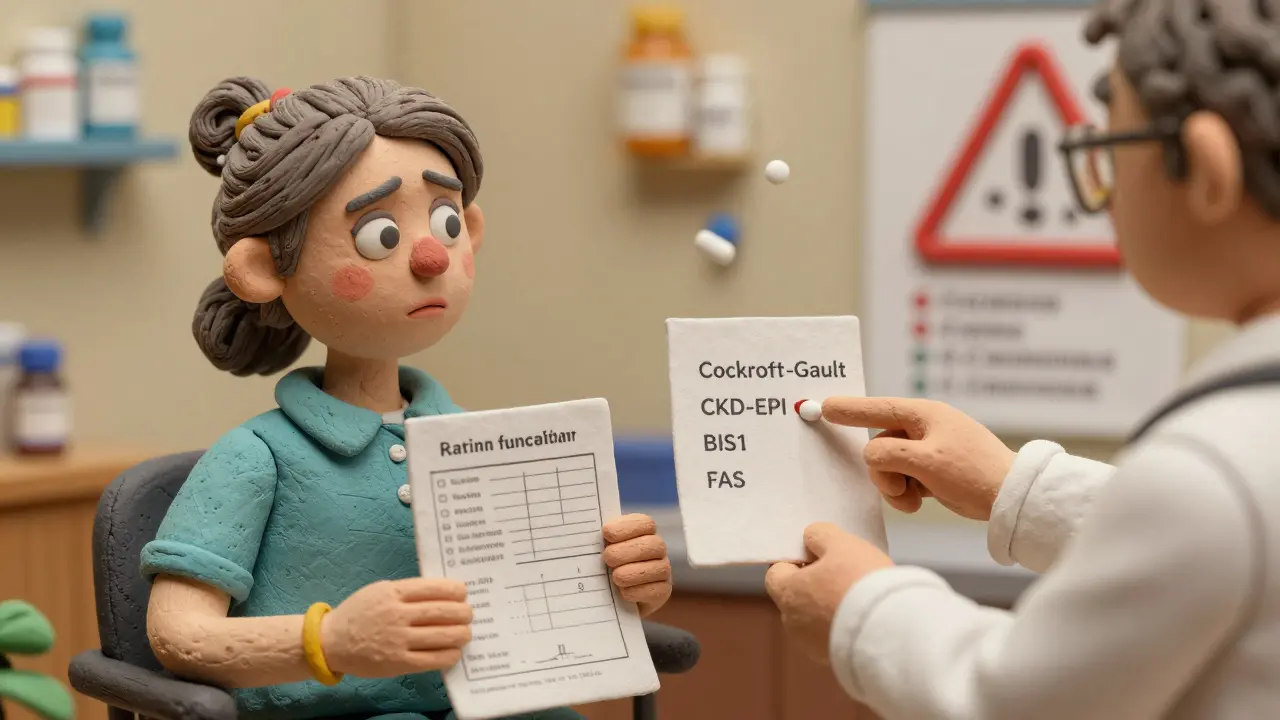
Why Kidney Function Matters More as We Age
Most seniors take at least three prescription medications. Some take ten or more. And here’s the quiet danger: kidney function drops naturally with age. By 70, the average person has lost nearly 40% of their kidney filtering capacity compared to their 20s. That means drugs that used to clear easily now build up. A standard dose of a blood thinner, painkiller, or antibiotic can become toxic - not because the pill is wrong, but because the body can’t process it anymore.
Every year, over 150,000 older adults in the U.S. are hospitalized due to medication overdoses linked to poor kidney function. Many of these cases are preventable. The problem isn’t just aging. It’s that doctors and pharmacists often use the same kidney tests and dosing rules designed for 30-year-olds. That’s like using a child’s car seat for a 6-foot-tall adult. It doesn’t fit. It doesn’t work. And it can be deadly.
What Tests Actually Tell You About Kidney Health
The most common test is serum creatinine - a waste product your muscles make. But here’s the catch: as you age, you lose muscle. Less muscle = less creatinine. So even if your kidneys are failing, your creatinine level might look normal. That’s a false sense of security. Two other tests help fill the gaps:
- Urine albumin-to-creatinine ratio (UACR): Checks for protein in the urine, a sign of kidney damage.
- Serum cystatin C: A protein made by all cells, not just muscles. It’s less affected by body size or muscle loss. More accurate for frail seniors.
Together, these give a clearer picture than creatinine alone. But the real challenge isn’t getting the test - it’s knowing how to interpret it.
The Four Equations That Change Everything
There are four main equations doctors use to estimate kidney function. Each gives a different number. And that number decides how much medicine you get.
1. Cockcroft-Gault (CG) - The Old Favorite
This formula from 1976 uses age, weight, sex, and serum creatinine. It’s not perfect, but it’s still widely used - especially for drugs like vancomycin, aminoglycosides, and some antivirals. The trick? Use ideal body weight, not actual weight. For seniors who are thin or frail, using their real weight overestimates kidney function by up to 25%. That’s how someone ends up with drug toxicity.
2. CKD-EPI - The Current Standard
Introduced in 2009, this is what most electronic health records use by default. It’s better than older methods for people with normal or mildly reduced kidney function. But in seniors over 75 - especially those with low muscle mass - it often says their kidneys are working better than they actually are. A 2023 study found CKD-EPI misclassified nearly 1 in 3 frail seniors as having stage 2 kidney disease when they were really in stage 3. That means they got full doses of drugs meant for healthy kidneys.
3. BIS1 - The Hidden Gem for Very Old Adults
Developed by German researchers, BIS1 was built specifically for people over 75. It accounts for age, sex, serum creatinine, and serum cystatin C. In one study of 85-year-olds, BIS1 was 95% accurate compared to the gold standard. CKD-EPI? Only 78%. When geriatric specialists switched from CKD-EPI to BIS1 for their oldest patients, medication-related hospitalizations dropped by 18%. It’s not widely used yet - but it should be.
4. FAS - The New Contender
FAS stands for Full Age Spectrum. It works from age 20 to 100+. Like BIS1, it uses both creatinine and cystatin C. It’s especially good at catching kidney problems in underweight or malnourished seniors. In one long-term care study, FAS and BIS1 agreed on kidney stage 90% of the time. CKD-EPI and MDRD? Only 65%.
When to Use Which Equation
There’s no one-size-fits-all. The right equation depends on the person.
- For frail, thin, or malnourished seniors over 75: Use BIS1 or FAS. These are your best bets.
- For obese seniors: Use Cockcroft-Gault with ideal body weight. Don’t use actual weight.
- For seniors with diabetes or high blood pressure: Always check urine albumin. Kidney damage from these conditions needs different handling.
- For drugs with narrow safety margins (like dabigatran, rivaroxaban, digoxin, lithium): Use BIS1 or FAS, then confirm with cystatin C if the result is borderline (eGFR 45-59).
- For hospitalized seniors: Don’t rely on any equation. Use 24-hour urine collection if possible. Acute illness changes kidney function fast.
Real Stories From the Front Lines
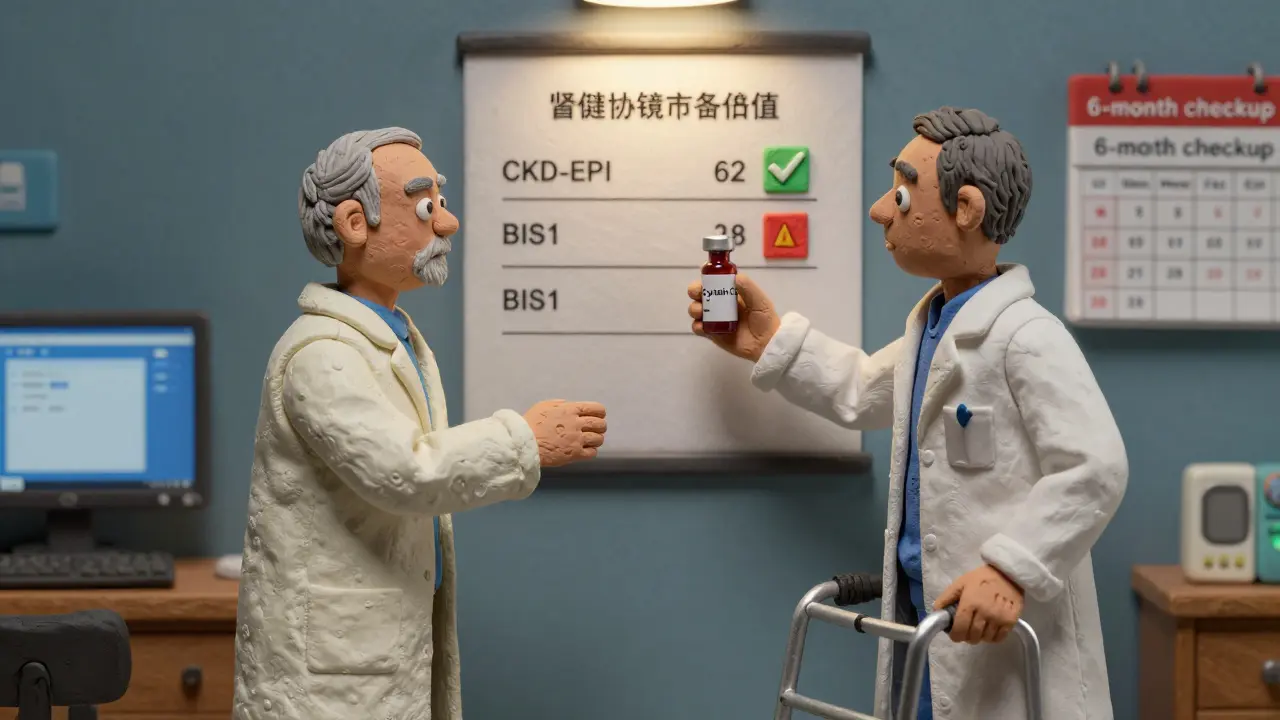
A 88-year-old woman in Michigan was on warfarin and metformin. Her EHR showed eGFR of 62 using CKD-EPI. Her doctor kept her on full doses. She ended up in the ER with low blood sugar and bleeding. Switching to BIS1 revealed her true eGFR was 38. Doses were cut. She went home safely.
A pharmacist in Florida noticed a pattern: elderly patients on colistin kept getting kidney damage. She started asking for cystatin C tests. Half the patients had normal creatinine but high cystatin C. Their kidneys were failing silently. She now pushes for cystatin C before any IV antibiotic in patients over 80.
These aren’t rare cases. They’re routine. And they happen because most clinics still use the default CKD-EPI setting - even when it’s wrong for the patient.
What You Can Do Right Now
You don’t need to be a doctor to protect yourself or a loved one.
- Ask for your eGFR number. Don’t just accept “your kidneys are fine.” Ask: “What’s my estimated GFR? Which equation was used?”
- Check if cystatin C was tested. If not, ask if it’s needed - especially if you’re frail, over 75, or on multiple meds.
- Review all meds with a pharmacist. Pharmacists are trained to spot kidney-related dosing risks. Ask them: “Are these doses safe for my kidney function?”
- Use the National Kidney Foundation’s calculator. It’s free, updated for 2024, and lets you compare equations side by side.
- Keep a kidney function log. Write down your eGFR, cystatin C, and creatinine numbers each time you get tested. Track changes over time.
The Bigger Picture: Why This Is Still Broken
Even though we’ve had better equations for over a decade, most hospitals still use CKD-EPI by default. Why? Because it’s built into the software. Changing it requires manual overrides - and most doctors don’t have time.
Pharmacists are the unsung heroes here. In senior care facilities, 63% say they override EHR recommendations weekly to fix dosing errors. That’s not efficiency. That’s a system failure.
The FDA now requires drug labels to include dosing guidance for multiple equations. But most prescribing guides still don’t include it. You might have to be the one to bring the right info to your doctor.
What’s Coming Next
In 2024, a new equation called CKD2024 was released. It combines creatinine and cystatin C with age-specific adjustments. Early results show 15% better accuracy in people over 80.
The National Institute on Aging is funding a project called SAGE to build point-of-care kidney tests that adjust for age, muscle loss, and nutrition - not just lab numbers.
And AI tools are being tested to recommend the best equation based on your full health profile - weight, muscle mass, diabetes status, even diet. One pilot cut dosing errors by 22%.
But none of this matters if we keep using the same old tools on a new population.
Final Thought: Kidneys Don’t Age the Same as Hearts or Lungs
Your heart slows. Your lungs get stiffer. But your kidneys? They don’t just slow down - they become unpredictable. A 70-year-old with strong muscles might have near-normal kidney function. A 75-year-old who’s lost weight and muscle might have failing kidneys - even if their creatinine looks okay.
Safe dosing isn’t about the pill. It’s about the person. And that means testing the right way, using the right equation, and never assuming.
What’s the best kidney function test for seniors?
There’s no single best test. For most seniors, start with serum creatinine and urine albumin-to-creatinine ratio. But for those over 75, especially if frail or underweight, serum cystatin C combined with the BIS1 or FAS equation gives the most accurate picture. Don’t rely on creatinine alone - it can be misleading.
Should I ask for cystatin C testing?
Yes, if you’re over 75, have low muscle mass, are losing weight, or take multiple medications. Cystatin C is more accurate than creatinine for older adults because it’s not affected by muscle loss. It costs about $50-$75 more, but it can prevent dangerous overdoses. Ask your doctor or pharmacist if it’s right for you.
Why does my doctor use CKD-EPI if it’s not accurate for seniors?
Most electronic health records use CKD-EPI by default because it’s the standard for general populations. Many doctors don’t realize it’s less accurate for frail seniors. It’s not negligence - it’s system design. You can help by asking, “Is CKD-EPI the right equation for me?” or “Would BIS1 be better given my age and body type?”
Can I calculate my own eGFR?
Yes. The National Kidney Foundation offers a free online calculator that lets you compare Cockcroft-Gault, CKD-EPI, and BIS1 side by side. Just enter your age, sex, race, serum creatinine, and cystatin C (if you have it). It’s not a substitute for medical advice - but it helps you ask better questions.
What medications are most dangerous for seniors with poor kidney function?
Drugs like dabigatran, rivaroxaban, metformin, lithium, digoxin, aminoglycosides (like gentamicin), and vancomycin are high-risk. Many painkillers (NSAIDs like ibuprofen) and some antibiotics also build up. Always check if your meds have kidney-specific dosing guidelines - and if they don’t, ask your pharmacist.
How often should seniors get their kidney function checked?
At least once a year if you’re over 65. If you have diabetes, high blood pressure, heart disease, or take five or more medications, check every 6 months. If you’re hospitalized or start a new high-risk drug, check before and within 72 hours after starting.
Arlene Mathison
January 19, 2026 AT 17:49Emily Leigh
January 20, 2026 AT 14:25Carolyn Rose Meszaros
January 21, 2026 AT 14:52Greg Robertson
January 23, 2026 AT 02:47Renee Stringer
January 23, 2026 AT 09:14Crystal August
January 24, 2026 AT 23:13Nadia Watson
January 25, 2026 AT 14:40Courtney Carra
January 25, 2026 AT 20:38thomas wall
January 26, 2026 AT 22:29