
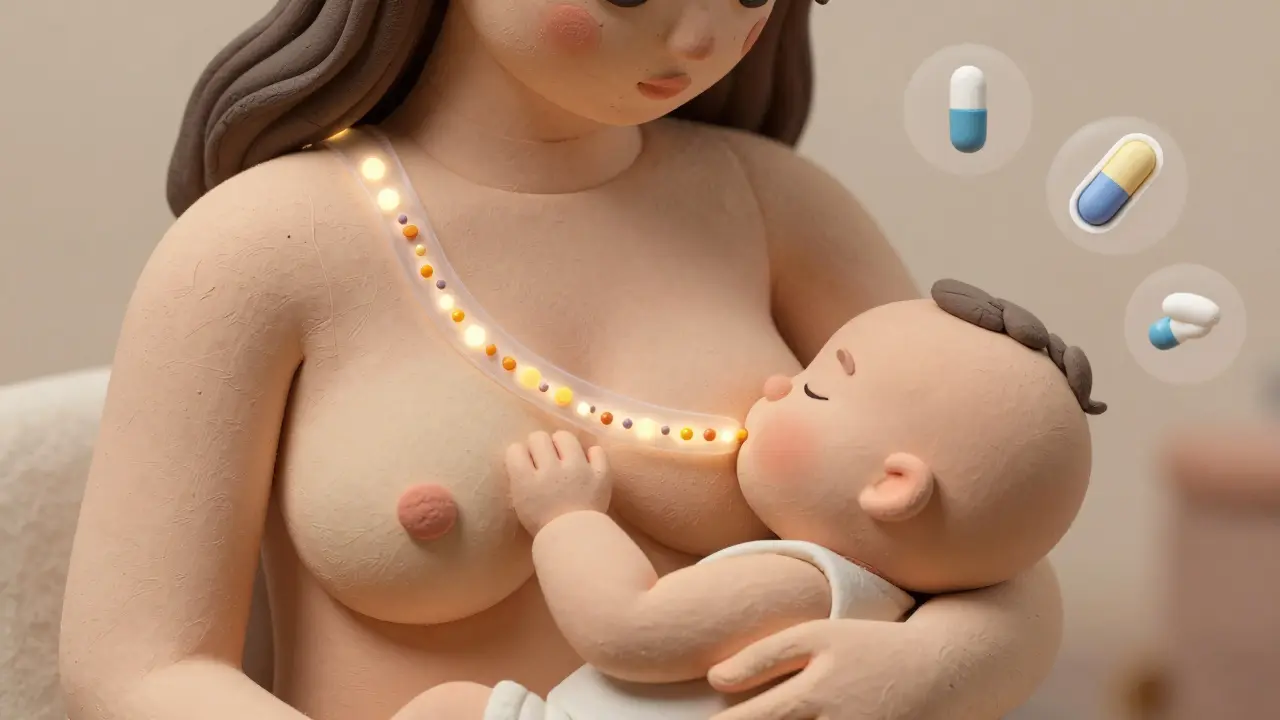
When you’re breastfeeding, every pill, injection, or drop you take doesn’t just affect you. It can reach your baby through breast milk. That’s a real concern for many new moms. You need your medication-maybe for depression, infection, or high blood pressure-but you also don’t want to harm your baby. The good news? Medications in breast milk are rarely dangerous, and most can be used safely with the right timing and monitoring.
How Do Medications Even Get Into Breast Milk?
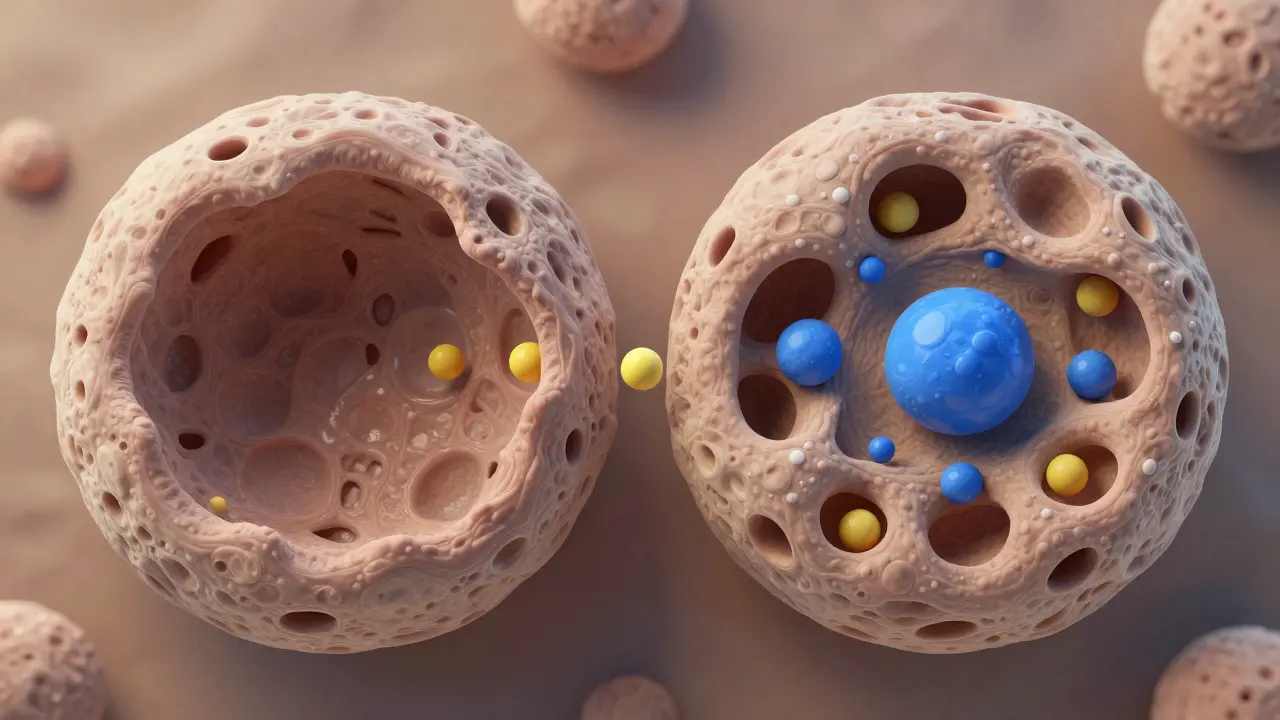
Breast milk isn’t just filtered blood. It’s made by specialized cells in the breast that pull substances from your bloodstream. Most drugs cross into milk the same way water does: through passive diffusion. About 75% of medications enter this way, moving from areas of higher concentration (your blood) to lower concentration (your milk). This happens naturally, no active pumping required. The rest use special pathways. Some drugs, like nitrofurantoin or acyclovir, hitch a ride on transport proteins that normally move nutrients or waste. Others are actively secreted into milk, meaning your body literally pushes them in. This is rare, but it happens with certain antibiotics and antivirals. Size matters. Drugs heavier than 800 daltons-like heparin, which weighs 15,000-barely make it through. That’s why blood thinners like heparin are considered safe during breastfeeding. On the flip side, small molecules like lithium (74 daltons) slip through easily and can build up in your baby’s system. Lipid solubility is another big factor. Drugs that dissolve well in fat-like diazepam or alprazolam-move more readily into milk because breast milk is mostly fat. Water-soluble drugs like gentamicin? They stay mostly in your blood. That’s why antibiotics like amoxicillin show up in milk at just 1.5% of your dose, while diazepam can reach 7%. Protein binding is the silent gatekeeper. If a drug is tightly glued to proteins in your blood (like warfarin at 99%), it can’t float freely into milk. That’s why even though warfarin is a powerful drug, less than 0.1% of it ends up in breast milk. But sertraline? It’s 98.5% bound-still a lot-and yet, it still gets through. Why? Because even a tiny fraction of a highly used drug can add up over time. There’s also something called ion trapping. If a drug is a weak base-like amitriptyline or fluoxetine-and your milk is slightly more acidic than your blood (pH 7.0-7.4 vs. 7.4), the drug gets trapped in milk. That means concentrations in milk can be 2 to 5 times higher than in your blood. It’s not dangerous for most drugs, but it’s something your doctor needs to know.What Happens in the First Few Days?
Right after birth, your breast tissue isn’t fully sealed. The cells that make milk are still loosely connected, with gaps up to 20 nanometers wide. That’s big enough for even large molecules like antibodies-and some medications-to slip through easily. This is why some drugs, like antibiotics or painkillers, might seem stronger in early milk. By day 10, those gaps close. Tight junctions form, and milk becomes more selective. After that, only small, fat-soluble, low-protein-bound drugs pass through in meaningful amounts. That’s good news: if you start a medication after the first week, your baby’s exposure is usually much lower than if you started on day 2.How Much of the Drug Actually Reaches Your Baby?
Most people assume if a drug is in milk, it’s a lot. It’s not. On average, infants receive less than 10% of the mother’s weight-adjusted dose. For most medications, it’s closer to 1-3%. Let’s look at real numbers:- Amoxicillin: 1.5% of maternal dose → infant gets about 0.1 mg/kg/day. Safe.
- Sertraline: 1-2% of maternal dose → infant serum levels typically under 10% of therapeutic range. Considered safe by most experts.
- Diazepam: Up to 7.3% of maternal dose → but it builds up because babies break it down slowly. Watch for drowsiness.
- Lithium: Can reach 10% of maternal dose → requires monitoring. Often avoided unless no other option.
- Gentamicin: Only 0.1% → nearly undetectable in infant blood. Safe.
Which Medications Are Safe? Which Should You Avoid?
There’s a simple system doctors use to rate drugs during breastfeeding. It’s called the Lactation Risk Categories (L1-L5):- L1 (Safest): Insulin, heparin, most antibiotics (penicillins, cephalosporins), acetaminophen, ibuprofen. No known risk.
- L2 (Probably Safe): Sertraline, fluoxetine, levothyroxine, metformin, most antihypertensives. Used by thousands of nursing moms with no issues.
- L3 (Caution Advised): Benzodiazepines (like lorazepam), some SSRIs (like paroxetine), certain anticonvulsants. Monitor baby for drowsiness or irritability.
- L4 (Possibly Hazardous): Lithium, cyclosporine, some chemotherapy drugs. Rarely used unless benefits outweigh risks.
- L5 (Contraindicated): Radioactive iodine, chemotherapy agents like methotrexate, ergotamine. Avoid completely.
Timing Matters More Than You Think
It’s not just about which drug you take. It’s when you take it. If you take a medication right after feeding, your baby gets the least amount. Why? Because your blood levels peak 1-2 hours after taking a pill, then slowly drop. Waiting 3-4 hours before the next feed cuts infant exposure by 30-50%. This works especially well for short-acting drugs like ibuprofen or acetaminophen. For long-acting ones-like diazepam, which can stay in your system for days-you might need to space doses differently or switch to a shorter-acting alternative. For antidepressants, doctors often recommend taking the dose right before your baby’s longest sleep stretch. That way, the peak concentration happens while your baby is asleep.What Signs Should You Watch For in Your Baby?
Most babies show no reaction at all. But in rare cases, you might notice:- Excessive sleepiness or difficulty waking to feed
- Poor feeding or reduced weight gain
- Unusual irritability or crying
- Jitteriness or tremors
What About Birth Control Pills?
Estrogen is the problem. Combination pills with more than 50 mcg of ethinyl estradiol can cut your milk supply by 40-60% within just 72 hours. That’s why most doctors recommend progestin-only pills (the “mini-pill”) or non-hormonal options like copper IUDs during breastfeeding. Even progestin-only pills can slightly reduce milk in the first few weeks, so it’s best to wait until your supply is well established-usually around 6 weeks-before starting.
Jessica Bnouzalim
January 12, 2026 AT 02:07OMG, I just read this and I’m crying?? Like, I was SO scared to take my sertraline while breastfeeding-my doctor said it was fine, but I felt guilty every time I pumped... this broke it down in a way that actually made sense. Thank you for writing this. I’m not alone.
Sumit Sharma
January 13, 2026 AT 19:53The pharmacokinetic parameters outlined here are statistically robust, yet the post lacks critical nuance regarding cytochrome P450 isoform polymorphisms in neonates. For instance, CYP2D6 ultra-rapid metabolizers may exhibit elevated sertraline clearance-this is not addressed. LactMed’s algorithm, while useful, does not account for neonatal hepatic immaturity beyond gestational age. A 2024 meta-analysis in JAMA Pediatrics (DOI: 10.1001/jamapediatrics.2024.0123) demonstrates that even sub-1% transfer can yield clinically significant plasma concentrations in preterm infants. This post is dangerously oversimplified.
Lawrence Jung
January 15, 2026 AT 12:47So we're just supposed to trust the system huh? The FDA only started requiring data in 2023? That's like saying you didn't care about babies until someone made you
Meanwhile, moms have been guessing for decades. You say 'most meds are safe' but safe for who? The baby? The hospital? The insurance company? You ever think maybe the real danger isn't the drug... but the silence around it?
Alice Elanora Shepherd
January 15, 2026 AT 21:37Thank you for this incredibly thorough breakdown. I particularly appreciated the clarification on ion trapping-it’s something even some pediatricians overlook. For anyone reading this: if you’re on a benzodiazepine, consider switching to lorazepam (L3) over diazepam (L3, but longer half-life). Timing your dose before the longest sleep window is also a game-changer. I’ve helped over 40 mothers navigate this, and the data is consistently reassuring. You’re not being selfish for needing your meds-you’re being a hero for staying well.
Ben Kono
January 17, 2026 AT 18:19Why do you think the FDA waited until 2023? Because they don’t care about moms. They care about profits. Look at lithium-everyone says avoid it but they still sell it. And what about the moms in India who can’t afford to switch meds? You talk about LactMed like it’s magic but most of us don’t have access to apps. This whole thing is a luxury for rich white women
Cassie Widders
January 19, 2026 AT 08:09I took ibuprofen for two weeks after my c-section and my baby didn’t even flinch. I thought I’d be hiding in the bathroom crying, but honestly? I just took the pill, fed him, and went to sleep. This post made me feel less weird about it.
Konika Choudhury
January 21, 2026 AT 06:11USA always thinks they have all the answers. In India we don’t need apps to know what’s safe. Our grandmothers knew-milk is sacred, medicine is poison. Why are you forcing Western drugs on our babies? Stop pretending science is better than tradition. We don’t need your L1-L5 labels. We have wisdom
Darryl Perry
January 23, 2026 AT 00:18Incorrect. The 10% threshold is outdated. Recent studies show that even 2% exposure to fluoxetine in neonates correlates with prolonged QT intervals. The AAP’s position is based on 1990s data. This post is misleading.
Rebekah Cobbson
January 24, 2026 AT 08:14Thank you for the science, but I just want to say: if you’re reading this and you’re scared-you’re not broken. You’re a mom trying to do right by your baby and yourself. The system doesn’t always make it easy, but you’re doing better than you think. And if your doctor doesn’t get it? Find one who does. You deserve care too.