
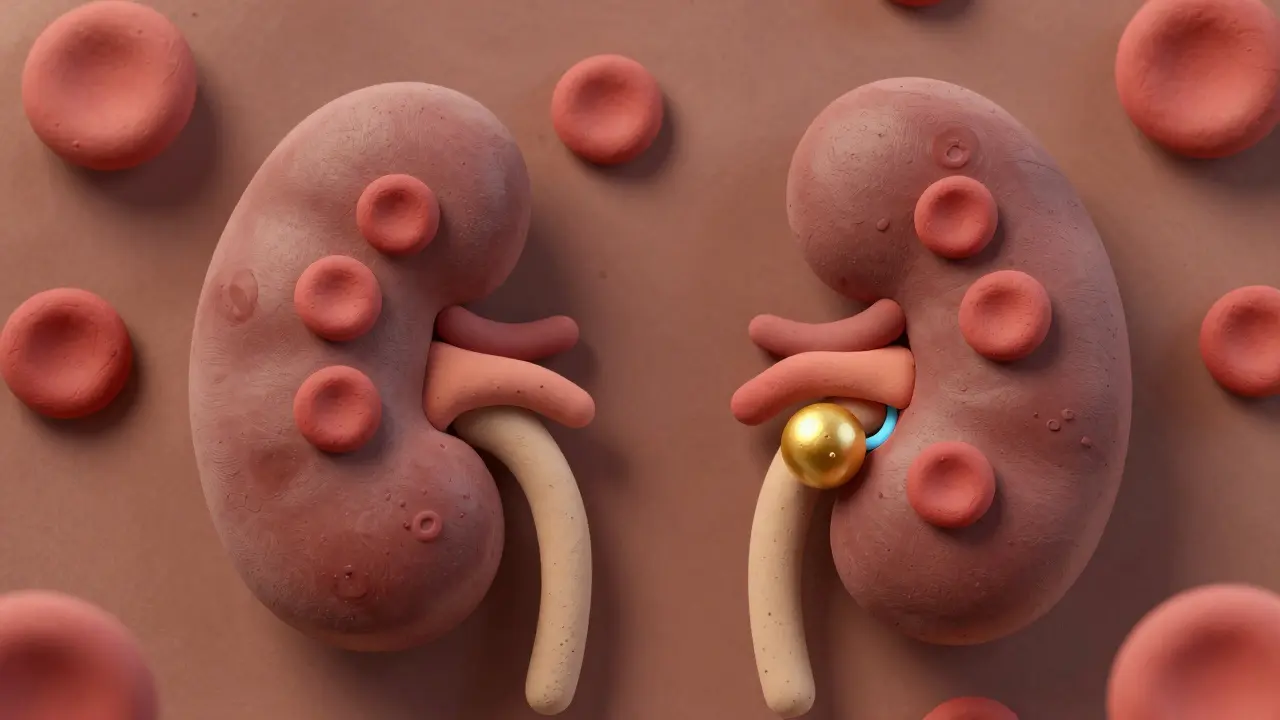
When your kidneys aren’t working right, your blood pressure doesn’t just rise-it starts to damage your kidneys even more. It’s a vicious cycle. But there’s a proven way to break it: ACE inhibitors and ARBs. These aren’t just ordinary blood pressure pills. For people with chronic kidney disease (CKD), they’re one of the few treatments that actually slow down kidney damage, not just lower numbers on a monitor.
Why Blood Pressure Matters in Kidney Disease
Your kidneys filter waste and extra fluid from your blood. When they’re damaged, they can’t do this well. That leads to fluid buildup, which raises blood pressure. High blood pressure, in turn, squeezes the tiny filters inside your kidneys-called glomeruli-until they scar and stop working. It’s like overworking a sieve until it tears.
Studies show that keeping systolic blood pressure below 130 mmHg cuts the risk of kidney failure by nearly half in people with proteinuria (protein in the urine). But here’s the catch: not all blood pressure meds work the same for kidneys. Beta-blockers or diuretics might lower pressure, but they don’t protect the filters. ACE inhibitors and ARBs do.
How ACE Inhibitors and ARBs Work
Both drugs target the same system: the renin-angiotensin-aldosterone system (RAAS). This is your body’s natural way of regulating blood pressure and fluid balance. But in kidney disease, it goes into overdrive.
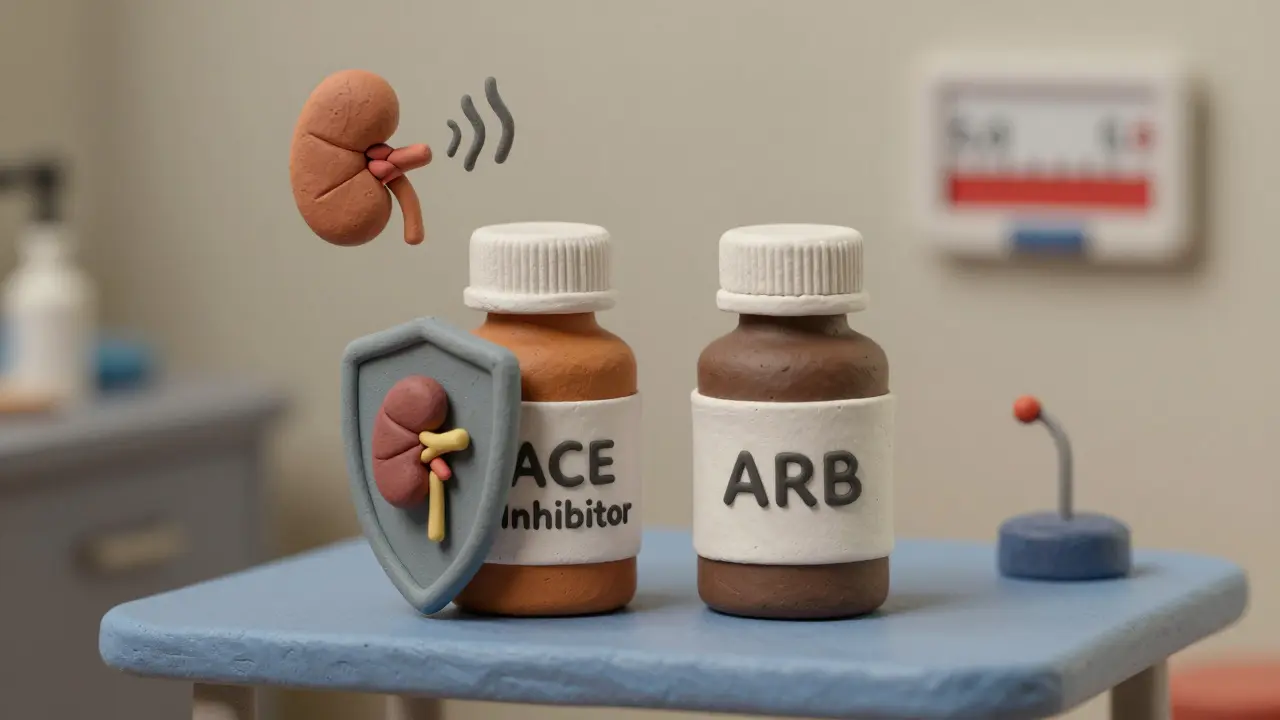
ACE inhibitors-like lisinopril, enalapril, and benazepril-block the enzyme that turns angiotensin I into angiotensin II. Angiotensin II is a powerful constrictor of blood vessels. Less of it means wider arteries, lower pressure, and less strain on the kidneys.
ARBs-like losartan, valsartan, and irbesartan-do something similar but differently. Instead of stopping angiotensin II from being made, they block its receptors. So even if angiotensin II is still around, it can’t bind to the receptors in your kidneys and cause damage.
The result? Both types reduce intraglomerular pressure by 20-30%. That’s the key. Lower pressure inside the kidney’s filtering units means less protein leaks out, less scarring happens, and kidney function slows its decline.
The Evidence: More Than Just Lower Numbers
In the 1990s, landmark trials like the RENAAL and IDNT studies showed that ARBs cut the risk of kidney failure by 25-30% in people with diabetic kidney disease. ACE inhibitors had similar results in trials like the REIN study.
A 2024 analysis of over 1,200 patients with advanced CKD (eGFR under 20) found that those taking ACE inhibitors or ARBs had a 34% lower risk of needing dialysis or a transplant compared to those on other blood pressure meds. That’s not a small benefit-it’s life-changing.
These drugs also cut proteinuria by 30-50%. That’s huge. Protein in the urine isn’t just a sign of damage-it actively worsens it. Reducing it is like turning off a slow leak in a boat.
ACE Inhibitors vs. ARBs: What’s the Difference?
They work the same way and have similar effects on blood pressure and kidney protection. But they’re not identical.
ACE inhibitors cause a dry cough in 5-20% of users. It’s not dangerous, but it’s annoying enough that many people stop taking them. That’s why some doctors start with an ARB-especially if a patient has had a cough on an ACE inhibitor before.
ARBs have a lower risk of cough and a much lower risk of angioedema (a rare but serious swelling of the face or throat). That makes them safer for some patients.
Both are equally effective at protecting the kidneys. The choice often comes down to side effects, cost, and patient preference. Lisinopril and losartan are the most prescribed in the U.S., partly because they’re generic and affordable.
What About Advanced Kidney Disease? Can You Still Use Them?
For years, doctors avoided ACE inhibitors and ARBs in stage 4 or 5 CKD. The fear? That they’d cause dangerous spikes in potassium or make kidneys fail faster.
That thinking is outdated.
A 2024 UK trial followed patients with eGFR under 30 who either kept or stopped their RAAS blockers. After three years, those who kept them had better kidney function and fewer needed dialysis. No extra deaths. No harm.
KDIGO 2023 guidelines now say: Continue ACE inhibitors or ARBs in advanced CKD as long as potassium is under 5.0 mmol/L and eGFR doesn’t drop more than 30% from baseline. That’s a big shift. These drugs aren’t just for early-stage disease anymore.
When to Be Cautious: Side Effects and Monitoring
These drugs are safe-but they need monitoring.
- Hyperkalemia (high potassium): Occurs in 10-15% of users. It’s usually mild and manageable with diet changes or dose adjustments. But if potassium goes above 5.5 mmol/L, the drug should be paused.
- Acute drop in eGFR: A 20-30% drop in kidney function within the first two weeks is common and often temporary. It means the drugs are working-reducing pressure in the kidneys. But if eGFR drops more than 30%, or keeps falling, reevaluate.
- Dehydration: If you’re sick with vomiting, diarrhea, or not drinking enough, stop the drug temporarily. Dehydration + RAAS blockers = high risk of sudden kidney injury.
Doctors check potassium and eGFR within 1-2 weeks after starting or increasing the dose. Then every 3-6 months if stable. Monthly checks are needed if you’re in stage 4 or 5 CKD.
Why So Many People Still Don’t Get Them
Despite clear guidelines, only 58% of people with advanced CKD and proteinuria are on an ACE inhibitor or ARB. In early CKD, it’s 82%. Why the gap?
Doctors are scared. Patients are scared. Too many assume these drugs are too risky in late-stage disease. But the data says otherwise. As Dr. Rajiv Agarwal put it: “Fear of adverse events has led to therapeutic nihilism in advanced CKD, denying patients proven benefits without evidence of harm.”
Also, some patients stop because of cough. Others get scared by a small potassium rise and quit on their own. That’s dangerous. These drugs need time to work-and they need support, not abandonment.

What About Combining ACE Inhibitors and ARBs?
Some studies showed combining them cuts proteinuria even more-by up to 35%. But it also doubles the risk of acute kidney injury and increases hyperkalemia by 50%.
The Veterans Affairs Nephropathy Trial found no survival benefit from dual therapy, just more side effects. So current guidelines strongly advise against combining them.
One drug at a time, at the highest tolerated dose, is the standard. If that’s not enough to control blood pressure, add a calcium channel blocker or a diuretic-but don’t add another RAAS blocker.
What’s Next? Newer Drugs on the Horizon
There’s promising research on ARNIs-angiotensin receptor-neprilysin inhibitors. Sacubitril/valsartan (Entresto) was originally for heart failure, but a 2024 extension of the PARADIGM-HF trial showed it slowed kidney decline by 22% compared to enalapril in patients with both heart failure and CKD.
It’s not yet approved for kidney disease alone, but it’s a sign of where things are headed: drugs that do more than block RAAS-they also boost protective hormones. For now, though, ACE inhibitors and ARBs remain the gold standard.
Real Talk: What Patients Say
On patient forums, stories vary. One man in Adelaide, 62, with type 2 diabetes and stage 3 CKD, says: “Lisinopril saved my kidneys. My protein levels dropped by half in six months. I had a cough at first, but it faded. Worth it.”
Another woman, 71, with polycystic kidney disease, stopped her ARB after her potassium jumped to 5.7. She didn’t tell her doctor. Three months later, her eGFR dropped 40%. She had to restart the drug-and now checks her potassium monthly.
Most people who stick with it, monitor closely, and don’t quit on their own report stable kidney function for years. That’s the goal.
Bottom Line: Don’t Underuse What Works
ACE inhibitors and ARBs are not just blood pressure pills. They’re kidney protectors. They work in early and advanced CKD. They reduce proteinuria. They delay dialysis. They save lives.
Yes, they need monitoring. Yes, side effects happen. But the risks are manageable. The benefits? Proven, consistent, and powerful.
If you have kidney disease and high blood pressure, ask your doctor: “Am I on the right medicine to protect my kidneys?” If you’re not on an ACE inhibitor or ARB-find out why. And if you are, don’t stop unless your doctor tells you to.
These drugs don’t cure kidney disease. But they give you time. And in chronic disease, time is everything.
Candice Hartley
January 28, 2026 AT 02:22This is so important ❤️ I’ve seen too many people quit their meds because of a silly cough. Your kidneys don’t get a second chance.
Andrew Clausen
January 28, 2026 AT 13:00The claim that ACE inhibitors reduce intraglomerular pressure by 20-30% is misleading. The cited studies measure albuminuria reduction, not direct pressure measurements. No non-invasive method reliably quantifies intraglomerular pressure in humans. This is a mechanistic assumption, not an empirical finding.
April Williams
January 28, 2026 AT 23:15Of course you’re going to see people stop these meds-they’re not magic. People think if they feel fine, they don’t need them. Meanwhile their kidneys are slowly dying and they blame the doctor for not ‘warning them enough.’ You don’t get to opt out of science because you hate swallowing pills.
And don’t even get me started on the ‘I stopped because my potassium was high’ crowd. You think your diet is fine? You’re eating bananas like candy and then acting shocked. It’s not the drug, it’s your choices.
Paul Taylor
January 30, 2026 AT 11:55I’ve been on lisinopril for 8 years now with stage 3 CKD from diabetes and honestly it’s been the only thing keeping me off dialysis. My doc told me at first it might cause a cough but I didn’t care. I’d rather cough than need a transplant. I also eat less salt, drink more water, and check my potassium every month like clockwork. It’s not hard. It’s just consistent. And yeah I know some people think it’s too risky in late stage but that’s just fear talking. My eGFR dropped 25% the first month but then stabilized. That’s not failure-that’s the drug working. Don’t let anyone scare you out of something that’s literally saving your body.
Also if you’re on this med and you’re not getting your labs checked every few weeks after starting-you’re playing Russian roulette with your kidneys. No one’s coming to save you if you ignore the numbers.
Marian Gilan
January 31, 2026 AT 19:04you ever wonder why big pharma pushes these drugs so hard? ACE inhibitors and ARBs? theyre just a front. the real agenda? to get you hooked on lifelong meds so you never question why your kidneys failed in the first place. what about the processed food? the sugar? the glyphosate in your water? they dont want you to know the truth. they want you to take pills and stay quiet. and now theyre saying its safe in stage 5? haha. sure. next theyll say its fine to drink battery acid if you take a pill with it.
Murphy Game
February 1, 2026 AT 17:19Let’s be real. The ‘kidney protection’ claim is mostly hype. The trials are funded by pharma. The ‘34% lower risk’? That’s relative risk. Absolute risk? Maybe 3%. And they never mention how many people had to be treated to prevent one dialysis. Also, the ‘protein in urine is bad’ thing? That’s a surrogate marker. We don’t even know if reducing it actually changes long-term outcomes-it’s just convenient for drug approvals.
Meanwhile, the real problem? Diet. Stress. Sleep. But you can’t sell a pill for that.
John O'Brien
February 3, 2026 AT 09:00bro i was skeptical too until my nephrologist told me if i didnt get on losartan i was gonna be on dialysis by 50. i was 42. i had a cough for like 2 weeks then it went away. now my protein is down 60% and my numbers are stable. i dont care if it’s pharma or not-this thing works. stop overthinking it. just take the damn pill and get your labs done.
Kegan Powell
February 4, 2026 AT 07:32time is everything… that line hit me hard. i used to think if i just ate better or meditated more i could fix my kidneys. but the truth? my body’s broken in a way that needs help. not just willpower. these drugs don’t fix me-but they buy me time. time to see my kid graduate. time to travel. time to not be afraid every time i feel tired. that’s worth a cough. that’s worth checking potassium. that’s worth being patient. we’re not just treating numbers-we’re protecting moments.
Anjula Jyala
February 6, 2026 AT 05:18RAAS blockade is only beneficial in proteinuric CKD. If you’re non-proteinuric, ACEi/ARBs offer no renoprotection. The guidelines are clear. Yet so many clinicians prescribe them empirically. This is iatrogenic overmedication. Also, the 2024 UK trial had significant confounding-patients who continued RAAS blockers were healthier at baseline. Selection bias. Don’t treat this as gospel.
Kirstin Santiago
February 6, 2026 AT 06:06I just want to say thank you to everyone who’s shared their stories. I’m newly diagnosed with stage 2 CKD and I was terrified. I didn’t know what to believe. Reading about people who stuck with it and monitored their numbers… it made me feel less alone. I started lisinopril last week. I’m scared of the cough but I’m more scared of losing my kidneys. I’ll check my labs. I’ll eat less salt. I’ll keep showing up. This isn’t just medicine-it’s self-respect.
Kathy McDaniel
February 7, 2026 AT 18:41so i started losartan and my potassium was 5.4 and i panicked and stopped it… then my eGFR dropped like a rock. i felt so dumb. now i check it every week and i eat less oranges and tomatoes. still on the med. still alive. still kidney function. lesson learned: dont quit without talking to your doc.
Patrick Merrell
February 7, 2026 AT 22:15It’s not about the drug. It’s about control. The medical system wants you dependent. They don’t want you to heal. They want you to keep coming back. ACE inhibitors? Just another leash. The real cure? Fasting. Ketosis. Avoiding all processed foods. But that doesn’t make money for them.
Conor Flannelly
February 9, 2026 AT 05:12I’m from Ireland and we’ve got a similar story here. GPs are still hesitant to prescribe these in advanced CKD. But the data’s clear. My uncle, 74, with stage 4 CKD and diabetes-stayed on valsartan for 5 years. No dialysis. His potassium was managed with diet and occasional diuretics. He’s still walking his dog every morning. That’s not luck. That’s medicine working. Don’t let fear silence the science.
Conor Murphy
February 9, 2026 AT 17:25My dad’s been on benazepril for 12 years. He had a cough for the first month. Then it vanished. His kidney numbers? Stable. He’s 80. Still plays golf. He says the drug didn’t cure him-but it gave him back his life. I used to think meds were just for weak people. Now I see they’re for people who don’t give up.
April Williams
February 9, 2026 AT 19:10Of course Conor’s uncle is fine-he had access to care, regular labs, and didn’t ignore his numbers. Most people don’t. They get the script, never fill it, or stop after a month because ‘it didn’t feel right.’ Then they blame the system. The system didn’t fail them. They did. And now they’re acting like they’re the victim.