
The Hatch-Waxman Act didn’t just change how drugs are approved in the U.S.-it saved the healthcare system trillions. Before 1984, getting a generic version of a brand-name drug was nearly impossible. Generic companies had to run their own full clinical trials, even though the original drug had already been proven safe and effective. That meant years of delays and millions in costs. Most generics never made it to market. Then came the Drug Price Competition and Patent Term Restoration Act of 1984-better known as the Hatch-Waxman Act. It didn’t just fix a broken system. It rebuilt it from the ground up.
What the Hatch-Waxman Act Actually Did
The Hatch-Waxman Act created a legal shortcut for generic drugs. Instead of starting from scratch, generic manufacturers could now use the brand-name drug’s existing safety and effectiveness data. All they had to prove was that their version worked the same way in the body. That’s called bioequivalence. The FDA requires that the generic drug’s active ingredient, strength, dosage form, and route of administration match the brand drug exactly. Then, through blood tests, they show the body absorbs it at the same rate and level-within 80% to 125% of the original. That’s it. No more repeating clinical trials on thousands of patients.
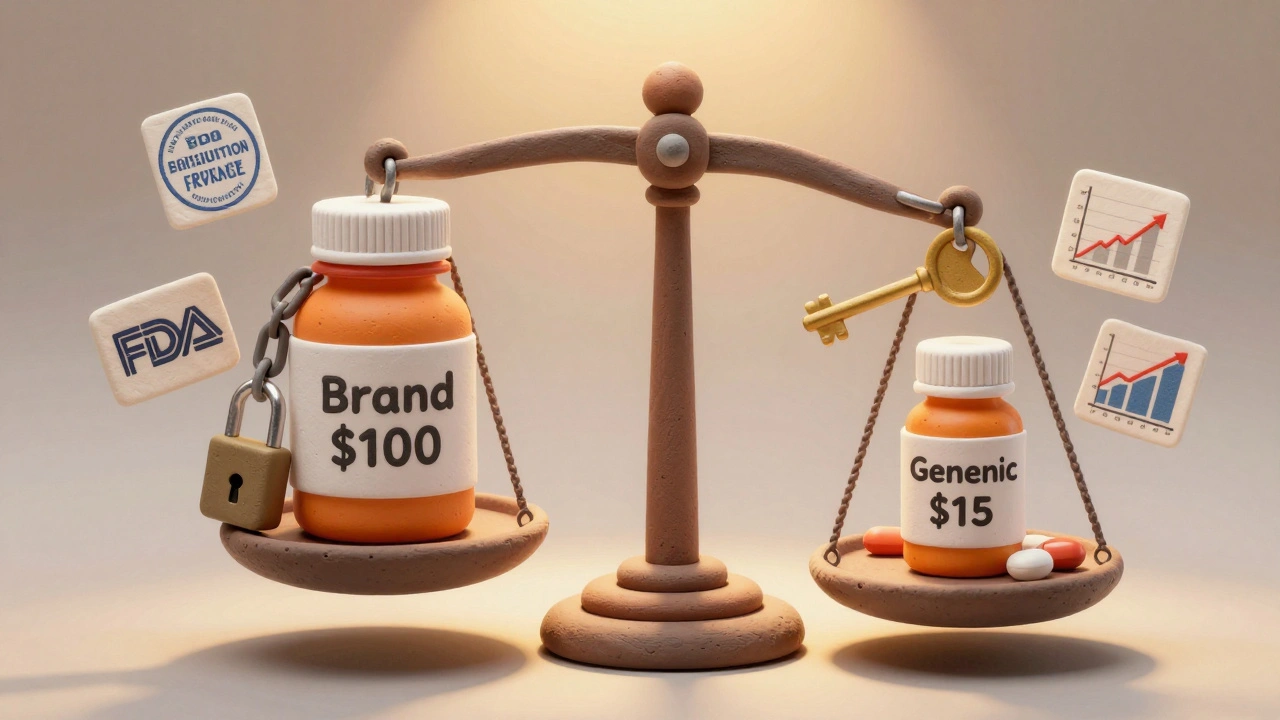
This change turned the generic drug industry from a niche side business into a massive force. In 1984, only 19% of prescriptions filled in the U.S. were for generics. Today, over 90% of prescriptions are for generic drugs. And yet, they make up only about 23% of total drug spending. That’s because a generic version of a drug often costs 80% to 90% less than the brand. A drug that once cost $100 a month might drop to $15 after a generic hits the market.
The ANDA: The Engine Behind Generic Approval
The legal tool that made this possible is the Abbreviated New Drug Application, or ANDA. It’s called “abbreviated” because it skips the long, expensive clinical trials. Instead, it relies on data already approved by the FDA for the brand-name drug, called the Reference Listed Drug (RLD). To file an ANDA, a company must show:
- The generic has the same active ingredient
- The same strength and dosage form (tablet, injection, capsule, etc.)
- The same route of administration (oral, topical, IV)
- Identical bioequivalence to the RLD
- Same labeling, except for the brand name and manufacturer
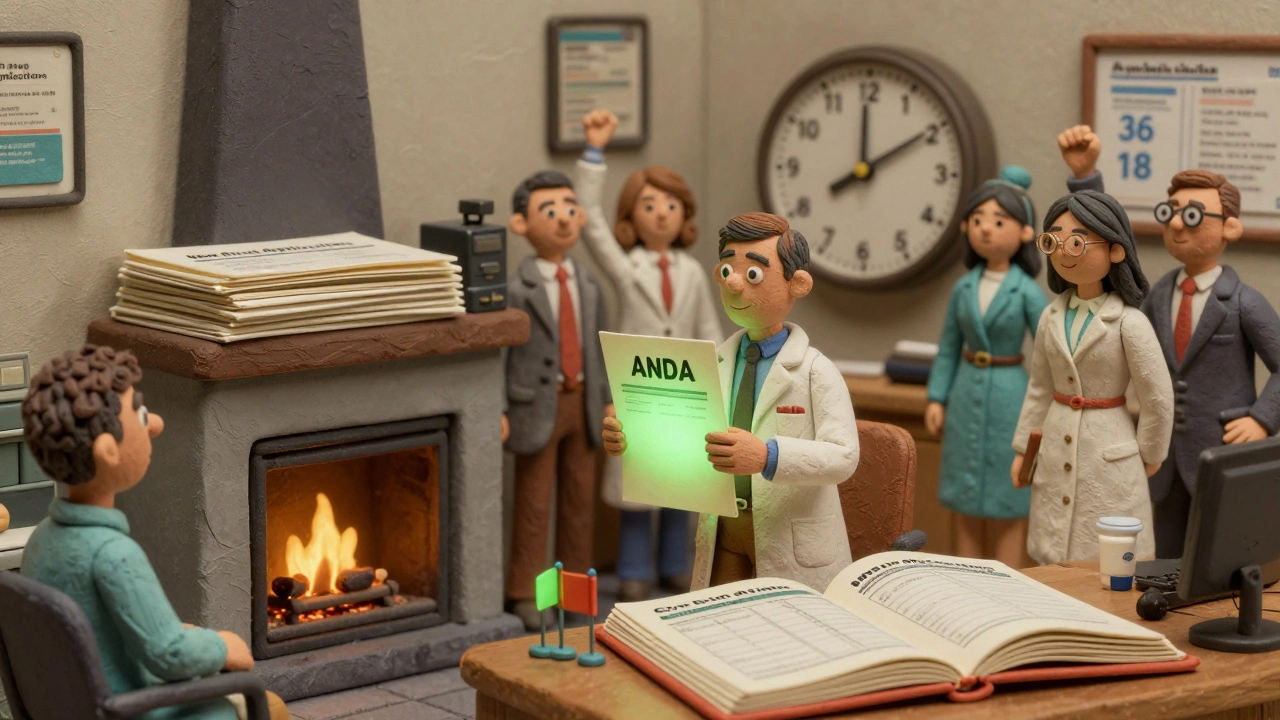
The FDA reviews ANDAs for quality, safety, and performance. In 2023 alone, the agency approved 746 ANDAs. That’s more than two every day. And the review time? It’s dropped from 36 months in 2012 to just 18 months today, thanks to user fee programs that give the FDA more resources to hire reviewers.
The Orange Book: The Patent Map That Controls Access
But here’s the catch: brand-name drugs are protected by patents. And patents don’t expire at the same time for every drug. That’s where the Orange Book comes in. Officially called Approved Drug Products with Therapeutic Equivalence Evaluations, the Orange Book is the FDA’s public list of all approved drugs and the patents linked to them. Every brand-name drugmaker must list patents that cover the drug’s active ingredient, formulation, or method of use.
When a generic company files an ANDA, it must check the Orange Book and make a legal statement-called a patent certification-about each patent listed. There are four types:
- Paragraph I: No patents listed
- Paragraph II: Patents have expired
- Paragraph III: We’ll wait until the patent expires
- Paragraph IV: This patent is invalid or we won’t infringe it
Paragraph IV is the big one. It’s the legal shot across the bow. It says: “We’re coming in, and we’re challenging your patent.” And when a company files a Paragraph IV certification, it triggers a chain reaction.
The 180-Day Exclusivity: The First Mover’s Prize
If a generic company files a Paragraph IV certification and wins a patent challenge, it gets a reward: 180 days of market exclusivity. During that time, no other generic can enter the market. That’s a huge incentive. It means the first filer can capture the entire generic market-often 80% or more of sales-before competitors even show up.
This system created a race. In the early 2000s, generic companies would camp outside FDA offices to be the first to submit their ANDAs. The FDA had to change the rules in 2003 to prevent chaos: if two companies file on the same day, they share the 180-day exclusivity. But even with that, the race is fierce. Companies spend millions on legal teams and pharmacokinetic studies just to be first.
The 30-Month Stay: When Patents Fight Back
But the brand-name companies aren’t defenseless. When they get notified of a Paragraph IV filing, they have 45 days to sue for patent infringement. If they do, the FDA is legally required to pause approval of the generic for up to 30 months. That’s not a coincidence. It’s a delay tactic.
Most patent lawsuits take about 31 months to resolve-right on the edge of that 30-month window. That means even if the generic wins in court, the delay often pushes generic entry past the patent’s original expiration date. It’s called “evergreening” when brand companies file multiple secondary patents-on coatings, packaging, or dosing schedules-to reset the clock. One drug might start with one patent and end up with five or six by the time generics try to enter.
And sometimes, the brand and generic companies make secret deals. “Pay-for-delay” agreements happen when the brand pays the generic to hold off on launching. The FTC has sued over dozens of these deals, calling them anti-competitive. In 2023, the FDA cracked down harder, requiring brand companies to provide generic manufacturers with drug samples needed for testing. Before the CREATES Act of 2019, some brands refused to sell samples, blocking generics from even starting the approval process.

Who Benefits? Patients, Payors, and the System
The numbers don’t lie. Since 1984, generic drugs have saved the U.S. healthcare system over $1.7 trillion. In 2023 alone, that’s $158 billion in annual savings. Medicare Part D beneficiaries saved an average of $3,200 per person last year because they filled 78% of their prescriptions with generics.
It’s not just about money. It’s about access. A cancer drug that costs $10,000 a month might become $2,000 after generics enter. A heart medication that was out of reach for a retiree on a fixed income becomes affordable. The Hatch-Waxman Act didn’t just lower prices-it made treatment possible for millions who couldn’t afford it before.
Where the System Falls Short
But it’s not perfect. In 2023, 283 generic drugs were in short supply. Many of them are older, low-margin drugs made by just one or two manufacturers. If one plant shuts down-due to quality issues, inspections, or supply chain problems-there’s no backup. The FDA has cracked down on foreign facilities with poor sanitation, but the system still struggles with complex drugs.
Biologics-drugs made from living cells, like insulin or rheumatoid arthritis treatments-don’t fit the Hatch-Waxman model. They’re too big, too complex to copy exactly. That’s why Congress passed the Biologics Price Competition and Innovation Act (BPCIA) in 2010, creating a separate pathway for “biosimilars.” But even that system has been slow to take off, partly because of legal battles and manufacturer resistance.
And then there’s the cost of filing an ANDA. While it’s cheaper than a full NDA, it still runs $5 million to $10 million and takes 3 to 4 years. That’s a barrier for small companies. Only a handful of giants-Teva, Viatris, Sandoz, and Mylan-dominate the market. Newer players struggle to compete.
What’s Next for Generic Drugs?
The Hatch-Waxman Act is 40 years old, and it’s still the backbone of U.S. drug policy. But the landscape is changing. More complex drugs are coming off patent-oral cancer pills, inhalers, injectables with tricky delivery systems. The FDA is updating its guidance every year. In 2023 alone, it released 15 new documents to help generic manufacturers navigate these challenges.
Congress is also watching. Lawmakers are debating whether to limit patent thickets, ban pay-for-delay deals outright, or shorten the 30-month stay. The FDA is pushing for faster reviews and better transparency. And the generic industry is investing in new technologies-like artificial intelligence to predict patent outcomes and advanced manufacturing to handle complex formulations.
The goal hasn’t changed since 1984: get safe, effective drugs to patients at the lowest possible price. The Hatch-Waxman Act made that possible. It’s not flawless. But without it, most Americans wouldn’t be able to afford the medicines they need.
What is the Hatch-Waxman Act?
The Hatch-Waxman Act, passed in 1984, is a U.S. federal law that created a legal pathway for generic drugs to enter the market without repeating costly clinical trials. It balances innovation by protecting brand-name drug patents while encouraging competition through the Abbreviated New Drug Application (ANDA) process and incentives like 180-day market exclusivity for the first generic challenger.
How do generic drugs get approved under Hatch-Waxman?
Generic manufacturers file an ANDA with the FDA, proving their product is identical in active ingredient, strength, dosage form, and route of administration to the brand-name drug. They must also demonstrate bioequivalence-meaning the body absorbs the generic at the same rate and level as the original-using pharmacokinetic studies with a 90% confidence interval within 80%-125% of the brand drug’s levels.
What is the Orange Book?
The Orange Book is the FDA’s official list of approved drug products and their associated patents. Brand-name manufacturers must list patents covering the drug’s active ingredient, formulation, or use. Generic companies use this list to determine when they can legally enter the market and to file patent challenges under Paragraph IV certifications.
Why does the first generic company get 180 days of exclusivity?
The 180-day exclusivity is an incentive for generic companies to challenge weak or questionable patents. Filing a Paragraph IV certification is risky and expensive-it often leads to lawsuits. The reward is a head start in the market, allowing the first generic to capture most of the sales before competitors enter, which drives prices down faster for everyone.
Can brand-name companies block generic entry indefinitely?
They can delay it significantly. If a brand company sues after a Paragraph IV filing, the FDA must pause approval for up to 30 months. Many lawsuits are designed to last just under that limit, effectively extending monopoly pricing. Some companies also file multiple secondary patents to reset the clock. While courts can rule against these tactics, the system still allows for strategic delays that harm competition.
How has Hatch-Waxman affected drug prices?
Since 1984, generic drugs have saved the U.S. healthcare system over $1.7 trillion. When a generic enters the market, prices typically drop 80% to 90% within a year. In 2023, generics made up 90% of prescriptions filled but only 23% of total drug spending. The average Medicare Part D beneficiary saved $3,200 annually because of generic alternatives.
Sheryl Lynn
December 2, 2025 AT 05:55The Hatch-Waxman Act is the unsung hero of American pharmacology - a masterclass in regulatory elegance. It didn’t just tweak the system; it orchestrated a symphony of innovation and access. The ANDA pathway? Pure genius. Bioequivalence as the new gold standard? Brilliant. And that 180-day exclusivity? A masterstroke of economic incentive wrapped in legal finesse. We’re talking about a law that turned pharmaceuticals from luxury items into everyday staples. The Orange Book? More like the pharmaceutical Rosetta Stone. This isn’t policy - it’s poetry written in FDA guidelines.
Paul Santos
December 3, 2025 AT 20:09It’s funny how we romanticize bureaucracy, isn’t it? 😅 Hatch-Waxman? More like Hatch-Waxman™ - a corporate dance where patent thickets are the waltz and pay-for-delay is the slow drag. The 30-month stay? A legal loophole dressed as a ‘protection.’ And don’t get me started on how ‘bioequivalence’ lets them swap out fillers like it’s a flavor of yogurt. We’re not saving billions - we’re just letting Big Pharma write the rules while pretending generics are ‘the same.’ 🤷♂️
Eddy Kimani
December 4, 2025 AT 18:01Really fascinating breakdown. One thing I’ve been wondering - with the rise of complex generics like inhalers and injectables, how well does the current ANDA framework handle them? The 80-125% bioequivalence window feels a bit archaic when you’re dealing with nanoparticle delivery systems or liposomal formulations. Is the FDA adapting its guidance fast enough? Or are we stuck with 1984 logic trying to regulate 2025 science?
Kristen Yates
December 6, 2025 AT 07:11My grandmother takes three generic pills every day. One costs $3. One costs $1. One she gets for free at the pharmacy. She doesn’t know what an ANDA is. But she knows she can breathe. That’s enough.
Saurabh Tiwari
December 6, 2025 AT 15:37So this law basically said ‘hey, if it works like the original, just copy it’ and boom - millions saved 💸🔥
Now if only we could copy this logic to housing or education 🤔
Michael Campbell
December 6, 2025 AT 22:21Foreign factories. FDA bribes. China controls the API. This isn’t healthcare - it’s a supply chain hostage situation. And we’re celebrating a law that outsourced our medicine to a dictatorship? Wake up. This isn’t progress. It’s surrender.
Victoria Graci
December 6, 2025 AT 23:24There’s something deeply American about this - a tension between innovation and access, between monopoly and merit. Hatch-Waxman didn’t just lower prices; it redefined what ‘fair’ means in a market driven by patents. The 180-day exclusivity? It’s not just a reward - it’s a moral compromise. We’re paying the first challenger to break the lock, knowing full well that the lock was built on shaky ground. And yet, without that compromise, the system collapses. It’s not perfect. But it’s the closest we’ve come to justice in a system built on profit.
Saravanan Sathyanandha
December 7, 2025 AT 20:05This is a remarkable example of how thoughtful regulation can align public health with market incentives. The Orange Book, the ANDA, the Paragraph IV certifications - each component is meticulously designed to balance intellectual property rights with equitable access. In countries where such frameworks are absent, patients pay exorbitant prices for life-saving drugs. The U.S. model, despite its flaws, remains a global benchmark. Perhaps we should export this wisdom - not just the generics, but the policy architecture behind them.
Fern Marder
December 7, 2025 AT 21:06Ugh. I knew it. The real villains aren’t the pharma giants - it’s the ‘generic’ companies that file Paragraph IV just to delay, then take the 180-day exclusivity and sit on it. 💅 They’re not saving money - they’re gaming the system. And the FDA? Letting them. #WakeUpAmerica
Allan maniero
December 8, 2025 AT 11:47You know, I’ve been thinking about this for a while - and I think the real brilliance of Hatch-Waxman isn’t just in the legal mechanics, but in the cultural shift it enabled. Before 1984, generics were seen as ‘cheap knockoffs.’ After? They became the default. That’s a massive change in public perception. It’s not just about cost - it’s about trust. People started believing that a pill with a different label could do the same job. That’s a quiet revolution in consumer confidence. And honestly? That’s harder to achieve than any patent challenge.
Anthony Breakspear
December 9, 2025 AT 06:40Let’s be real - this law is why your insulin isn’t $1,000 a vial. 🙌 The system? Yeah, it’s messy. Patent thicket? Pay-for-delay? Totally sketchy. But here’s the thing: without Hatch-Waxman, we wouldn’t have 90% generic use. We’d be stuck in a world where ‘affordable medicine’ was a punchline. So yeah, fix the loopholes. Ban pay-for-delay. Force sample access. But don’t throw the baby out with the bathwater. This is the reason millions of people are alive today. And that’s worth fighting for - not dismantling.