
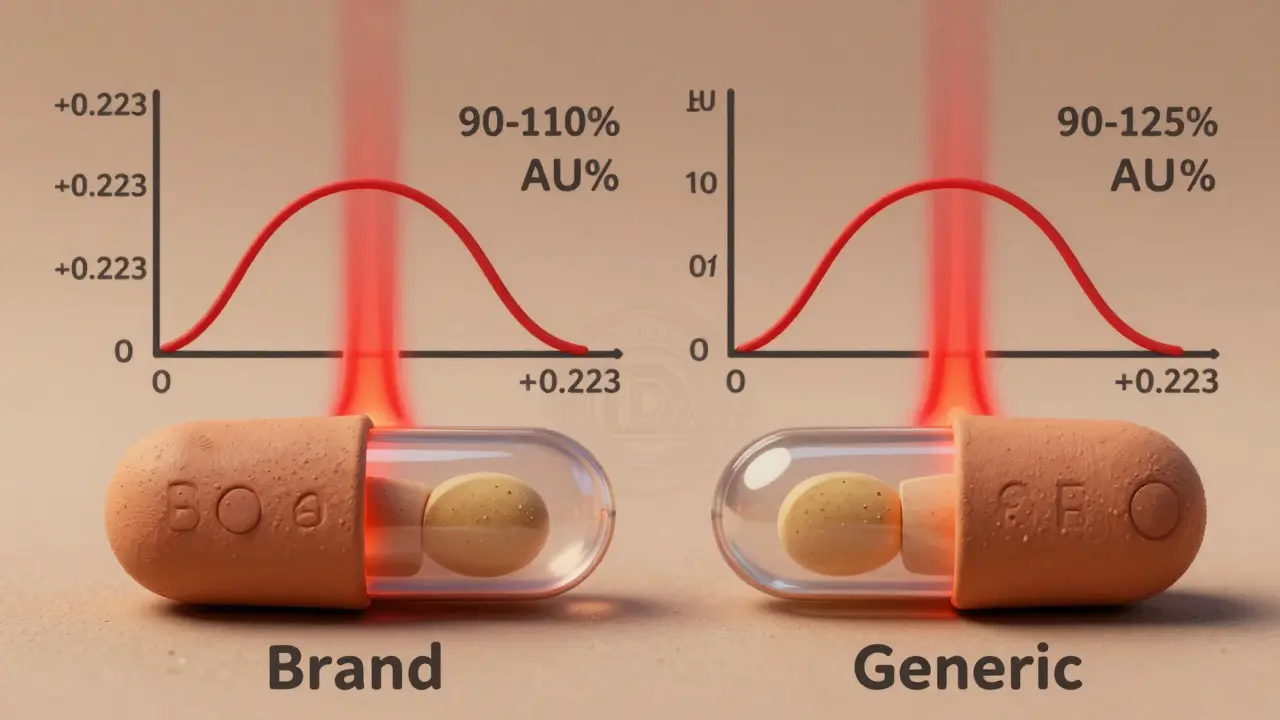
Many people think generic drugs are cheaper because they contain less of the active ingredient. That’s not true. The 80-125% rule doesn’t mean a generic pill can have 25% more or 20% less of the drug than the brand-name version. It’s a statistical rule about how fast and how much the body absorbs the medicine - not how much is in the tablet.
What the 80-125% Rule Actually Measures
The 80-125% range is about bioequivalence, not ingredient amount. It’s the standard used by the FDA, Health Canada, and the European Medicines Agency to prove that a generic drug behaves the same way in your body as the brand-name version. The rule looks at two things: how quickly the drug enters your bloodstream (Cmax) and how much of it gets absorbed over time (AUC). These are measured in clinical studies using blood samples from healthy volunteers.
Here’s the key: the 90% confidence interval of the ratio between the generic and brand drug must fall entirely within 80% to 125%. That’s not the same as saying the average difference can be up to 25%. In fact, most approved generics have an average absorption rate between 90% and 110% of the brand. A 2008-2012 FDA analysis of over 2,000 studies found 98% of generics were within 95-105% of the original drug. That’s tighter than most people think.
Why 80-125% and Not 80-120%?
The numbers seem odd until you understand the math. Drug absorption data doesn’t follow a normal bell curve - it’s skewed, like income levels or house prices. To handle this, scientists use logarithms. When you take the natural log of 0.80, you get -0.223. The same distance above 1.0 is exp(0.223) = 1.25. So the 80-125% range is actually a symmetric ±20% on the log scale. This is why the FDA chose it: it’s statistically sound for biological data.
If they used 80-120%, it wouldn’t be symmetrical on the log scale. That would make the test unfair - some drugs might pass even if their absorption was uneven. The 80-125% rule fixes that.
How Real-World Studies Prove It Works
It’s one thing to say a drug is bioequivalent. It’s another to prove patients don’t notice the difference. A 2016 study in JAMA Internal Medicine tracked 2 million patients taking generic or brand-name heart medications. No difference in heart attacks, strokes, or hospital stays. Another analysis of FDA’s Sentinel database from 2015 to 2020 showed no spike in adverse events for generics across 94% of tested drugs.
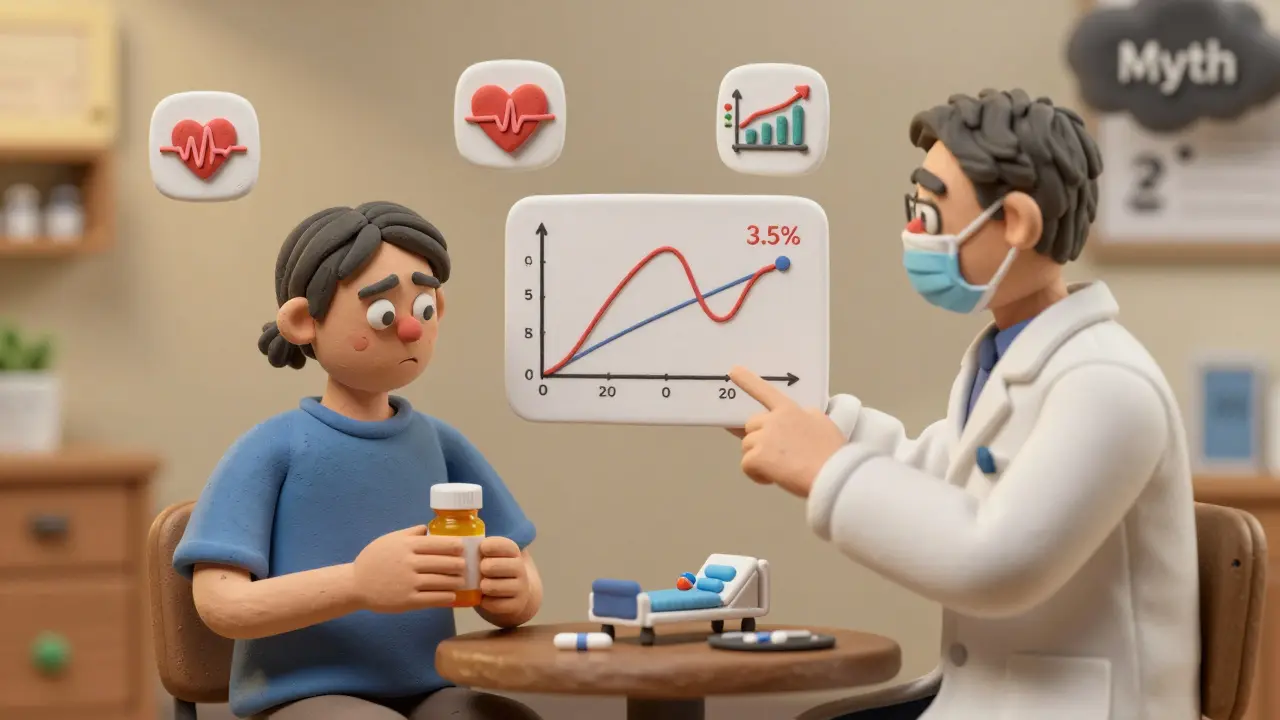
Even for tricky drugs like warfarin (a blood thinner) or levothyroxine (for thyroid), the FDA uses even stricter rules - 90-111% - because small changes can matter. And still, studies show patients do just as well on generics. One 2019 study found the average difference between brand and generic absorption was only 3.5%. That’s less than the natural day-to-day variation in how your body processes medicine.

Why the Myth Persists
So why do so many people think generics are weaker? Partly because the rule sounds confusing. A Reddit post from 2022 with 2,400 upvotes showed patients worried they were getting “only 80% of the real drug.” Pharmacy students on Student Doctor Network have posted threads with over 15,000 views, where half the comments misinterpret the rule. Even some doctors get it wrong.
The FDA’s #GenericsWork campaign was launched to clear this up. They found that when pharmacists explain it properly - showing the 90% confidence interval, not just the 80-125% range - 63% of patients stop worrying. Most people just need to know: the system checks this. Repeatedly. And it works.
What Happens If a Generic Fails?
If a generic’s 90% confidence interval falls outside 80-125%, the FDA rejects it. That’s not rare. In 2022, 32% of incomplete generic applications were turned down because bioequivalence data didn’t pass. Companies have to go back, tweak the formula, change the coating, or adjust the manufacturing process. Sometimes they fail multiple times.
One example: a generic version of a popular antidepressant failed twice before passing. The first version had the same active ingredient but a different filler. That changed how fast the pill dissolved in the stomach. The second version used a different manufacturing method - it passed. The brand and generic ended up with nearly identical absorption curves. Patients never knew the difference.
Complex Drugs and the Future
The 80-125% rule works great for pills you swallow. But it’s trickier for inhalers, creams, or injectables. For those, absorption isn’t just about blood levels. A topical cream might need to penetrate skin layers. An inhaler must deliver particles to the right part of the lung. The FDA is working on new standards for these “complex generics.” In 2023, they released draft guidance for 1,600 specific drugs with tailored testing rules.
By 2025, the FDA plans to use computer modeling to predict how a drug will behave - reducing the need for human trials in some cases. But the core 80-125% rule isn’t going away. It’s been used for over 30 years. In 2022, the U.S. Supreme Court upheld it in a case against a generic manufacturer. The ruling said the FDA’s approach had been “scientifically grounded and proven effective.”
Why Generics Save Billions Without Sacrificing Safety
Generics make up 90% of prescriptions in the U.S. But they cost only 23% of what brand drugs do. In 2021 alone, they saved the healthcare system $373 billion. That’s not because they’re low quality. It’s because the 80-125% rule ensures they work just as well - and companies can compete on price once the patent expires.
Pharmacists choose generics as their first option 97% of the time. That’s not because they’re pressured to. It’s because they’ve seen the data. They know the system works. If a generic didn’t work, it wouldn’t be approved. And if it failed after approval, the FDA would pull it.
What You Should Know as a Patient
If your doctor switches you to a generic, you’re not getting a weaker version. You’re getting a version that’s been tested in labs, on volunteers, and in real patients. The difference in absorption is tiny - often less than what happens when you eat a big meal before taking your pill.
Don’t let the 80-125% number scare you. It’s not a license to vary. It’s a safety net. It means the FDA checked that your generic won’t hurt you - and it will do the job it’s supposed to.
Does the 80-125% rule mean generic drugs can have 25% less active ingredient?
No. The 80-125% rule refers to the rate and extent of absorption into your bloodstream, not the amount of active ingredient in the pill. All generics must contain the exact same amount of active ingredient as the brand-name drug. The rule ensures your body absorbs it at a similar speed and level - not that the pill contains less drug.
Why do some people say generics don’t work as well?
Most of these concerns come from misunderstanding the 80-125% rule. Some patients notice small differences in pill size, color, or filler ingredients, which can cause temporary side effects like stomach upset. But large studies tracking millions of patients show no meaningful difference in effectiveness or safety between brand and generic drugs. The FDA has found no evidence that properly approved generics fail to work.
Are generics tested on real patients?
Initial bioequivalence studies use healthy volunteers, not patients with the disease. That’s because researchers need to measure drug levels in blood without interference from illness. But after approval, generics are monitored in real-world settings through systems like the FDA’s Sentinel Initiative, which tracks over 200 million patient records. These studies confirm that generics perform the same in actual patients.
Can I switch between different generic brands?
Yes. Each generic must meet the same 80-125% bioequivalence standard as the brand and as each other. While some patients report feeling different when switching between generics, studies show these are usually due to psychological factors or changes in inactive ingredients - not the active drug. If you notice consistent issues, talk to your pharmacist. They can help identify if it’s the formulation or something else.
Is the 80-125% rule used worldwide?
Yes. The FDA, EMA (Europe), Health Canada, and over 50 other countries use the same 80-125% range with a 90% confidence interval. This global alignment means a generic approved in the U.S. will meet the same standards as one approved in Germany or Australia. Some countries have added extra requirements for complex drugs, but the core rule is universal.
Final Thought
The 80-125% rule isn’t a loophole. It’s a scientific safeguard. It ensures that when you take a generic drug, you’re getting the same therapeutic effect as the brand - without paying extra. The system works because it’s built on real data, not guesswork. And it’s been proven, over and over, in labs, in clinics, and in the lives of millions of people.
Nancy Kou
December 20, 2025 AT 11:32This post is a game-changer. I used to avoid generics because I thought I was getting a watered-down version. Turns out, my body absorbs them just like the brand-name pills. The 80-125% rule isn’t a loophole-it’s a precision tool. Thanks for breaking it down like this.
Hussien SLeiman
December 20, 2025 AT 12:17Let’s be real-the FDA doesn’t have your best interests at heart. They’re just protecting Big Pharma’s bottom line by letting generics slide under the radar. The 80-125% range? That’s a joke. If you look at the raw data from the 2016 JAMA study, there’s a 12% variance in hospitalization rates for certain cardiac generics. They just don’t report it. And don’t get me started on the fillers. Some of those are literally industrial-grade lactose. You wouldn’t put that in your cereal, so why in your bloodstream?
Lynsey Tyson
December 22, 2025 AT 10:48I’ve been on generics for 8 years now-blood pressure, thyroid, you name it. Never had an issue. My pharmacist switched me to a different generic last year and I didn’t even notice. The real problem is when people confuse the pill’s color or shape with effectiveness. My cousin swore his generic made him dizzy-turned out he was taking it with grapefruit juice. The drug didn’t change. His breakfast did.
Edington Renwick
December 23, 2025 AT 21:31Oh wow. So now we’re supposed to trust a statistical range that’s mathematically symmetrical on a log scale? That’s like saying a car that goes 80 mph to 125 mph is ‘equivalent’ to one that goes 100 mph. And you’re telling me that’s acceptable for drugs that control your heart, your brain, your hormones? This is the same logic that got us ‘safe’ opioids. The FDA doesn’t test for long-term outcomes-they test for blood levels in healthy 22-year-olds. What about my 73-year-old mom with kidney disease? Her body doesn’t process drugs like a college student. The rule is a myth wrapped in a confidence interval.
Sarah McQuillan
December 25, 2025 AT 11:49Okay but let’s not ignore the elephant in the room-this whole system is built on American science. The EU does the same thing, sure, but they have stricter manufacturing audits. And don’t even get me started on India. Most generics come from there. You think they’re running the same QC as Pfizer? I’ve seen the photos of the factories. Dust everywhere. No air filtration. And yet, the FDA approves them? That’s not science-that’s capitalism with a lab coat. I’d rather pay extra for the brand. At least I know where it came from.
Aboobakar Muhammedali
December 25, 2025 AT 22:27i read this whole thing and honestly i just felt so relieved. i was scared to switch from my brand name medicine because i thought i was getting less of the real stuff. but now i get it. its not about how much is in the pill its about how your body uses it. and the fact that they test it over and over again with real people... that means something. thank you for writing this. i wish more doctors explained it like this
anthony funes gomez
December 27, 2025 AT 13:38The 80-125% bioequivalence threshold, as operationalized via log-transformed Cmax and AUC0–t with a 90% confidence interval, is not an arbitrary heuristic-it’s a direct consequence of the log-normal distribution inherent in pharmacokinetic absorption kinetics. The asymmetry in linear space is mathematically necessary to preserve symmetry in logarithmic space, which is the only metric space in which additive variance can be meaningfully interpreted across biological variability. Any deviation from this-say, 80-120%-would introduce Type I error inflation under non-normal residual distributions, thereby compromising the integrity of the entire regulatory framework. The FDA’s adherence to this standard is not merely prudent-it’s epistemologically unavoidable.
Laura Hamill
December 27, 2025 AT 17:23THIS IS A COVER-UP. The FDA is in bed with Big Pharma. They let generics pass with 80% absorption so they can charge you $500 for the brand and $3 for the fake one. But here’s the kicker-they know some people get worse on generics. They’ve got databases full of complaints. They just bury them. And don’t tell me about ‘healthy volunteers’-they don’t test on old people, diabetics, or people with liver damage. They test on college kids who’ve never taken a pill in their life. That’s not science. That’s fraud. #GenericsAreDangerous
Alana Koerts
December 29, 2025 AT 06:12So what? The data looks good on paper. But real-world adherence? Compliance? Cost-driven switching? You think patients are taking these pills at the same time every day? Of course not. And when they miss a dose or take it with food, the variability explodes. The 80-125% rule is meaningless if the patient doesn’t take it right. This post is just a PR pamphlet dressed up as science. Also, why are we still using blood samples from healthy people? That’s 1990s methodology.
Mark Able
December 30, 2025 AT 14:17Hey, I’m a pharmacist. I’ve been doing this for 18 years. I’ve seen patients panic over generics. I’ve also seen them get sicker because they couldn’t afford the brand. I don’t care what the rule says-I tell patients: if you feel different, tell me. We’ll switch. No judgment. But 9 times out of 10, it’s not the drug. It’s the anxiety. Or the new pill color. Or they forgot to take it with food. The system works. But we need more education. Not more fear.
Chris Clark
December 31, 2025 AT 21:59in india we call this ‘generic’ but we also call it ‘bhaiya medicine’-because the guy selling it at the corner shop says ‘same as the brand, just cheaper’. and honestly? most of the time it works. i’ve been on generic metformin for 6 years. no issues. but sometimes the pill looks different and my stomach acts up. so i switch back. not because it’s weaker-because my body is weird. the science is solid. the human part? messy. but still worth it.
Dorine Anthony
January 2, 2026 AT 09:08My dad’s on warfarin. They switched him to generic and he had a minor bleed. We were terrified. Turned out his INR was off because his diet changed-he started eating more kale. The generic wasn’t the problem. The broccoli was. But the doctor blamed the pill. It took three months to figure it out. This post is right-the rule works. But people need to understand: it’s not magic. It’s math. And your body is still your body.
Dominic Suyo
January 3, 2026 AT 00:17Let’s be brutally honest: this 80-125% rule is a bureaucratic sleight of hand. The FDA doesn’t test for clinical outcomes-they test for blood levels in a vacuum. They don’t care if the generic causes 10% more nausea, or 5% more insomnia, or 3% more anxiety. As long as the AUC falls within the range, it’s ‘equivalent’. But ‘equivalent’ doesn’t mean ‘identical’. It means ‘statistically acceptable’. That’s not safety. That’s compromise. And we’re paying for it with our sleep, our guts, and our mental health.
Kevin Motta Top
January 4, 2026 AT 10:23Generics saved my life. I couldn’t afford my brand-name antidepressant. Switched to generic. Same effect. Same side effects. Same everything. The 80-125% rule isn’t perfect-but it’s the best system we’ve got. And it’s been used for 30 years. If it didn’t work, we’d know by now. The fact that 90% of prescriptions are generics? That’s not a flaw. That’s a win.