
The U.S. Food and Drug Administration (FDA) approves over 1,000 generic drugs every year. These aren’t just cheaper versions of brand-name medications-they’re exact copies in how they work, how they’re made, and how safe they are. But getting that approval isn’t simple. It’s a detailed, tightly regulated process built around the Abbreviated New Drug Application (ANDA). This isn’t a shortcut-it’s a science-backed pathway designed to ensure that every generic drug performs just like its brand-name counterpart.
What Is an ANDA, Really?
The ANDA is the official form used to apply for generic drug approval. It was created by the Hatch-Waxman Act of 1984, which struck a balance: protect innovation for brand-name companies while letting generics enter the market once patents expire. Unlike the New Drug Application (NDA) that brand-name makers use-which requires full clinical trials-the ANDA skips those expensive and time-consuming steps. Instead, it focuses on proving equivalence.
To qualify, a generic drug must be pharmaceutically equivalent to the brand-name drug, called the Reference Listed Drug (RLD). That means it has the same active ingredient, strength, dosage form (pill, injection, cream, etc.), and route of administration (oral, topical, inhaled). It doesn’t need to look the same or have the same inactive ingredients-but those inactive ingredients still must be safe and not interfere with how the drug works.
The real test, though, is bioequivalence. This isn’t just about chemistry. It’s about what happens inside your body. A generic drug must deliver the same amount of active ingredient into your bloodstream at the same rate as the brand-name version. The FDA requires this to be proven through studies in 24 to 36 healthy volunteers. Blood samples are taken over time to measure how quickly and completely the drug is absorbed. If the generic’s absorption curve falls within 80% to 125% of the brand’s, it passes. That’s the standard. No exceptions.
The ANDA Submission: What’s Inside the File
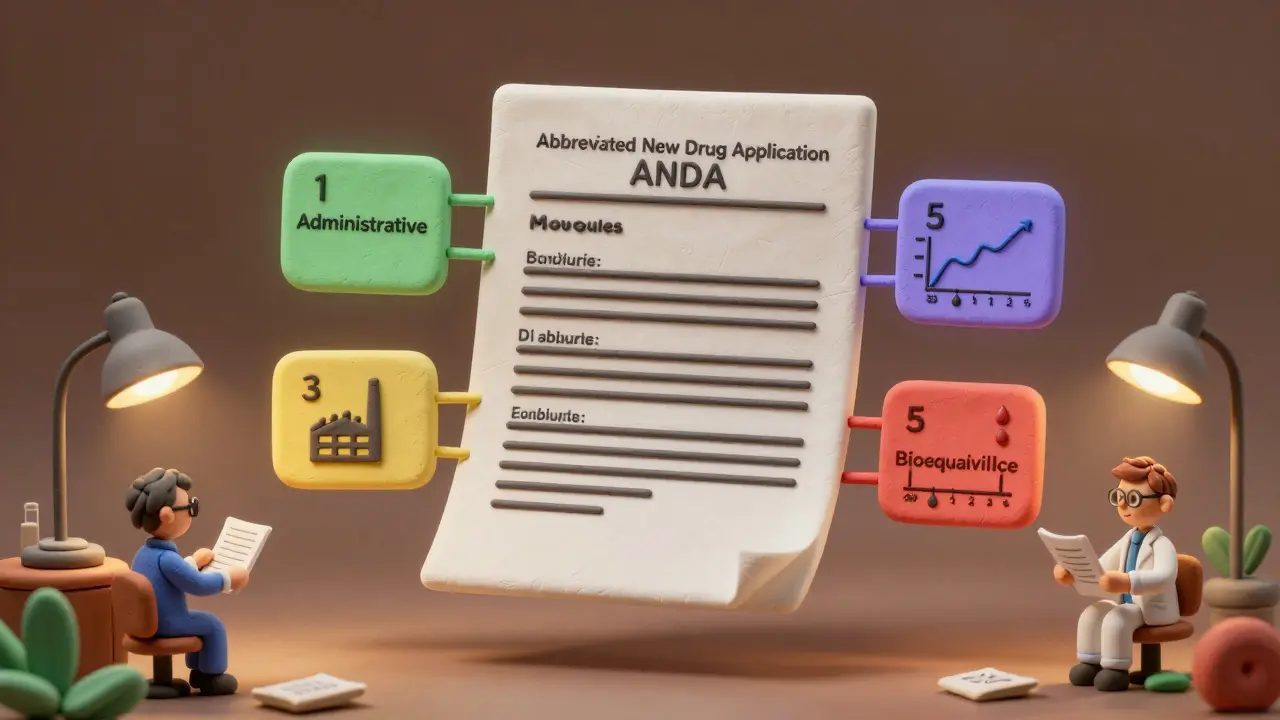
Preparing an ANDA isn’t just filling out a form. It’s compiling hundreds of pages of technical data. The entire application must follow the electronic Common Technical Document (eCTD) format, organized into five modules:
- Module 1: Administrative information-company details, patent certifications, and fee payments.
- Module 2: Summaries-overviews of quality, nonclinical, and clinical data.
- Module 3: Chemistry, Manufacturing, and Controls (CMC)-the most critical section. This details how the drug is made, from raw materials to final packaging. Every step must follow Current Good Manufacturing Practices (cGMP). The FDA inspects manufacturing sites, often without warning. If the facility fails inspection, the ANDA gets rejected.
- Module 4: Nonclinical study reports-usually minimal for generics, since safety is already established by the RLD.
- Module 5: Clinical data-just the bioequivalence study results. No new human trials for safety or effectiveness.
Labeling must match the brand-name drug exactly, except for minor changes to inactive ingredients or manufacturer info. Even small wording differences can trigger a Complete Response Letter (CRL), which halts approval until the issue is fixed.
The Review Timeline: How Long Does It Take?
The FDA’s goal under GDUFA IV (2023-2027) is to approve 90% of original ANDAs within 10 months. That’s down from 12 months under the previous agreement. But this isn’t a guarantee-it’s a target. The actual timeline depends on how clean the submission is.
Here’s how it breaks down:
- 60-day filing review: The FDA checks if the ANDA is complete. If it’s missing key data, they issue a Refuse-to-File (RTF) letter. You have to fix it and resubmit. About 15% of submissions get RTF notices.
- 10-month review clock: Once filed, the clock starts. Reviewers from the Office of Generic Drugs (OGD) examine every section. They may send Information Requests (IRs)-essentially detailed questions that require written answers within 30 days. Most ANDAs get 1 to 3 IRs. Each delay adds weeks to the timeline.
- Inspection: Around the 6-month mark, the FDA schedules a facility inspection. If your plant hasn’t passed cGMP inspection in the last 3 years, expect a pre-approval inspection (PAI). A single violation can delay approval by 6 to 12 months.
- Approval or CRL: About 75% of ANDAs get approved on the first try. The other 25% get a CRL. Common reasons? Incomplete CMC data (32%), flawed bioequivalence protocols (28%), or manufacturing issues (22%).
One industry manager shared in 2023 that their ANDA for extended-release metformin took 11.2 months-just over the target-with two IRs that took 45 days total to answer. Another company spent 28 months and over $2.3 million trying to get approval for a nasal spray product. It got three CRLs because the bioequivalence method didn’t match the RLD’s.

Why Some Generics Take Longer-The Complex Drug Problem
Not all drugs are created equal. Simple pills? Easy. Inhalers? Ointments? Injectable suspensions? Those are different. The FDA calls them complex drug products. They’re harder to replicate because their performance depends on how they’re made-not just what’s in them.
For example, a generic inhaler must deliver the exact same particle size and spray pattern as the brand. A topical cream must penetrate the skin at the same rate. The FDA now has a dedicated initiative for these products, with draft guidance for 27 types of complex drugs. These applications take longer to review, often 18 to 24 months. They’re also more likely to get CRLs. About 15% of all ANDAs fall into this category.
That’s why biosimilars-the generic version of biologic drugs like Humira-are handled under a different pathway. They’re not ANDAs. They’re Biologics License Applications (BLAs). The FDA approved 7 biosimilars in 2023. By 2026, they expect 10 to 15 per year.
What Happens After Approval?
Approval doesn’t mean the drug hits shelves right away. Patents and exclusivity rules can block entry. The first company to file an ANDA that challenges a patent can get 180 days of exclusive marketing rights. That’s why companies rush to file-even before the patent expires. The first generic version of Humira made over $1.2 billion in its exclusivity window in 2023.
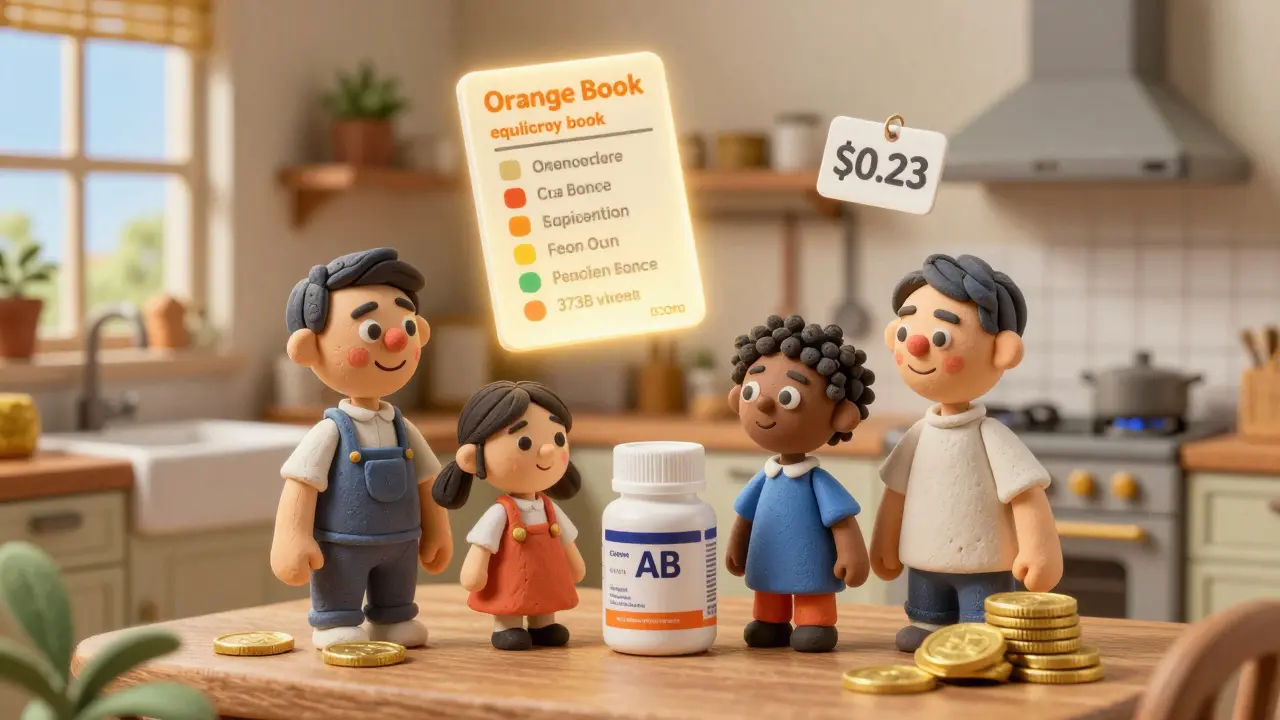
Once approved, the drug is added to the FDA’s Orange Book, which lists all approved drugs and their therapeutic equivalence ratings. Pharmacists use this to substitute generics automatically. If a drug is rated AB, it means it’s interchangeable with the brand. If it’s BX, it’s not recommended for substitution.
After approval, the FDA still monitors. Post-market surveillance catches issues. If a generic drug causes unexpected side effects, the FDA can pull it. In rare cases, manufacturing flaws have led to recalls. That’s why the FDA inspects foreign facilities too-over 80% of generic drug ingredients come from outside the U.S.
Why This Matters: The Real-World Impact
Generic drugs make up 90% of all prescriptions filled in the U.S. But they cost only 23% of what brand-name drugs do. In 2023, they saved the healthcare system $373 billion. That’s not just a number-it’s a mother choosing between insulin and groceries. It’s a veteran getting their blood pressure pills without skipping doses. It’s a family not going bankrupt because of medication.
And it’s all possible because of the ANDA process. It’s not perfect. It’s slow. It’s expensive to navigate. But it works. The FDA approved 1,087 generic drugs in 2023. That’s more than three per day. Each one represents months of work, hundreds of thousands of dollars, and a commitment to making medicine accessible.
What Goes Wrong? Common Pitfalls
Many companies fail because they underestimate the process. Here are the top mistakes:
- Using outdated bioequivalence methods. The FDA updates guidance regularly. If you’re using a 2018 protocol in 2026, you’re already behind.
- Skipping pre-submission meetings. The FDA offers free meetings to clarify expectations. Skipping them is like flying blind.
- Assuming cGMP compliance is automatic. One failed inspection can wipe out years of work. Audits must be done internally before submission.
- Underestimating the time to fix IRs. Each response takes weeks to draft, review, and submit. Delays pile up.
Successful applicants don’t just have scientists-they have teams. Regulatory affairs, formulation chemists, bioanalytical labs, QA specialists, and legal experts working together. Large companies often assign 15 to 25 full-time people to a single ANDA.
What’s Next? The Future of Generic Approval
The FDA is moving fast. Under GDUFA IV, they aim to cut the median review time to 8 months. They’re piloting AI tools to sort through documents faster, reducing administrative delays by 25% by 2025. They’re also expanding the Complex Generic Drug Products Initiative to cover more drug types.
More generics mean more competition. More competition means lower prices. And lower prices mean better access. The system isn’t flawless, but it’s working. Every year, thousands of patients get life-saving drugs because this process exists.
How long does it take to get a generic drug approved by the FDA?
The FDA aims to approve 90% of original ANDAs within 10 months under GDUFA IV (2023-2027). But the actual timeline varies. A clean submission with no issues can be approved in 8 to 10 months. If the FDA issues Information Requests (IRs) or the manufacturing site needs inspection, it can take 12 to 18 months. Complex products like inhalers or injectables often take 2 years or more.
Do generic drugs work the same as brand-name drugs?
Yes, when approved by the FDA. Generic drugs must be pharmaceutically equivalent (same active ingredient, strength, dosage form) and bioequivalent (same absorption rate and amount in the bloodstream) as the brand-name drug. Studies show that 99% of generics perform the same as their brand counterparts. The FDA considers them interchangeable unless labeled BX. Rare exceptions exist for narrow therapeutic index drugs (like warfarin or lithium), where some doctors prefer brand-name due to historical concerns-but even those are often safe as generics.
Why are some generic drugs cheaper than others?
Price differences come from competition. When a drug first goes generic, the first company to file gets 180 days of exclusivity and charges a premium. Once more companies enter, prices drop fast-often by 80-90%. The number of manufacturers, the complexity of the drug, and the cost of manufacturing (especially overseas) also affect price. A simple pill with 10 manufacturers will cost far less than a complex inhaler with only two suppliers.
Can a generic drug be recalled after approval?
Yes. Even after approval, the FDA monitors drugs through post-market surveillance. If a batch is found to have contamination, incorrect dosage, or stability issues, the FDA can issue a recall. In 2022, a generic blood pressure medication was recalled due to a trace impurity. The FDA also conducts unannounced inspections of manufacturing sites-both domestic and foreign. If a facility fails inspection, future shipments can be blocked.
What’s the difference between an ANDA and a biosimilar application?
An ANDA is for small-molecule generic drugs-like pills or injections with simple chemical structures. A biosimilar application is for complex biological drugs made from living cells, like insulin or Humira. Biosimilars don’t require full clinical trials but must prove they’re highly similar to the reference product with no clinically meaningful differences. The approval pathway is different, the data requirements are heavier, and reviews take longer. The FDA approved 7 biosimilars in 2023 and expects 10-15 per year by 2026.
The FDA’s generic drug approval system isn’t flashy. It doesn’t make headlines. But every day, it saves lives and billions of dollars. Behind every generic pill on the shelf is a long, rigorous, science-driven process. And it’s working.
Chris Bird
March 12, 2026 AT 09:13Robert Bliss
March 13, 2026 AT 09:33APRIL HARRINGTON
March 13, 2026 AT 22:09Randall Walker
March 14, 2026 AT 14:52Miranda Varn-Harper
March 15, 2026 AT 04:58Alexander Erb
March 16, 2026 AT 22:12Donnie DeMarco
March 18, 2026 AT 17:56Tom Bolt
March 20, 2026 AT 11:13Shourya Tanay
March 22, 2026 AT 07:54LiV Beau
March 23, 2026 AT 22:03Adam Kleinberg
March 24, 2026 AT 14:28