
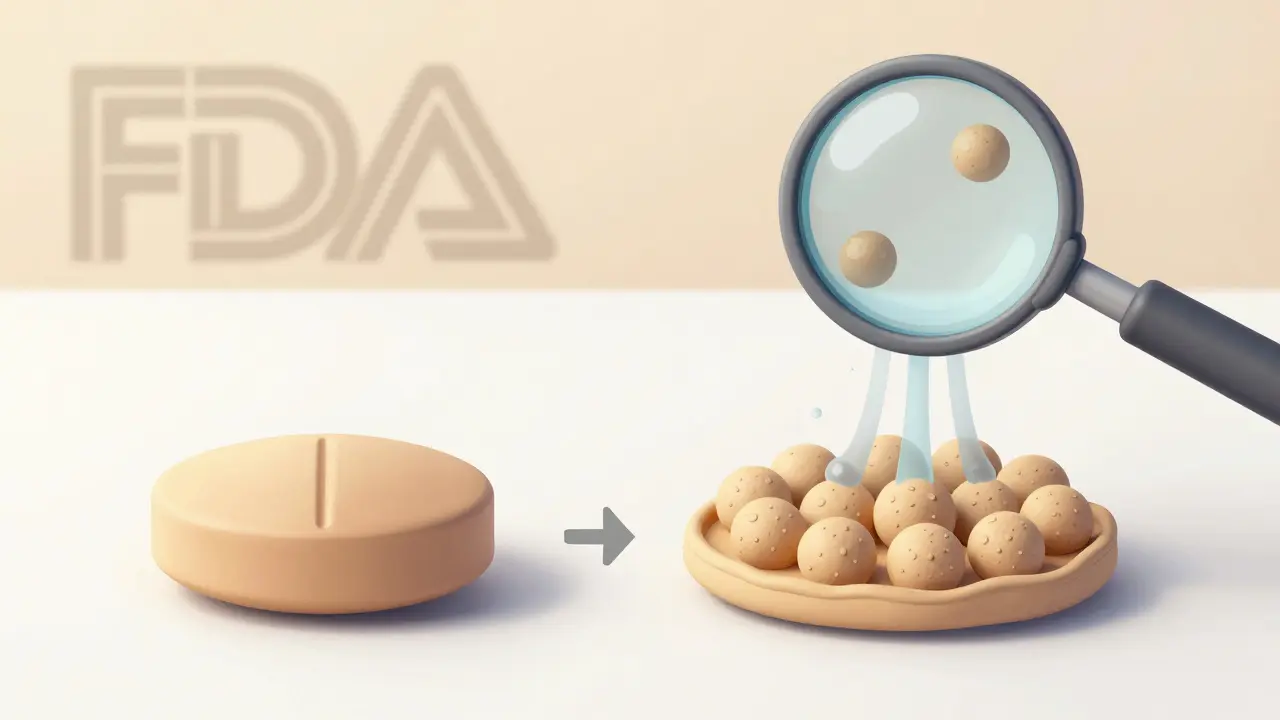
When you think of generic drugs, you probably picture cheap pills that work just like the brand-name version. But not all generics are created equal. Some - called complex generic drugs - are far harder to get approved than others. These aren’t just copies of simple pills. They’re intricate formulations like liposomal injections, long-acting injectables, inhalers, and peptide-based therapies. And because of their complexity, the FDA often takes years longer to approve them - if they get approved at all.
What Makes a Generic Drug "Complex"?
A simple generic drug, like generic lisinopril, has one active ingredient, a straightforward chemical structure, and an oral tablet form. The FDA can test it easily: compare blood levels in volunteers, check for the same absorption rate, and approve it. That’s the Abbreviated New Drug Application (ANDA) pathway - designed for simplicity.
But complex generics? They break that mold. Take bupivacaine liposome injectable, for example. It’s a painkiller trapped inside tiny fat bubbles (liposomes) that slowly release the drug over days. To prove it works the same as the brand version, you can’t just measure blood levels. You have to prove the liposomes behave identically - how they’re made, how they break down, how they deliver the drug to tissues. That’s not a simple test. It requires advanced equipment, specialized labs, and entirely new scientific methods.
Other examples include:
- Long-acting injectables - like monthly schizophrenia treatments - where even a 5% difference in release speed can change how well the drug works.
- Drug-device combinations - such as inhalers or auto-injectors - where the device itself (the nozzle, the plunger, the pressure) affects how much medicine reaches the lungs or bloodstream.
- Peptides and polymeric compounds - larger molecules that can trigger immune reactions. A tiny change in structure might make the body attack the drug as if it were a virus.
These aren’t theoretical edge cases. They treat real conditions: chronic pain, asthma, diabetes, mental illness. But because they’re so hard to copy, few companies even try.
The FDA’s Approval Bottleneck
The FDA approved over 1,000 generic drugs between 2015 and 2023. But only 15 of them were complex generics. That’s not because there aren’t enough applicants. It’s because the science is so demanding.
One major issue? Bioequivalence. For simple generics, bioequivalence means the drug gets into the bloodstream at the same rate and amount as the brand. For complex ones, that’s not enough. The drug must behave the same way in the body - not just in the blood, but in tissues, organs, and at the site of action.
Take an inhaler. Two products might have identical active ingredients. But if the spray pattern, droplet size, or how the device delivers the dose differs even slightly - even if it’s clinically meaningless - the FDA can reject it. Why? Because the agency requires exact matches in delivery, not just chemistry. That’s a huge barrier. A 2019 FDA workshop found that minor device differences blocked approval for dozens of potential generic inhalers.
And then there’s the lack of clear guidance. Until 2017, the FDA didn’t have a formal definition for complex generics. Even now, many developers say they’re flying blind. Without specific instructions - called Product-Specific Guidances (PSGs) - companies spend millions developing a product, only to find out the FDA expected something entirely different.
As of 2023, the FDA had issued over 1,700 PSGs - but many complex products still don’t have them. That means developers guess. And guesswork leads to rejection.
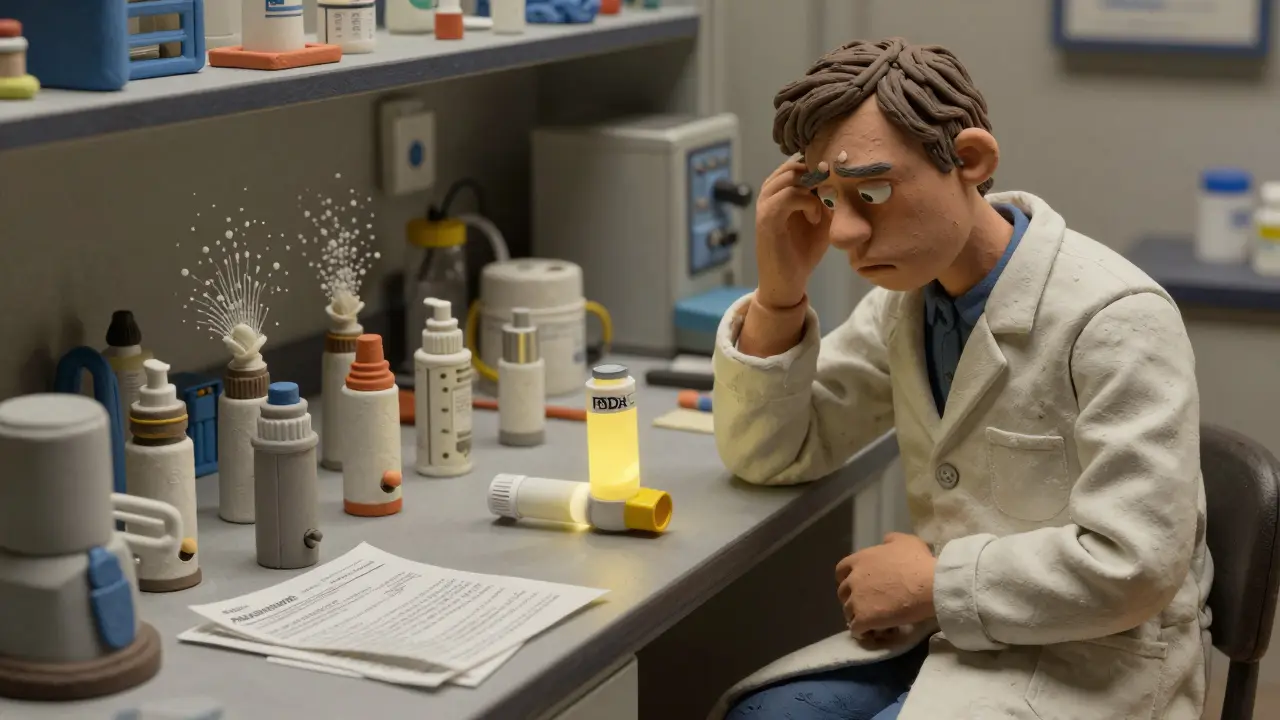
Why Companies Walk Away
Developing a simple generic costs $5 million to $10 million and takes 2-3 years. A complex generic? It can cost $20 million to $50 million and take 5-7 years. And even then, the odds of approval are low.
Many companies use the 505(b)(2) pathway instead - a hybrid route that lets them rely on some of the brand-name drug’s data. But that’s not a true generic. It’s more like a modified version. And it’s expensive to navigate. Plus, it doesn’t always lead to price drops because the FDA still treats it as a new drug.
Some manufacturers just give up. Why spend seven years and tens of millions on a product that might still get rejected? Especially when the market for a complex generic is often small - maybe 100,000 patients - compared to millions for a common pill.
And it’s not just the FDA. Other countries make it harder. China requires local clinical trials. Brazil demands certification of every lab involved. That means a company can’t just develop one version - it has to build different versions for each market. The cost and time balloon even further.
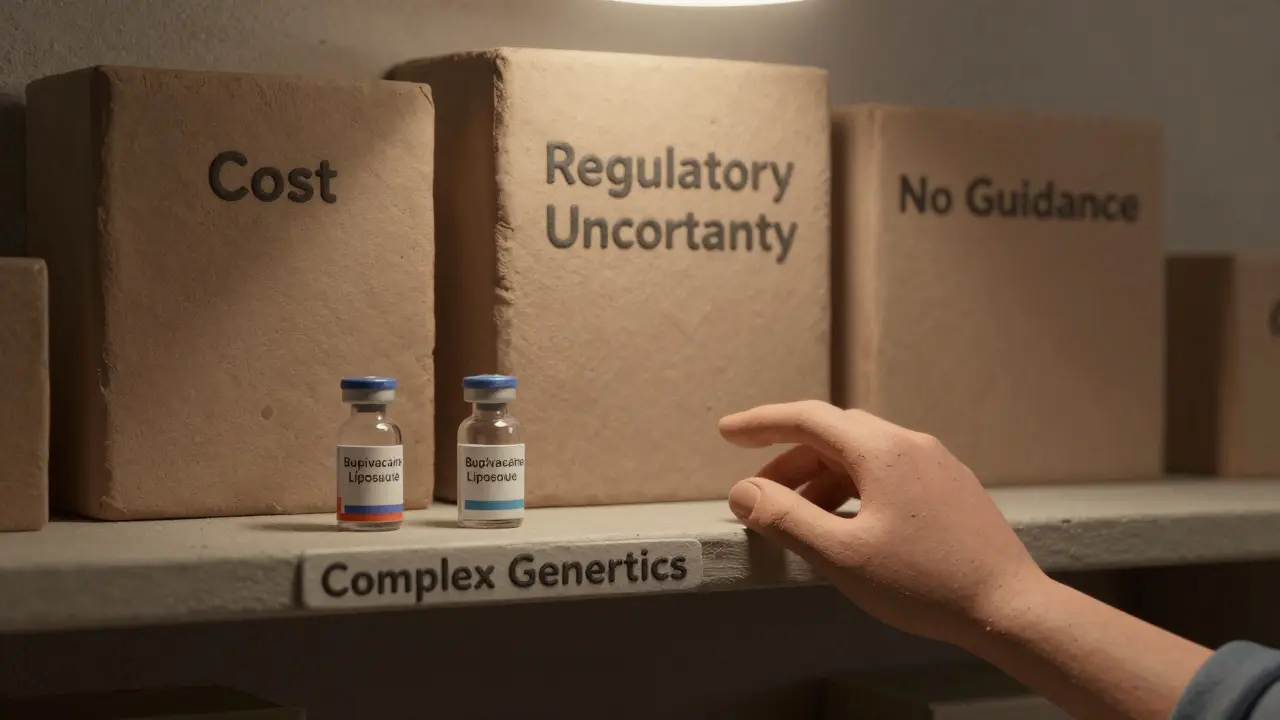
What’s Being Done - and What’s Still Missing
The FDA knows the problem. Since 2017, under the GDUFA II agreement, they’ve created the Pre-ANDA Meeting Program. This lets developers meet with regulators early, ask questions, and get feedback before spending millions. By 2023, over 1,200 of these meetings had been held. That’s progress.
The FDA has also hired 128 new reviewers and pledged to cut approval times for complex generics. The approval of bupivacaine liposome in 2019 was a turning point - proof that collaboration can work. But it’s still rare.
Experts say the next big leap will come from technology:
- Machine learning could predict how a drug will behave in the body, reducing trial-and-error.
- Quality-by-design approaches - building quality into the product from the start - could cut review time by 40%.
- Orthogonal testing - using multiple methods to verify performance - is becoming standard for complex products.
But technology alone won’t fix this. What’s missing is patient input. Right now, the FDA doesn’t systematically ask: Which complex drugs are patients struggling to access? Which ones cause the most harm when they’re unavailable? A 2021 Health Affairs study argued that patient advisory councils could help prioritize which complex generics the FDA should push hardest to approve.
The Bottom Line
Complex generic drugs aren’t just harder to make - they’re harder to approve. The science is advanced, the regulations are unclear, and the costs are staggering. That’s why, despite billions in potential savings, only a handful have made it to market.
But change is coming. With better guidance, smarter tools, and patient-focused priorities, the FDA could start approving more of these drugs - not just because they’re generics, but because they’re necessary.
For patients who rely on long-acting injectables, inhalers, or pain treatments that can’t be taken orally - this isn’t just about cost. It’s about access. And until the system adapts, many will keep waiting.
Milad Jawabra
March 4, 2026 AT 17:49Lebogang kekana
March 5, 2026 AT 08:41Jessica Chaloux
March 6, 2026 AT 09:28Mariah Carle
March 7, 2026 AT 08:18Raman Kapri
March 8, 2026 AT 08:28Tildi Fletes
March 9, 2026 AT 14:47Siri Elena
March 9, 2026 AT 19:55Alex Brad
March 10, 2026 AT 12:57Renee Jackson
March 10, 2026 AT 15:05RacRac Rachel
March 11, 2026 AT 11:08Jane Ryan Ryder
March 12, 2026 AT 10:18Callum Duffy
March 13, 2026 AT 21:03