
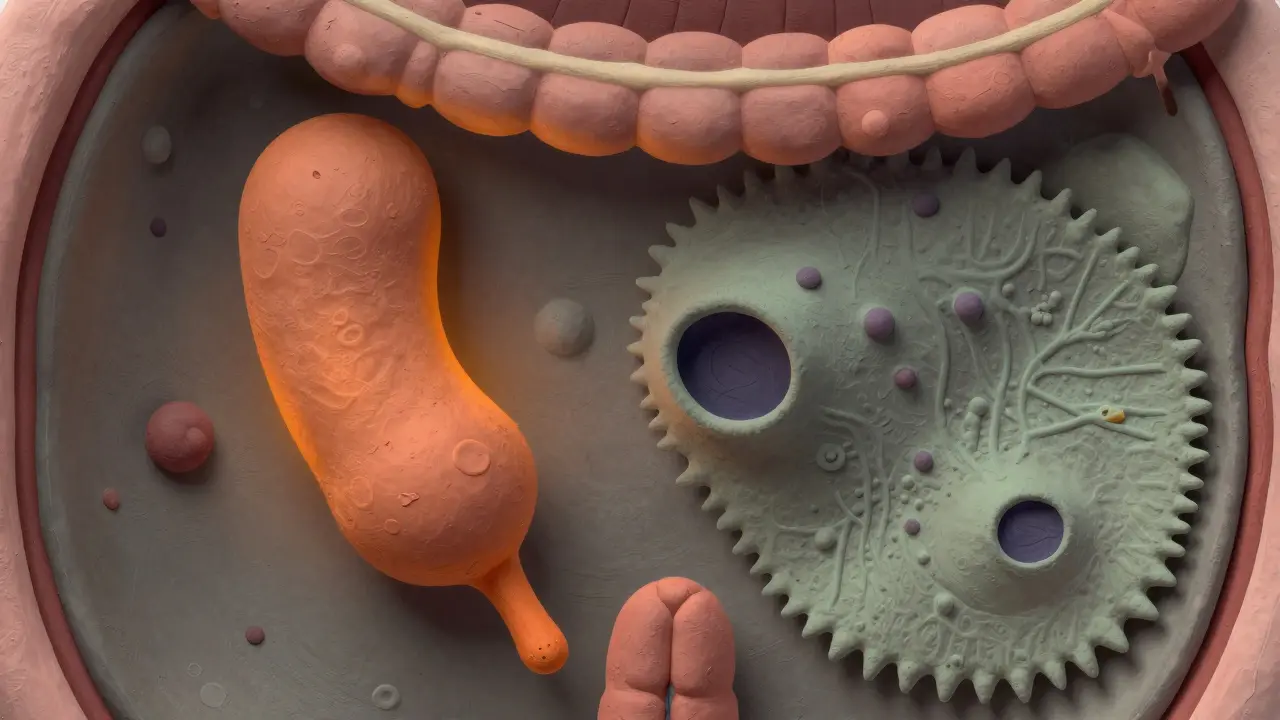
By age 60, about half of all adults will have at least one colorectal polyp. Most of these are harmless, but some can turn into cancer if left untreated. The two main types of precancerous polyps-adenomas and serrated lesions-grow differently, hide in different places, and need different approaches to catch and remove. Knowing the difference isn’t just medical jargon; it’s what keeps you from developing colon cancer.
What Are Adenomas?
Adenomas are the most common precancerous polyps, making up about 70% of all polyps found during colonoscopies. They start as small bumps on the colon lining and grow slowly over years. Under the microscope, they look like disorganized glandular tissue. Not all adenomas become cancer, but their size and shape tell doctors how risky they are.There are three subtypes:
- Tubular adenomas (70% of adenomas): Small, rounded, and easiest to remove. Less than 1% chance of cancer if under 0.5 cm.
- Tubulovillous adenomas (15%): Mixed growth pattern. Higher risk-around 5-10% chance of cancer if larger than 1 cm.
- Villous adenomas (15%): Flat, spread-out, and harder to remove completely. Up to 40% chance of containing cancer if over 2 cm.
Size matters. A polyp smaller than half an inch has less than a 1% chance of cancer. Once it hits 1 cm or bigger, that risk jumps to 10-15%. And if it has villous features, the risk climbs even higher. That’s why doctors don’t just remove adenomas-they measure them, describe their shape, and track them closely.
What Are Serrated Lesions?
Serrated lesions are trickier. They don’t look like typical polyps. Instead of rounded bumps, they have a saw-toothed edge under the microscope-hence the name. These make up 20-30% of colon cancers, even though they’re less common than adenomas.There are three kinds:
- Hyperplastic polyps: Usually harmless, especially if they’re small and in the lower colon. Almost never turn cancerous.
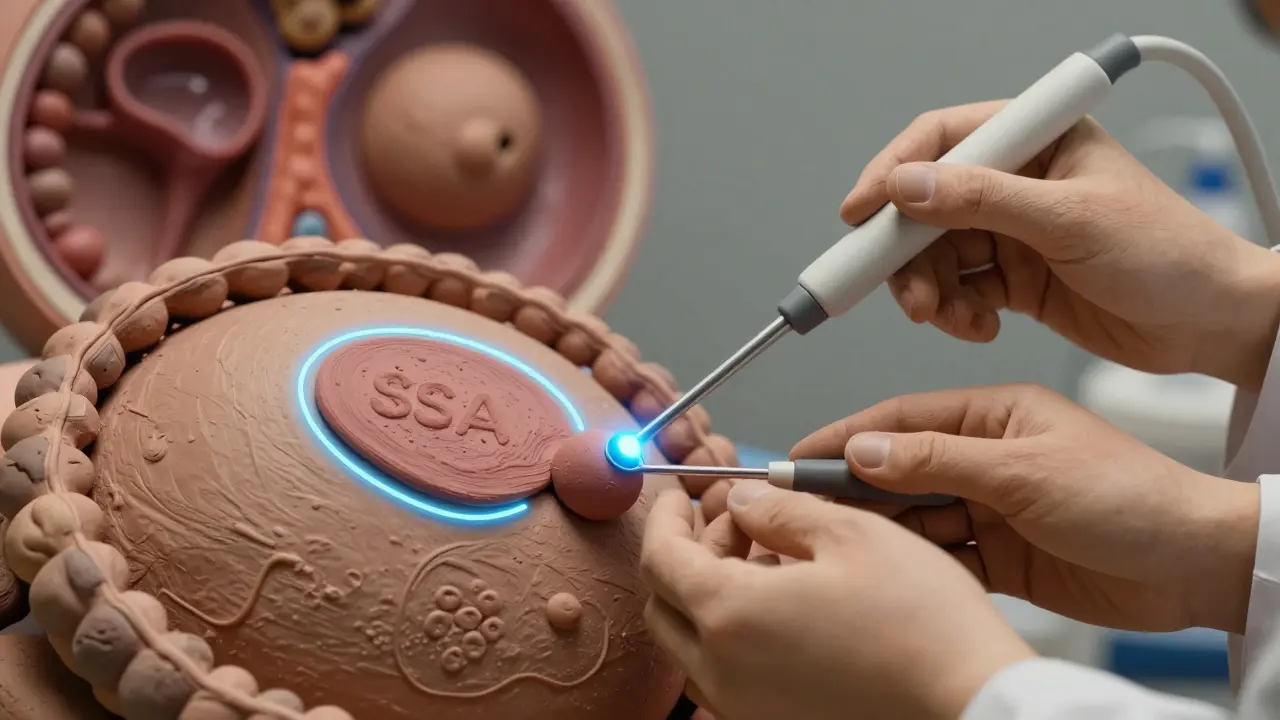
- Sessile serrated adenomas/polyps (SSA/Ps): These are the dangerous ones. Flat, hard to see, and often hidden in the upper colon-right near the cecum and ascending colon. They grow silently, and by the time they’re found, up to 13% may already have high-grade dysplasia or early cancer.
- Traditional serrated adenomas (TSAs): Rarer than SSA/Ps, but still precancerous. Often found in the left colon and have a more obvious polyp shape, but still carry cancer risk.
The real problem with SSA/Ps is how well they hide. They don’t stick out like a mushroom. They’re flat, flush with the colon wall, and blend in. Standard colonoscopies miss them 2-6% of the time. That’s why some experts say they’re the silent killers of colorectal cancer.
Why Detection Is So Different
Not all polyps are created equal when it comes to spotting them. Pedunculated polyps-those with a stalk-stick out like a balloon on a string. Easy to find, easy to grab with a snare. But sessile and flat polyps? They’re like stains on a carpet. You need to look closely, use special lighting, and sometimes zoom in with magnifying lenses.SSA/Ps are especially sneaky. They’re often in the right side of the colon, where the bowel is wider and folds are deeper. They don’t bleed much, so they don’t cause symptoms until they’re advanced. That’s why screening is so important-even if you feel fine.
Studies show that even experienced endoscopists miss up to 20% of serrated lesions during routine exams. That’s why newer tools like AI-assisted colonoscopy systems (like GI Genius) are changing the game. In trials, they boosted adenoma detection by 14-18%. That same tech is now helping spot SSA/Ps that human eyes might overlook.
Cancer Risk: How They Turn Dangerous
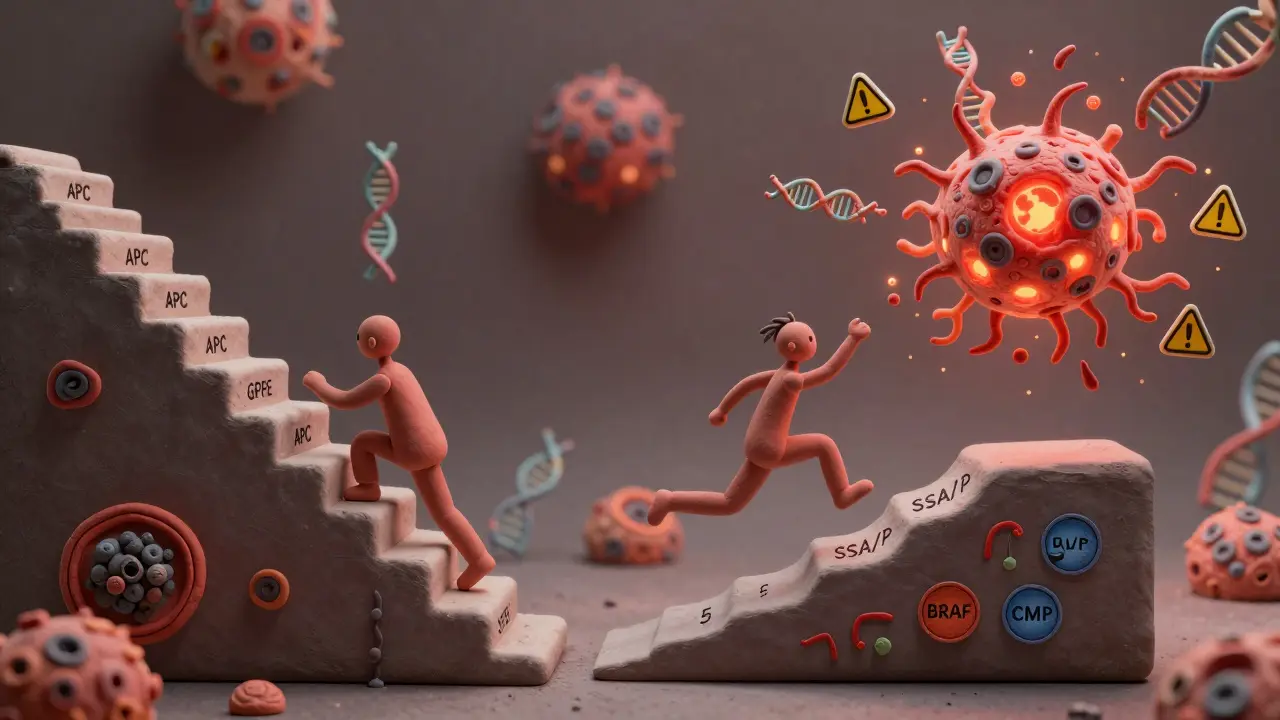
Adenomas follow the classic “adenoma-carcinoma sequence.” They slowly accumulate mutations-first in the APC gene-then others-over 10 to 15 years. It’s a predictable path.Serrated lesions follow a different route: the serrated pathway. These polyps mutate in the BRAF gene and get caught up in something called CpG island methylator phenotype (CIMP). This causes DNA to be improperly packaged, silencing tumor-suppressing genes. This path can skip the long middle stage and jump straight to cancer in as little as 5 years.
That’s why a small SSA/P can be more dangerous than a larger tubular adenoma. It’s not about size alone-it’s about biology. A 6 mm SSA/P in the right colon carries more risk than a 12 mm tubular adenoma in the lower colon.
What Happens After They’re Found?
If a polyp is found, the goal is simple: remove it completely. For adenomas under 2 cm, success rates are 95-98%. For larger or flat serrated lesions? That drops to 80-85%. Sometimes, you need a second procedure, or even surgery, if the polyp wasn’t fully removed.After removal, your next colonoscopy isn’t scheduled based on a fixed timeline. It’s based on what was found:
- 1-2 small tubular adenomas (<1 cm): Next colonoscopy in 7-10 years.
- 3 or more adenomas, or any over 1 cm: Back in 3 years.
- Any SSA/P ≥10 mm: Back in 3 years (U.S. guidelines). Some European doctors say 5 years is fine.
- SSA/P <10 mm with no dysplasia: 5 years.
- TSAs: Always 3 years, regardless of size.
And if cancer cells were found in the polyp? That’s a different story. You’ll need more tests, possibly surgery, and much closer follow-up.
Do Polyps Cause Symptoms?
Most don’t. That’s the scary part. You can have a large villous adenoma or an SSA/P and feel perfectly fine. But when symptoms do show up, they’re often late signs:- Bleeding from the rectum (30-40% of symptomatic cases)
- Anemia from slow, hidden blood loss (15-20%)
- Changes in bowel habits-diarrhea, constipation, or narrowing of stool
- Unexplained fatigue from low iron
If you’re seeing blood in your stool, don’t wait. Don’t assume it’s hemorrhoids. Get checked. Most polyps are found during screening, not because of symptoms.
What’s Changing in Screening?
The future of colon cancer prevention is personal. Right now, everyone gets the same screening schedule. But that’s shifting.Researchers are now testing blood and stool tests that can detect DNA changes linked to specific polyp types. Soon, we might know not just if you have a polyp-but what kind it is, and how likely it is to turn cancerous. That could mean some people get screened every 10 years, while others with high-risk lesions get checked every 2.
By 2030, molecular profiling of polyps will likely be standard. Instead of just saying “remove and wait,” doctors will say, “This polyp has BRAF mutation and high methylation-your risk is elevated. Let’s see you back in 2 years.”
That’s the goal: fewer colonoscopies overall, but smarter ones. Less fear. More precision.
Bottom Line
Adenomas and serrated lesions are both precancerous. But they’re not the same. One is old news. The other is the new threat.Adenomas are predictable. Serrated lesions are stealthy. One grows outward. The other grows sideways, hiding in plain sight.
Screening saves lives. But only if you’re looking for the right things. If you’re over 45, get screened. If you’ve had a polyp before, follow your doctor’s timeline. Don’t skip your next colonoscopy because you feel fine. The polyp that kills you won’t make you feel sick until it’s too late.
Most people with polyps never get cancer. But that’s not luck. It’s because they got checked. And they listened.
Are all colorectal polyps cancerous?
No. Most colorectal polyps are not cancerous. In fact, the vast majority are benign. However, adenomas and certain serrated lesions-like sessile serrated adenomas/polyps-are precancerous. That means they have the potential to turn into cancer over time if not removed. Removing them during colonoscopy is what prevents most cases of colon cancer.
Which polyp type is more dangerous: adenoma or serrated lesion?
It depends. Large villous adenomas carry high cancer risk due to their size and shape. But sessile serrated adenomas/polyps (SSA/Ps) are more dangerous in a different way-they’re harder to find, grow faster, and can turn cancerous in as little as 5 years. A small SSA/P in the right colon can be riskier than a larger tubular adenoma in the lower colon. Both need removal, but SSA/Ps require more careful detection and shorter follow-up intervals.
Can I tell if I have a polyp by my symptoms?
Usually not. Most polyps cause no symptoms at all. When symptoms do appear, they’re often late signs-like rectal bleeding, anemia, or changes in bowel habits. That’s why screening colonoscopies are critical. Waiting for symptoms means you’re already playing catch-up. By the time you feel something, the polyp may already be advanced.
How often should I get a colonoscopy after having a polyp removed?
It depends on the type, size, and number of polyps found. For 1-2 small tubular adenomas (<1 cm), the next colonoscopy is usually in 7-10 years. If you had a sessile serrated polyp 10 mm or larger, you’ll need another in 3 years. Traditional serrated adenomas always require a 3-year follow-up. Your doctor will give you a personalized schedule based on your pathology report.
Is AI helping doctors find polyps better now?
Yes. AI-assisted colonoscopy systems, like GI Genius, have been shown in clinical trials to increase adenoma detection by 14-18%. They’re especially good at spotting flat and sessile lesions-like SSA/Ps-that human eyes often miss. These tools don’t replace the endoscopist, but they act like a second set of trained eyes, highlighting areas that need a closer look. Many hospitals in the U.S. and Europe are now using them routinely.
Joanne Smith
December 28, 2025 AT 10:21So let me get this straight-my colon is basically a minefield of tiny, sneaky landmines disguised as harmless bumps? And the worst ones don’t even look like polyps? Thanks, biology. I’ll just be over here scheduling my colonoscopy… again. 😅
Prasanthi Kontemukkala
December 29, 2025 AT 13:33This is such an important breakdown! So many people think if they feel fine, they’re fine-but polyps don’t shout, they whisper. And by the time they scream, it’s too late. Thank you for explaining the difference between adenomas and serrated lesions so clearly. Knowledge really is power here.
Alex Ragen
December 30, 2025 AT 10:07One must, of course, acknowledge the epistemological rupture that occurs when one realizes that the colon-long dismissed as a mere digestive conduit-is, in fact, a labyrinthine arena of molecular betrayal. The adenoma-carcinoma sequence, with its APC-driven cadence, is a tragedy in iambic pentameter; the serrated pathway? A postmodernist nightmare of CpG methylation and existential DNA misfolding. We are not merely patients-we are narrative casualties of cellular entropy.
Lori Anne Franklin
December 30, 2025 AT 11:45Okay but why is it that the scary polyps are always hiding in the right side?? Like why can’t they just be easy to find?? I got my first colonoscopy last year and they found a tiny tubular one-thank god-but now I’m paranoid every time I eat fiber. Also, who invented colon prep?? That’s a crime.
Bryan Woods
December 31, 2025 AT 04:01The distinction between adenomas and serrated lesions is clinically significant and underscores the necessity of high-quality colonoscopy techniques. The data supporting AI-assisted detection systems, such as GI Genius, is compelling and suggests a measurable improvement in lesion identification rates. This represents a meaningful advancement in preventive gastroenterology.
Ryan Cheng
January 1, 2026 AT 11:04Real talk: if you’re over 45 and haven’t had a colonoscopy yet, do it. Like, today. Even if you feel fine. Even if you’re scared. Even if the prep sounds like torture (it is). One little procedure could save your life. And if you’ve got a family history? Double down. You’re not being dramatic-you’re being smart.
Jeanette Jeffrey
January 1, 2026 AT 19:27Wow. So we’re just supposed to trust that some guy with a camera and a 20% miss rate on flat lesions is gonna catch the one that’s gonna kill us? And now we’re supposed to rely on AI? Cute. Next they’ll put a robot in your colon to hold your hand. This whole system is a glorified lottery. You’re not ‘preventing’ cancer-you’re just gambling with your gut.
Shreyash Gupta
January 3, 2026 AT 14:55But what if I don’t want to do a colonoscopy? 🤔 I mean, maybe my body knows better? Maybe polyps are just nature’s way of saying ‘slow down’? 🤷♂️ I’ve heard people say fasting helps… 🌿 Maybe I’ll just drink lemon water and pray? 🙏
Ellie Stretshberry
January 5, 2026 AT 12:38i had a polyp removed last year and i didnt even know it was there. i felt totally fine. now i drink more water and try not to eat too much red meat. i still dont know what tubular means but i know its better than villous. thanks for the info. i feel less scared now.
wendy parrales fong
January 6, 2026 AT 03:46It’s wild how something so quiet can be so life-changing. I used to think colon cancer was something that happened to older people who didn’t take care of themselves. But this? This is just bad luck with your cells. I’m so glad we’re getting better at catching these things early. Keep sharing this stuff-it helps more than you know.
christian ebongue
January 7, 2026 AT 17:57SSA/Ps are the real villains. Adenomas? Slow burn. These? Silent, sneaky, and stupidly good at hiding. And yeah, AI helps-but only if the doc actually looks at the alerts. Too many still just click ‘next’.
jesse chen
January 8, 2026 AT 16:23Thank you for this. I’m a nurse who’s seen too many patients come in too late. This breakdown is exactly what people need-not just the science, but the why it matters. I’m sharing this with every patient over 45 who says, ‘I’m fine.’ You’re not fine until you’ve been checked.