
For a long time, getting a cochlear implant was seen as a last resort. You had to be almost completely deaf, and your hearing aids had to be virtually useless before a surgeon would even consider the procedure. But the conversation has changed. We've moved away from the "wait and see" approach toward a model of earlier intervention. Why? Because waiting too long can lead to irreversible neural degeneration and social isolation that makes recovery harder. Today, cochlear implant candidacy is a comprehensive assessment process used to determine if a person with severe to profound sensorineural hearing loss will benefit from an electronic device that bypasses damaged parts of the inner ear.
The Shift in Who Qualifies
If you've been told you aren't a candidate because you still have some "residual hearing," that advice might be outdated. The American Cochlear Implant Alliance (ACIA) released updated recommendations in late 2023 that fundamentally change the game. The old FDA rules were strict: you needed a pure-tone average of 70 dB HL or worse and a sentence recognition score of 40% or less while using hearing aids.
The new standard is much more inclusive. Experts now argue that if you understand fewer than 50% of words while wearing properly fitted hearing aids, you should be evaluated for an implant. This shift recognizes that many people struggle in the real world even if they pass a test in a quiet sound booth. In fact, Dr. Sarah Sydlowski from the Cleveland Clinic notes that having some benefit from a hearing aid doesn't exclude you; in many cases, the earlier the implant happens, the better the outcome.
How the Evaluation Actually Works
Walking into a candidacy evaluation isn't just a quick hearing test. It's a multi-stage process that usually takes 4 to 6 hours across several appointments. The goal is to get a complete picture of how you hear and how your brain processes sound. Here is the typical path:
- Hearing Aid Verification: Before they decide a hearing aid "doesn't work," a specialist uses real-ear measurements to ensure the device is actually programmed correctly. This is a critical step, as many referrals are rejected simply because the hearing aid wasn't optimized.
- Audiometric Testing: This involves both unaided tests and aided tests. Specialists use the AzBio sentence recognition scores, which are considered the gold standard for measuring how well you understand speech in different environments.
- The 60/60 Rule: Many clinics use a practical threshold where a pure-tone average of 60 dB HL and a word score of 60% or less trigger a formal referral. This captures about 95% of potential candidates.
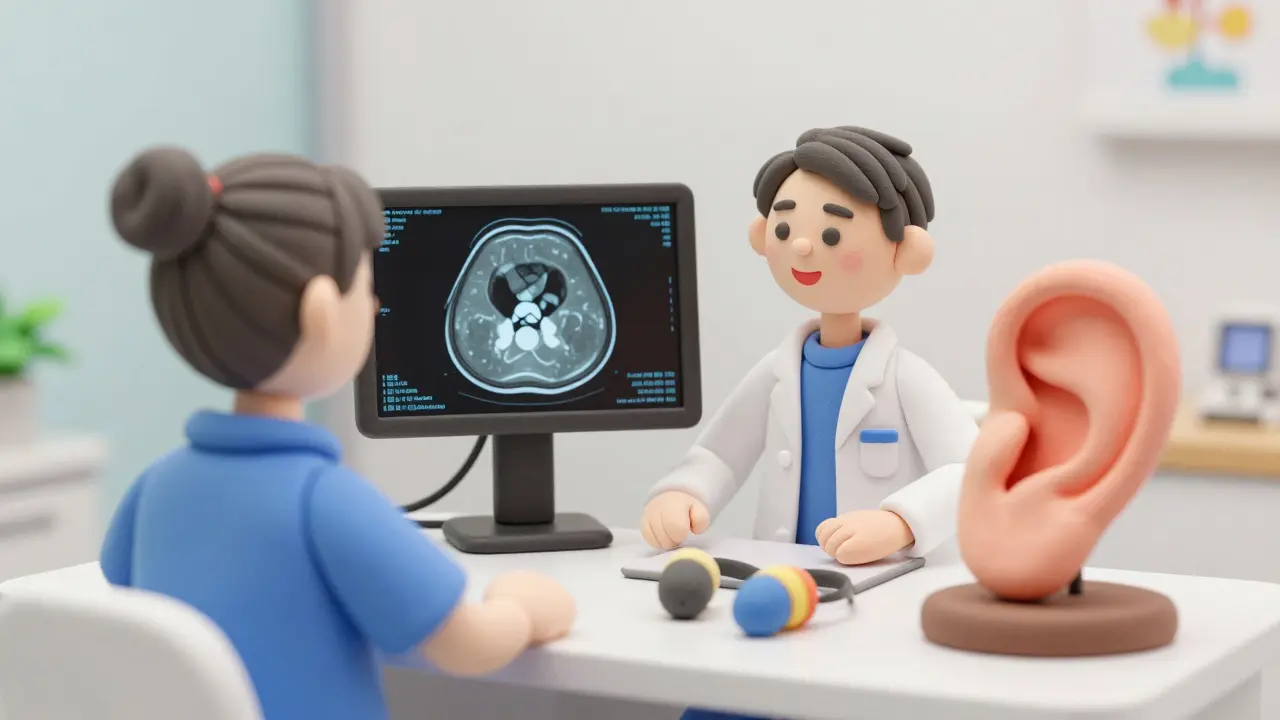
- Radiologic Imaging: You'll likely need a high-resolution CT scan or an MRI. The doctors need to see the anatomy of your cochlea to ensure the implant can be safely placed.
- Motivation and Cognitive Check: Because a cochlear implant isn't a "plug-and-play" device, the team assesses your ability to commit to auditory rehabilitation.
| Criteria Set | Hearing Threshold (PTA) | Speech Recognition Score | Primary Philosophy |
|---|---|---|---|
| Traditional FDA | ≥ 70 dB HL | ≤ 40% | Last resort after profound loss |
| 2019 CMS (Medicare) | > 50 dB HL (at high freq) | 40% - 60% | Expanded access for seniors |
| 2023 ACIA Guidelines | Individual ear basis | < 50% (AzBio) | Earlier intervention for quality of life |
Real-World Outcomes: What Happens After?
The data on outcomes is encouraging, especially for those who previously fell into the "gray area" of candidacy. In a study of over 1,200 recipients, those who met the 60/60 referral criteria saw an average jump of 47.3 percentage points in their sentence recognition scores. That's the difference between guessing what someone said and actually following a conversation.
For people over 65 who didn't meet the strict old rules but fell into the "expanded criteria" group, the results were still strong. About 78% of these patients achieved over 50% sentence recognition post-surgery. Beyond the numbers, the impact on daily life is where the real value lies. Common reports include a massive reduction in listening fatigue-that exhausted feeling you get after trying to decode speech for three hours at a family dinner-and a regained ability to use the phone.
However, it's not perfect. You should know that sensorineural hearing loss affects the way we perceive tone. About 63% of users report that music doesn't sound the same and can be challenging to enjoy. Noisy environments like crowded restaurants remain a struggle, though they are still far easier to manage with an implant than with a failing hearing aid.

Overcoming the "Last Resort" Mentality
Despite the evidence, many people are still under-treated. In the US, millions of adults have disabling hearing loss, but only a tiny fraction receive implants. One of the biggest hurdles is the primary care physician. Many doctors still believe you have to be totally deaf to qualify, leading to a lack of referrals.
Another point of contention has been the duration of deafness. There was an old belief that if you've been deaf for 10 or 20 years, your brain "forgets" how to hear and the implant won't work. Recent studies in the Ear and Hearing journal have debunked this. When cognitive function is stable and the patient is committed to rehab, those with long-term deafness see comparable outcomes to those implanted sooner. The key is the quality of the rehabilitation, not just the timing of the surgery.
Next Steps for Potential Candidates
If you're struggling to hear despite wearing hearing aids, the first step isn't to give up-it's to get a specialized evaluation. Look for a center that employs board-certified audiologists with CI specialty certification and neurotologists (surgeons who specialize in the ear and skull base).
Don't be discouraged if you've been told "no" in the past. With the 2023 ACIA guidelines, the definition of a "good candidate" has widened. Even if you aren't a candidate today, getting a comprehensive baseline test is valuable. It allows doctors to monitor your hearing over time so they can tell you the exact moment you do become a candidate.
Can I get a cochlear implant if I still have some hearing?
Yes. Modern guidelines emphasize that residual hearing does not disqualify you. In some cases, "hybrid" implants are used to preserve whatever natural hearing you have while providing electronic stimulation for the frequencies where you are most deaf.
Is there an age limit for cochlear implants?
There is no strict upper age limit. Success is measured by cognitive health and the motivation to undergo rehabilitation rather than a number on a birth certificate. Many seniors see significant improvements in quality of life and a potential reduction in dementia risk.
How long does the evaluation process take?
Expect to spend about 4 to 6 hours in clinical assessments across multiple appointments. This includes hearing tests, speech recognition trials, and imaging like CT or MRI scans.
Will a cochlear implant make me hear perfectly again?
No. It provides a sense of sound, not a perfect restoration of natural hearing. While most users see huge improvements in speech understanding, things like music perception and hearing in extreme noise can still be challenging.
What is the 60/60 rule?
The 60/60 rule is a clinical shorthand: if a patient has a pure-tone average of 60 dB HL or worse and a word recognition score of 60% or less, they are generally considered a strong candidate for a formal cochlear implant evaluation.
Rauf Ronald
April 7, 2026 AT 05:05This is a game changer for so many people. The old rules were way too restrictive and basically told people to just suffer until they were completely deaf. I've seen so many patients get a second opinion and suddenly qualify under these new guidelines. The key is really that rehabilitation part though. You can't just get the surgery and expect to hear like a movie. You've gotta put in the work with the audiologist to retrain your brain to recognize those electronic sounds. It's a journey, but the payoff in terms of reducing that mental fatigue is absolutely massive. If anyone is on the fence, just go get the evaluation. Even if you aren't a candidate now, you'll have a baseline for the future.
jack hunter
April 9, 2026 AT 02:41probly just a way for the big medical cos to sell more hardware since the old rules were actually based on real science and not just market expansion lol
Ethan Davis
April 9, 2026 AT 16:20Wait, so they want to put a computer chip in your head? Sounds like a great way for the government to track your every move and maybe even broadcast signals directly into your brain. Once you let them in the skull, it's game over.
Jay Vernon
April 10, 2026 AT 01:19I'm so glad the rules are changing! 🥳 Everyone deserves a chance to hear better! ❤️
Rupert McKelvie
April 11, 2026 AT 01:15It's really heartening to see the medical community move toward a quality-of-life model. The reduction in social isolation alone is worth the process. It gives people a real sense of hope again.
Brady Davis
April 11, 2026 AT 17:17Oh sure, because nothing says "natural" like a piece of titanium and some wires in your ear. I'm sure the music sounds just like a symphony of robots.
Del Bourne
April 13, 2026 AT 12:20Regarding the music perception mentioned in the post, it's worth noting that many users find that their preference for certain genres shifts. While complex orchestral music might be challenging at first, many find that rhythmic music or clear vocals are much easier to adapt to over time. I always suggest that new recipients keep a journal of the sounds they rediscover; it helps the rehabilitation process by making the auditory mapping more conscious and rewarding. It is also vital to ensure that the initial mapping is done by a specialist who understands the patient's specific lifestyle needs, whether that is a noisy office or a quiet home.
Vivek Hattangadi
April 15, 2026 AT 10:51Spot on with the rehabilitation point! It really is a collaborative effort between the patient and the clinic. If you stay committed and keep practicing, the results are just fantastic. Let's all support each other in getting the right evaluations!
shelley wales
April 16, 2026 AT 14:06I love how this post emphasizes that it's not just about the hearing loss level, but about how it affects your life. For many, the struggle is invisible to others, and these new standards acknowledge that struggle.
Timothy Burroughs
April 17, 2026 AT 05:04only in america do they let the lawyers and board rooms decide what a disability is instead of just letting the doctors do their jobs without these fake guidelines
Srikanth Makineni
April 17, 2026 AT 15:59too much fluff. just get the test and see
Danielle Kelley
April 18, 2026 AT 07:17Don't trust the "baseline test" they mention at the end. That's just a way for them to keep your data on file so they can target you for surgery the second you dip below a certain number. It's all a racket!
Dhriti Chhabra
April 18, 2026 AT 17:55It is most encouraging to witness the evolution of medical standards toward a more inclusive approach. Such advancements undoubtedly foster a higher quality of existence for many individuals.
charles mcbride
April 19, 2026 AT 12:47This is great news for everyone. It is truly a wonderful time for medical progress.