
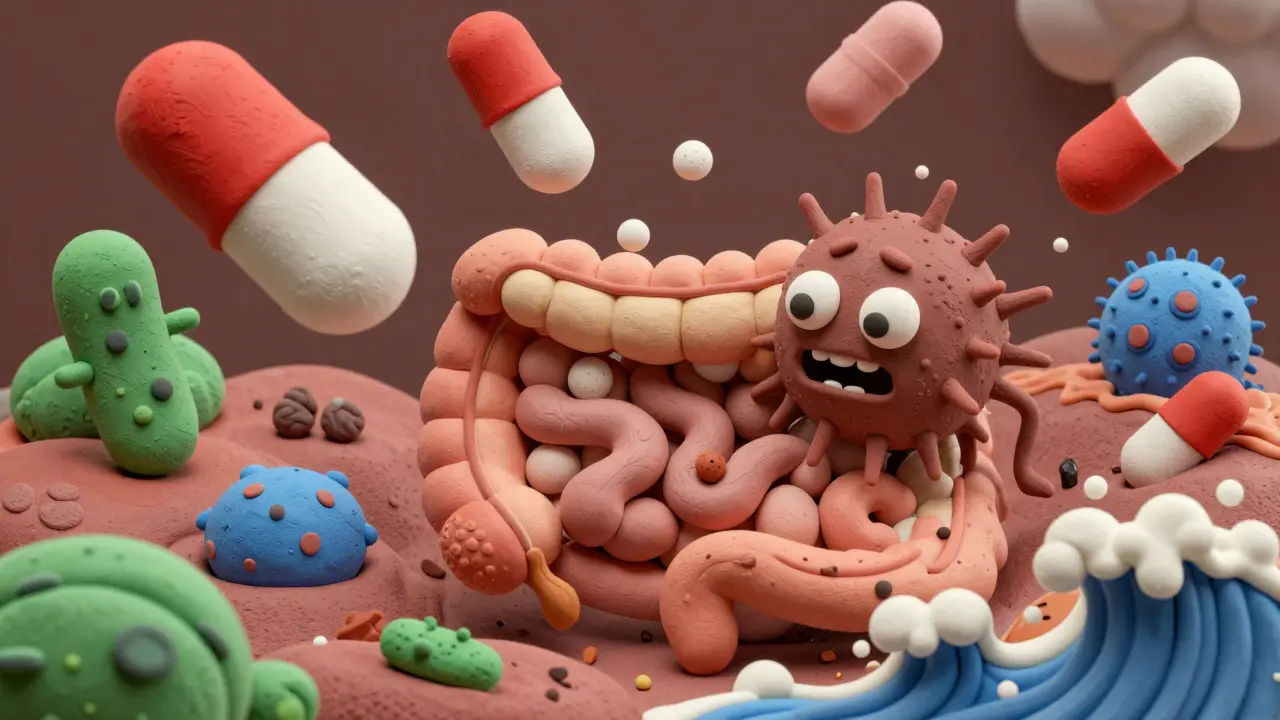
Every year, hundreds of thousands of people in the U.S. end up in the hospital not because of a flu or a fall, but because a common antibiotic they took to treat a simple infection went wrong. It’s not a side effect you hear much about - until it happens to you or someone you know. That’s C. diff colitis, a bacterial infection that turns your gut upside down. Diarrhea turns violent. Stomach cramps become unbearable. And sometimes, it doesn’t stop - even after you’ve finished your antibiotics.
How Antibiotics Trigger C. diff
Antibiotics are lifesavers. But they don’t discriminate. When you take them for a sinus infection, a urinary tract infection, or even a dental procedure, they wipe out not just the bad bacteria - but the good ones too. Your gut is home to trillions of microbes that keep things balanced. When antibiotics knock out those helpful bacteria, Clostridioides difficile - a stubborn, spore-forming bug - takes over.It’s not just any antibiotic that causes this. Some are far more dangerous than others. Research shows that piperacillin-tazobactam, a common IV antibiotic used in hospitals, carries the highest risk - nearly double the chance of triggering C. diff compared to other drugs. Other high-risk offenders include clindamycin, cephalosporins like ceftriaxone, and fluoroquinolones like ciprofloxacin. These are broad-spectrum antibiotics, meaning they attack a wide range of bacteria. That’s useful in emergencies, but dangerous when overused.
Here’s the scary part: every extra day you’re on one of these antibiotics, your risk goes up by 8%. And it doesn’t just spike early. The danger grows after 14 days. That’s why doctors are now told to review antibiotic prescriptions within 48 to 72 hours. If the infection isn’t getting worse, maybe you don’t need to keep taking it.
Even people who aren’t in the hospital are at risk. About half of all C. diff cases now happen in the community - not hospitals. Someone takes amoxicillin for a sore throat, gets diarrhea a week later, and assumes it’s just a stomach bug. By the time they see a doctor, the infection is already advanced.
Why Recurrence Is the Real Problem
Most people who get C. diff respond to antibiotics like vancomycin or fidaxomicin. But here’s the catch: one in five will get it again. And after the second recurrence, the odds of a third jump to 60%. Why? Because antibiotics don’t fix the broken gut ecosystem. They just temporarily silence the bad bacteria - while leaving the environment still hostile to the good ones.That’s why many patients end up in a cycle: antibiotic → relief → relapse → more antibiotics → another relapse. It’s exhausting. And expensive. A single hospital stay for C. diff can cost over $11,000. Repeat episodes? That adds up fast.
One Reddit user, posting from Adelaide, described going through five recurrences over 18 months. "I was on vancomycin for months. I lost 20 kilos. I couldn’t leave the house. My doctor said, ‘We’ve run out of options.’" Then he got a fecal transplant. Within days, his symptoms vanished. "It wasn’t magic. It was science."
Fecal Transplant: The Gut Reset
Fecal microbiota transplantation - or FMT - sounds strange, but it’s one of the most effective treatments in modern medicine. The idea is simple: take healthy stool from a carefully screened donor, process it, and put it into the patient’s colon. It’s like rebooting a corrupted computer with a clean operating system.The evidence is overwhelming. In a landmark 2013 study published in the New England Journal of Medicine, 94% of patients with recurrent C. diff were cured after just one or two FMT treatments. Compare that to 31% cured with standard antibiotics. That’s not a slight improvement. That’s a revolution.
Today, FMT isn’t just a last-resort experiment. It’s a recommended treatment by the American Gastroenterological Association for anyone who’s had three or more C. diff recurrences. Success rates now sit at 85-90%.
There are different ways to deliver it. Most common: colonoscopy (65% of cases), followed by enema (20%), and now, oral capsules (15%). The capsules - frozen, tasteless, and easy to swallow - have made FMT much more accessible. No need for a scope. No hospital stay. Just a pill.
In 2022 and 2023, the FDA approved two standardized FMT products: Rebyota and Vonjo. These aren’t messy jars of stool anymore. They’re clean, regulated, lab-produced microbiome therapies. They cost between $1,500 and $3,000 - far less than another hospital admission.
What About Probiotics?
You’ve probably seen ads for probiotic yogurts or supplements claiming to prevent C. diff. The truth? They don’t work reliably. The Infectious Diseases Society of America says there’s not enough proof to recommend them. Worse, in people with weakened immune systems, probiotics have been linked to dangerous infections like bloodstream infections.One small study did show that combining a slow taper of antibiotics with kefir (a fermented milk drink rich in live cultures) led to cure rates similar to FMT. But that’s just one small group. It’s not a replacement for proven treatments.
The bottom line: probiotics aren’t a magic bullet. They might help some people, but they’re not a substitute for stopping the wrong antibiotics - or getting FMT when you need it.
The Bigger Picture: Why This Matters
C. diff isn’t just a personal health issue. It’s a public health crisis. The CDC calls it an “urgent threat.” Each year, it causes about 500,000 infections and nearly 30,000 deaths in the U.S. alone. The total cost? Over $6 billion.And it’s getting worse in the community. While hospital cases have dropped 24% since 2009 thanks to better hygiene and antibiotic stewardship, community cases have risen by 14% every year since 2011. Why? Because antibiotics are overprescribed - even for viral infections like colds and flu, where they do nothing.
Doctors are starting to change. More hospitals now have antibiotic stewardship teams. They ask: "Do we really need this? Can we use something narrower? Can we stop it sooner?" But patients need to speak up too. If you’re prescribed an antibiotic, ask: "Is this the right one? Are there lower-risk options? What happens if I don’t take it?"

What You Can Do
If you’ve had C. diff before, or you’re on antibiotics right now, here’s what matters:- Don’t take antibiotics unless you need them. Viral infections don’t respond to them. Ask before you say yes.
- Ask about the risk. If you’re getting piperacillin-tazobactam, clindamycin, or a later-generation cephalosporin, ask if there’s a safer alternative.
- Don’t stop antibiotics early - but don’t keep them longer than needed. Finish the full course if prescribed, but push back if it’s been more than 14 days and you’re feeling better.
- If you’ve had two or more recurrences, ask about FMT. It’s not experimental. It’s now standard care. And it works.
- Wash your hands with soap and water. Alcohol-based hand sanitizers don’t kill C. diff spores. Soap and water do.
What’s Next for C. diff Treatment
Scientists are working on the next generation of treatments. One promising drug, SER-109, is an oral pill made of purified bacterial spores from healthy donors. In trials, it cured 88% of patients - matching FMT’s success without the "yuck factor."There’s also research into monoclonal antibodies like bezlotoxumab, which neutralizes one of C. diff’s main toxins. When added to standard treatment, it cuts recurrence risk by 10%. That’s not a cure, but it’s a powerful shield.
The future isn’t just about killing bacteria anymore. It’s about rebuilding the gut. We’re moving from antibiotics as the default to microbiome repair as the goal. And that’s a game-changer.
Final Thoughts
C. diff colitis isn’t a rare glitch. It’s a direct consequence of how we use antibiotics. We’ve treated them like candy - popping them for every sniffle, every minor infection. But our guts pay the price.The good news? We have tools to fight back. Better prescribing. Shorter courses. Fecal transplants that work better than any drug. And now, pills that restore the gut without the mess.
If you’ve been through C. diff, you know how terrifying it is. But you’re not alone. And you don’t have to keep going through it. There’s a way out - and it’s not just more antibiotics.
Can you get C. diff from food?
C. diff spores can be found in soil, water, and some foods, but it’s extremely rare to get infected this way. Most cases come from person-to-person spread in healthcare settings or from taking antibiotics that disrupt your gut. The real danger is not what you eat - it’s what you take.
Is FMT safe?
FMT is very safe when done with properly screened donors. All donors are tested for HIV, hepatitis, parasites, and other dangerous pathogens. The FDA requires strict screening for both stool and donor health. Serious side effects are rare. The biggest risk is mild bloating or cramping after the procedure - which usually goes away in a day or two.
Can FMT help with other gut problems?
FMT is currently only FDA-approved for recurrent C. diff. But researchers are testing it for IBS, IBD, and even metabolic disorders. So far, results are mixed. It’s not a cure-all. For now, stick to using it for what it’s proven to do: stop recurrent C. diff infections.
How long does it take to feel better after FMT?
Many patients notice improvement within 24 to 48 hours. Diarrhea stops, cramps fade, and energy returns. Some take a few days longer. Full gut recovery can take weeks as the new bacteria settle in. But unlike antibiotics, which only suppress the infection, FMT helps your gut rebuild itself - so the relief lasts.
Are there alternatives to FMT if I don’t want a transplant?
Yes. For recurrent C. diff, fidaxomicin is more effective than vancomycin at preventing relapse. Bezlotoxumab, a one-time IV infusion, can reduce recurrence by 10% when used with antibiotics. These aren’t as effective as FMT, but they’re options if you’re not ready for a transplant. Still, if you’ve had three or more recurrences, FMT remains the best choice.
Hanna Spittel
January 1, 2026 AT 00:52Sara Stinnett
January 1, 2026 AT 17:23Brady K.
January 2, 2026 AT 03:58Marilyn Ferrera
January 2, 2026 AT 10:48Lawver Stanton
January 4, 2026 AT 01:34Kayla Kliphardt
January 5, 2026 AT 06:47Emma Hooper
January 6, 2026 AT 05:54John Chapman
January 7, 2026 AT 07:02Joy Nickles
January 7, 2026 AT 22:28Urvi Patel
January 9, 2026 AT 21:40Martin Viau
January 10, 2026 AT 20:55anggit marga
January 11, 2026 AT 20:09