
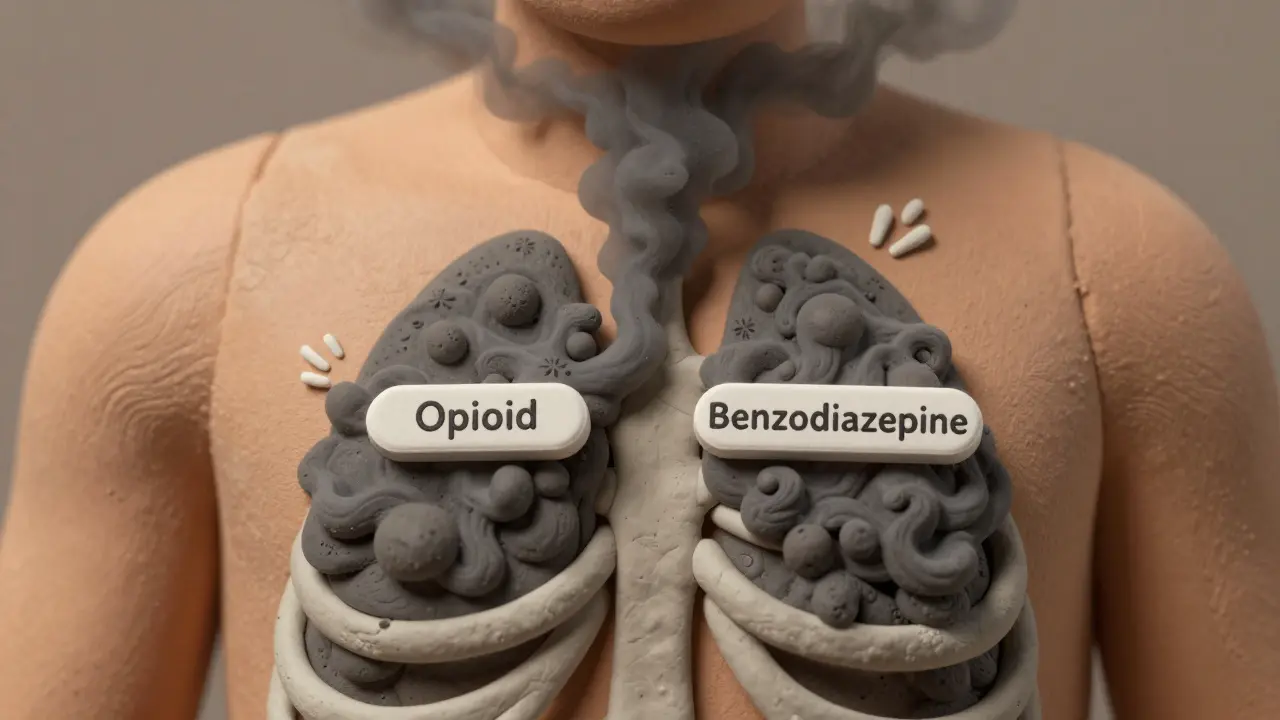
Benzodiazepine and Opioid Risk Assessment Tool
This tool helps you understand the risk of combining benzodiazepines with opioids. Even low doses of both drugs together can cause life-threatening respiratory depression.
Risk Assessment
Studies show that when opioids and benzodiazepines are combined, respiratory depression risk is not linear but synergistic. For example:
- 50% reduction in breathing with fentanyl alone
- 28% reduction with midazolam alone
- 78% reduction when both are combined
Even at therapeutic doses, this combination can cause dangerous respiratory depression, especially during sleep. The CDC reports that the risk of dying from an opioid overdose is 10 times higher when benzodiazepines are also present.
Safer Alternatives
If you're taking opioids for pain, consider non-addictive alternatives: physical therapy, acupuncture, or non-opioid pain medications.
For anxiety, discuss safer options with your doctor: SSRIs (like sertraline), buspirone, or cognitive behavioral therapy (CBT).
For pain: Non-opioid options include NSAIDs (like ibuprofen), physical therapy, and nerve blocks.
For anxiety: SSRIs (sertraline, escitalopram), buspirone, or CBT are safer alternatives.
For sleep: Melatonin or sleep hygiene practices can be safer than benzodiazepines.
When you take opioids for pain and benzodiazepines for anxiety, you might think you’re managing two separate problems. But in your body, these drugs are teaming up in a way that can stop your breathing-permanently. This isn’t a rare accident. It’s a predictable, well-documented, and preventable killer.
Why This Combination Is So Dangerous
Opioids like oxycodone, hydrocodone, or fentanyl slow your breathing by acting on specific brainstem neurons. They bind to mu-opioid receptors (MORs), especially in areas like the Kölliker-Fuse/Parabrachial complex and the preBötzinger Complex. These are the brain’s breathing control centers. When opioids activate these areas, they make you take longer, slower breaths. Exhalation stretches out. Inhales get weaker. At high doses, breathing stops entirely. Benzodiazepines like Xanax, Valium, or Ativan work differently but with the same deadly result. They boost GABA, the brain’s main calming signal. This doesn’t just make you sleepy-it shuts down the nervous system’s ability to keep breathing going, especially during sleep or when you’re sedated. Alone, benzodiazepines rarely kill healthy adults. But when paired with opioids? The effect isn’t just added. It’s multiplied. A 2018 study in the Journal of Pharmacology and Experimental Therapeutics showed that when fentanyl and midazolam were given together, minute ventilation dropped by 78%. Fentanyl alone caused a 45% drop. Midazolam alone? Just 28%. Together, they crushed breathing far beyond what either could do alone. This isn’t coincidence. It’s synergy-two drugs attacking breathing from different angles, leaving no backup system intact.The Numbers Don’t Lie
The Centers for Disease Control and Prevention (CDC) found that in 2019, benzodiazepines were present in 16% of all opioid overdose deaths. That number jumped to 22.5% in cases involving illicit opioids like heroin or fentanyl-laced street drugs. In 2020, nearly one in six opioid overdose deaths involved a benzodiazepine. The risk of dying from an opioid overdose is 10 times higher if you’re also taking a benzodiazepine, according to a landmark JAMA Internal Medicine study from 2016. These aren’t just numbers. They’re people. In Australia, the National Drug Strategy reports similar trends: polydrug overdoses involving opioids and sedatives are rising, especially among middle-aged adults. The highest death rates are in people aged 45 to 64-often those prescribed both drugs for chronic pain and anxiety. Many didn’t realize they were playing Russian roulette with their breathing.How the Brain Gets Shut Down
Think of your breathing like a two-engine plane. One engine (the opioid pathway) controls how deeply you inhale. The other (the benzodiazepine pathway) controls how long you exhale and whether your body even tries to breathe next. When opioids shut down the inhale engine, you gasp less. When benzodiazepines lock the exhale engine, your lungs stay full. No air moves. No oxygen enters. No carbon dioxide leaves. Your brain doesn’t register the danger because the very signals that scream “BREATHE!” are silenced. Studies using awake mice show that removing opioid receptors from the Kölliker-Fuse/Parabrachial complex restores breathing at therapeutic doses. But at overdose levels, the damage is too deep. Add benzodiazepines, and even that partial recovery vanishes. The combined effect overwhelms the brain’s last-resort breathing backup systems.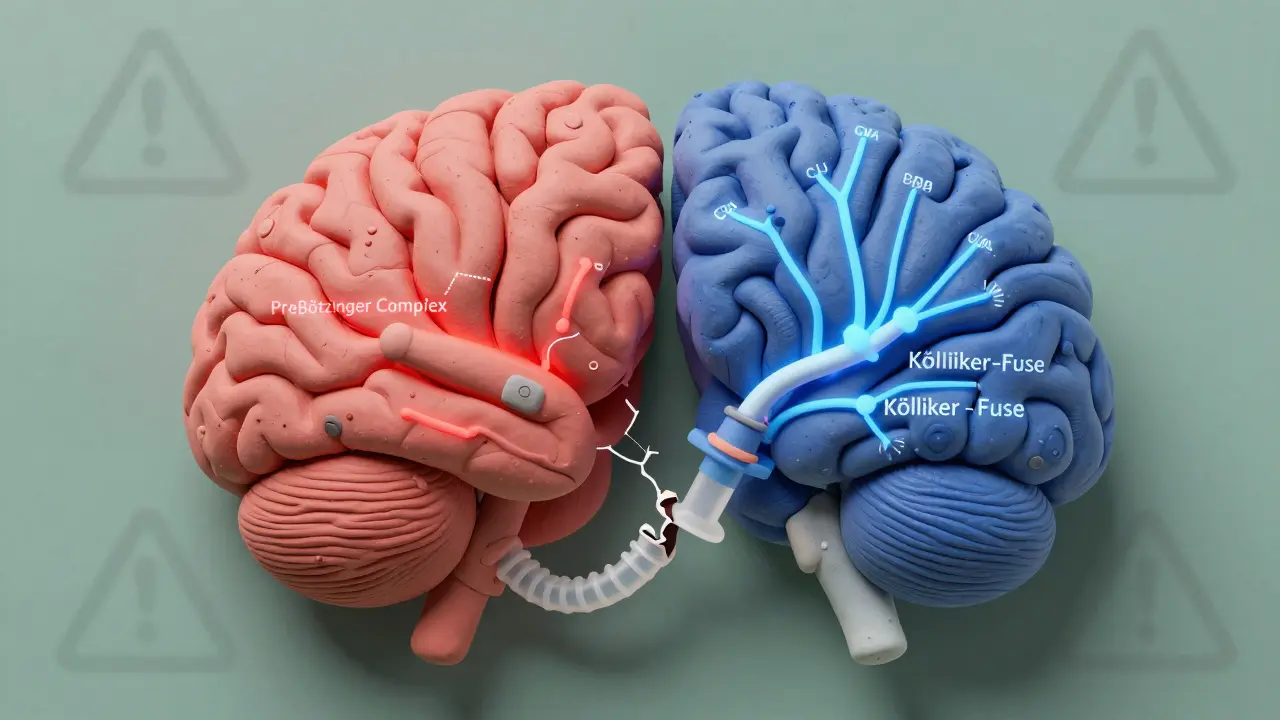
Why Naloxone Isn’t Enough
Naloxone saves lives. But only if the overdose is caused by opioids. If benzodiazepines are also in the system, naloxone can’t reverse their effect. It won’t wake you up if your breathing stopped because your brain’s GABA receptors are too overloaded. You might get a brief response-then slip back into respiratory arrest. That’s why many overdose deaths from this combination happen even after naloxone is given. Emergency responders now carry higher doses of naloxone and sometimes use additional tools like bag-valve masks or ventilators. But prevention is still the only surefire solution.What Doctors Are Told to Do
In 2016, the FDA issued a black box warning-the strongest possible alert-on all opioid and benzodiazepine labels: “Concomitant use can result in profound sedation, respiratory depression, coma, and death.” The American Society of Anesthesiologists says this combination should be avoided whenever possible. The CDC’s 2016 opioid prescribing guidelines state clearly: “Avoid prescribing benzodiazepines concurrently with opioids.” If it’s absolutely necessary-for example, in end-of-life care or severe, treatment-resistant anxiety-doctors are told to use the lowest possible doses for the shortest time and monitor closely. Even with these rules, prescribing patterns didn’t change overnight. A 2022 study found that while concurrent prescribing dropped by 14.5% after the FDA warning, nearly 9% of long-term opioid users were still getting benzodiazepines. Many patients didn’t know the risk. Some doctors didn’t either.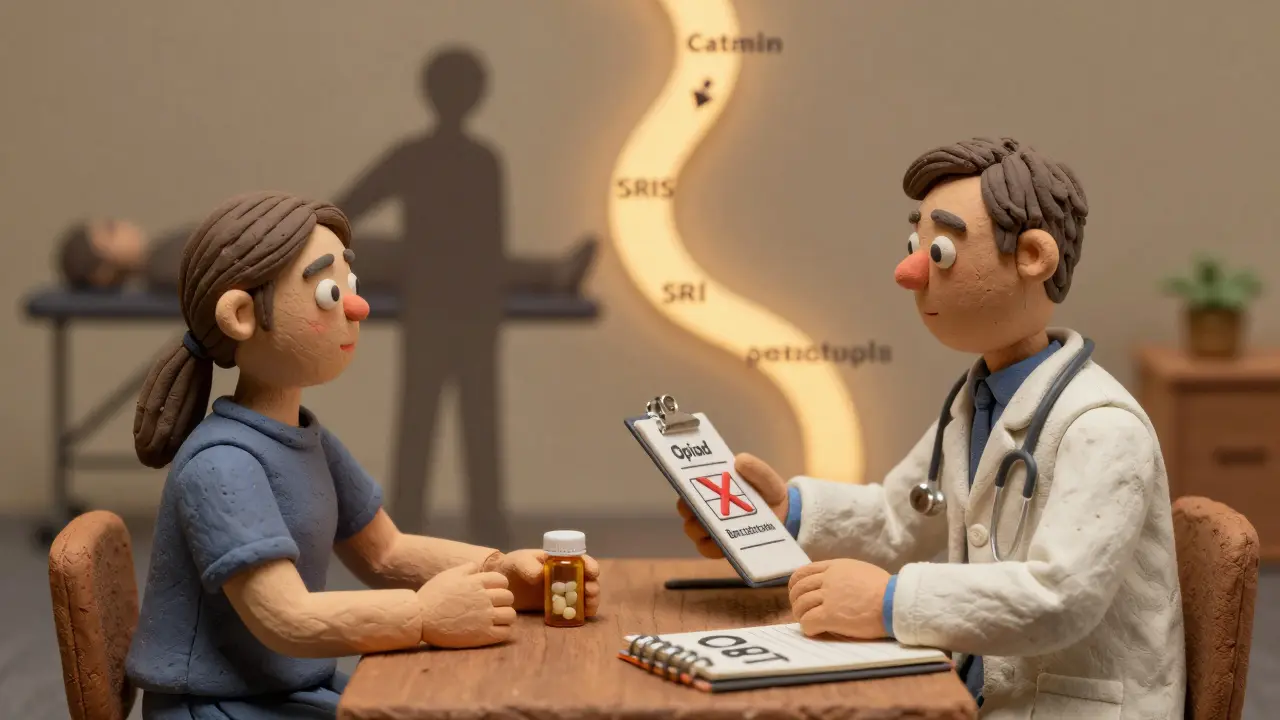
What You Can Do Instead
If you’re on opioids for chronic pain, ask: Is this benzodiazepine really necessary? For anxiety, there are safer options. Buspirone doesn’t suppress breathing. SSRIs like sertraline or escitalopram can help with anxiety without the respiratory risk. Cognitive behavioral therapy (CBT) is proven to reduce anxiety without drugs at all. If you’re on benzodiazepines for sleep or anxiety, ask: Can my pain be managed without opioids? Non-opioid pain treatments exist-physical therapy, nerve blocks, gabapentin, or even low-dose antidepressants for nerve pain. These don’t team up with benzodiazepines to kill you.What Public Health Is Doing
In the U.S., 16 states now require prescription drug monitoring programs (PDMPs) to flag doctors who prescribe opioids and benzodiazepines together. Medicare Part D now blocks or alerts on these combinations. The Substance Abuse and Mental Health Services Administration (SAMHSA) released guidelines in 2020 specifically warning against this pairing in addiction treatment. Research is moving forward too. A 2022 study found that an experimental drug called CX1739 reversed breathing suppression from both drugs in animal models. The NIH has poured millions into finding better reversal agents. But these are still years away from real-world use.Bottom Line
This isn’t about being reckless. It’s about ignorance. People aren’t dying because they’re addicts. They’re dying because they were told two common, legal medications were safe together. They weren’t. If you or someone you know is taking both opioids and benzodiazepines, talk to your doctor today. Don’t wait for a crisis. Ask: Is this combination necessary? Are there safer alternatives? What should I do if I feel too sleepy or can’t breathe? The data is clear. The science is settled. The warning has been out for nearly a decade. This combination kills. And it doesn’t have to.Can naloxone reverse an overdose caused by both opioids and benzodiazepines?
Naloxone can reverse the opioid component of the overdose, but it does nothing to counteract the respiratory depression caused by benzodiazepines. In cases where both drugs are involved, naloxone may provide temporary improvement, but breathing can stop again as the benzodiazepine effect remains. Emergency medical support-like oxygen, ventilation, or intubation-is often required.
Are all benzodiazepines equally dangerous when mixed with opioids?
Yes, all benzodiazepines carry the same risk when combined with opioids. Whether it’s a short-acting drug like alprazolam (Xanax) or a long-acting one like diazepam (Valium), they all enhance GABA activity in the brainstem. This suppresses breathing in the same way. The duration of the drug doesn’t change the danger-it just changes how long the risk lasts.
Can I safely take a low dose of a benzodiazepine with my opioid pain medication?
No. Even low doses can be deadly when combined. Studies show that the risk of respiratory depression is synergistic, not linear. A small amount of each drug can still push your breathing past a critical threshold. There is no safe threshold for this combination. The CDC and FDA recommend avoiding it entirely.
What are safer alternatives to benzodiazepines for anxiety while on opioids?
Non-sedating options like buspirone, SSRIs (e.g., sertraline, escitalopram), or SNRIs (e.g., duloxetine) are safer for anxiety. Cognitive behavioral therapy (CBT) is also highly effective and has no physical side effects. For sleep issues, melatonin, sleep hygiene practices, or non-benzodiazepine sleep aids like suvorexant may be alternatives-but always under medical supervision.
How common is this dangerous combination in Australia?
While Australian data isn’t as detailed as U.S. statistics, the National Drug Strategy reports that polydrug overdoses involving opioids and sedatives have increased steadily since 2015. Benzodiazepines are among the most commonly detected drugs in opioid-related deaths, especially in middle-aged adults. Prescribing patterns show similar trends to the U.S., with many patients receiving both drugs for chronic pain and anxiety without awareness of the risk.
Alexander Erb
March 11, 2026 AT 02:12Yikes. I had no idea mixing these two was this bad. My uncle took Xanax and oxycodone for years after his back surgery - thought he was just being careful. He passed last year. 😔 Turns out, he didn’t even know the warning was on the bottle. If this post saves one life, it’s worth it. Please, if you’re on both, talk to your doc. No shame in asking - your breath matters more than your pride.
Donnie DeMarco
March 12, 2026 AT 22:37so like… opioids = slow breath
benzos = forget to breathe
together = u just… stop?
bro. that’s not a combo. that’s a death wish with a prescription.
Tom Bolt
March 14, 2026 AT 17:28The scientific precision of this post is breathtaking. The way it dissects the neuroanatomical pathways - Kölliker-Fuse, preBötzinger Complex - isn’t just informative, it’s art. This isn’t a rant. It’s a eulogy for the 22.5% who didn’t know they were signing their own death warrant with a pill bottle. The FDA’s black box warning? It should’ve been a siren. Instead, we got silence. And now, we’re burying the middle-aged. This is systemic negligence dressed as medical care.
Shourya Tanay
March 15, 2026 AT 03:23As someone who works in clinical pharmacology in Mumbai, I’ve seen this play out in real time. The synergy between mu-opioid receptor suppression and GABAergic disinhibition of the respiratory drive is well-documented in rodent models, but the translational gap in low-resource settings is staggering. Many patients self-medicate with imported benzodiazepines alongside tramadol or codeine - often obtained without prescriptions. The absence of PDMPs, coupled with poor patient education, creates a perfect storm. We need culturally adapted harm-reduction campaigns - not just FDA warnings in English.
Denise Jordan
March 15, 2026 AT 13:55Okay but like… isn’t this just fearmongering? I mean, I know people who take both and they’re fine. Maybe the real problem is people are too scared to take meds?
Gene Forte
March 16, 2026 AT 18:29Every breath you take is a gift. But when you mix these drugs, you’re trading that gift for a moment of comfort. That’s not worth it. There’s always another way - therapy, movement, connection. You don’t need chemicals to quiet your mind. You just need someone who cares enough to say: ‘I see you. Let’s find a safer path.’
Kenneth Zieden-Weber
March 18, 2026 AT 02:29So let me get this straight… we’ve got a medical system that prescribes two drugs that, together, turn your brainstem into a light switch with no ‘on’ setting… and then we’re surprised when people die? 🤦♂️
And yet, somehow, the ‘just take less’ advice still gets thrown around like it’s a magic trick. Nah. This isn’t about dosage. It’s about dumbass policy. Someone get me a better system - or at least a better meme.
Chris Bird
March 19, 2026 AT 07:56people die because they are weak. if you can't handle pain and anxiety without drugs you are broken. stop blaming the medicine. blame the man.
David L. Thomas
March 19, 2026 AT 16:13Interesting how the preBötzinger complex is the real bottleneck here - it’s the pacemaker for breathing rhythm. Opioids blunt its output, benzodiazepines mute the chemoreceptor feedback loop that should compensate. Together? It’s like pulling the plug on the backup generator while the main engine’s already sputtering. The 78% drop in minute ventilation? That’s not additive. That’s catastrophic. We need better biomarkers to flag high-risk patients before they even get the script.
Bridgette Pulliam
March 20, 2026 AT 04:47I appreciate the thoroughness of this post. It’s rare to see such a balanced, evidence-based breakdown that doesn’t sensationalize. The fact that naloxone fails here is deeply concerning - it suggests our emergency response infrastructure is built on an outdated model of overdose. We need protocols that account for polypharmacy, not just single-drug events. And we need to stop treating addiction as moral failure. This is a physiological crisis, not a character flaw.
Mike Winter
March 20, 2026 AT 23:35It’s chilling how this combination has been quietly killing people for decades. The science has been clear since the 90s - yet we still treat it like a ‘personal choice.’ I wonder: if this were a new recreational drug, would we be this lenient? Or would it be banned overnight? The hypocrisy is exhausting. We protect people from cigarettes, but not from their own prescriptions. There’s a moral inconsistency here that deserves more than a footnote.
Randall Walker
March 21, 2026 AT 14:49So… I’m on oxycodone for my back. And Xanax for my panic attacks. And I’ve been doing this for 8 years. And I’ve never felt like I couldn’t breathe. So… maybe the problem isn’t the combo… maybe it’s the people who scare everyone into thinking it’s a death sentence? 🤷♂️