
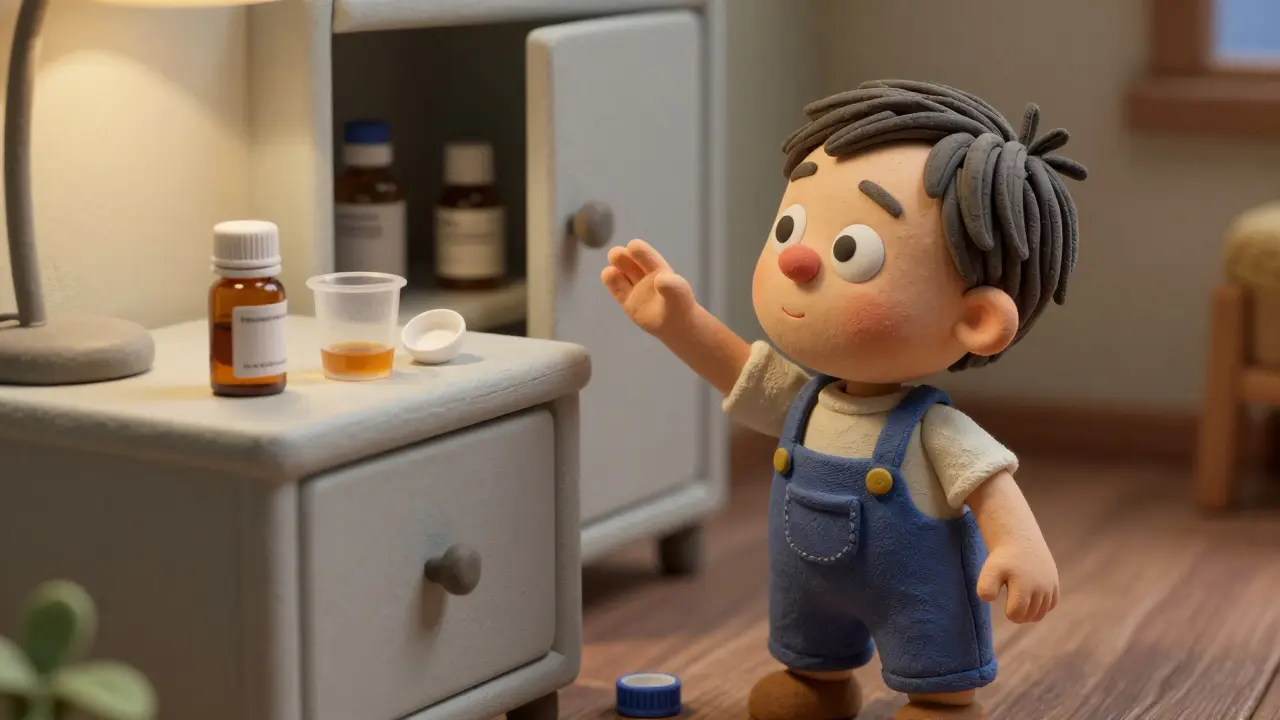
Every year, thousands of young children end up in emergency rooms because they got into medicine they weren’t supposed to. It’s not because parents are careless-it’s because medicine is everywhere, and kids are curious. A child under five doesn’t see a bottle of liquid acetaminophen as medicine. They see a colorful liquid in a bottle that smells sweet. And if it’s sitting on the counter, on a nightstand, or even inside an unlocked drawer, they’ll find it. Accidental pediatric medication overdose is one of the most common causes of poisoning in young kids, and it’s entirely preventable-if you know how.
Why Kids Get Into Medicine (And Why It’s So Dangerous)
Children under five are natural explorers. They put things in their mouths to learn about the world. A bottle of cough syrup might look like juice. A pill might look like candy. And if it’s within reach, they’ll grab it. According to the CDC, emergency visits for unsupervised medication exposures in this age group peaked at 76,000 in 2010. Even today, over 50,000 kids are treated each year for accidental overdoses.
The most common culprits? Liquid acetaminophen and diphenhydramine (the active ingredient in Benadryl). Together, they account for nearly half of all pediatric medication overdoses. Why? Because they’re everywhere-on bathroom counters, in purses, in nightstands. And because many caregivers don’t realize how easy it is to make a dosing mistake. Using a kitchen spoon instead of the dosing cup that came with the medicine? That’s a major risk. One teaspoon isn’t the same as another. A tablespoon of one formulation might be twice as strong as another.
The PROTECT Initiative: A Proven Approach
In 2008, the CDC launched the PRevention of Overdoses and Treatment Errors in Children (PROTECT) Initiative to tackle this crisis. It’s not just a slogan. It’s a three-part system that’s actually working.
- Packaging that works: Child-resistant caps aren’t foolproof. But the best ones require a twist-and-push motion that makes a clicking sound. And newer bottles now include flow restrictors-small plastic inserts inside the bottle neck that slow the pour. These aren’t on every bottle yet, but they’re becoming standard.
- Clear dosing labels: Since 2019, the FDA has required all liquid pediatric medications to use milliliters (mL) only. No more teaspoons, tablespoons, or drams. This reduces confusion. And 95% of manufacturers now comply. But if you’re still using an old bottle with mixed units? Toss it. Get the new version.
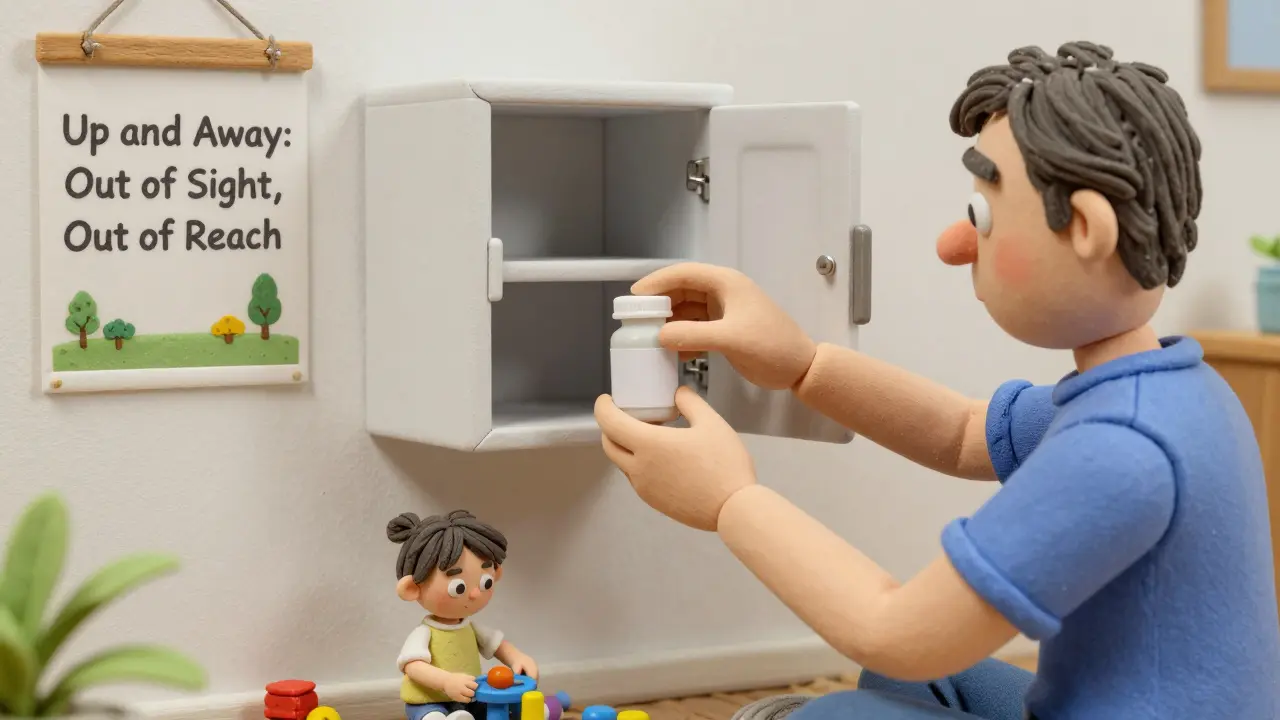
- Education that sticks: The Up and Away and Out of Sight campaign tells caregivers one simple rule: keep medicine locked up, out of sight, and out of reach. Not just out of reach. Out of sight. Because if a child sees it, they’ll want it.
The results? Between 2010 and 2020, emergency visits for these overdoses dropped by 25%. That’s 19,000 fewer kids in the ER each year because of smarter packaging, clearer labels, and better habits.
How to Store Medication Safely (The Real Rules)
"I just left it on the nightstand for a minute"-that’s the most common excuse after an overdose. But that minute is all it takes.
Here’s what actually works:
- Lock it up. Use a locked cabinet, not just a high shelf. Kids climb. They pull things down. A cabinet with a childproof latch is best. If you don’t have one, use a lockable plastic box.
- Keep it high. At least 4 feet off the ground. That’s above most toddlers’ reach, even if they stand on a chair.
- Keep it in the original bottle. Never transfer medicine to a different container. A candy jar might look fun, but it also looks like food. And if the label’s gone, you won’t know what it is.
- Return it immediately. After you give a dose, put the bottle back in the locked cabinet. Right away. Don’t wait. Don’t think, "I’ll put it back later." Later is when the accident happens.
And here’s something most people don’t know: 10% of children can open child-resistant packaging by age 3.5 years. That’s not a flaw in the design-it’s a fact of child development. So don’t rely on the cap alone. Lock the whole thing.
Dosing Mistakes: The Silent Killer
One of the biggest causes of overdose isn’t access-it’s confusion.
Infant acetaminophen (160 mg/5 mL) is different from children’s acetaminophen (160 mg/5 mL). Wait-that’s the same. But older versions used to be 80 mg/5 mL. Some bottles still have old labels. If you’re using an old bottle or a generic version, double-check the concentration. Always read the label.
And never use a kitchen spoon. Ever. A teaspoon from your drawer might hold 4 mL. Or 6 mL. Or 8 mL. The dosing cup that comes with the medicine? It’s marked in mL. Use that. Always. If you lose it? Call your pharmacy. They’ll give you a new one for free.
Studies show that 40% of parents make at least one dosing error when giving liquid medicine to a child. The most common? Mixing up concentrations. The second? Using the wrong tool. Both are easy to fix-with one simple habit: read the label. Twice.
What to Do If Your Child Gets Into Medicine
If you catch them in the act-take the bottle away. Don’t panic. Don’t try to make them throw up. Don’t wait to see if they look sick.
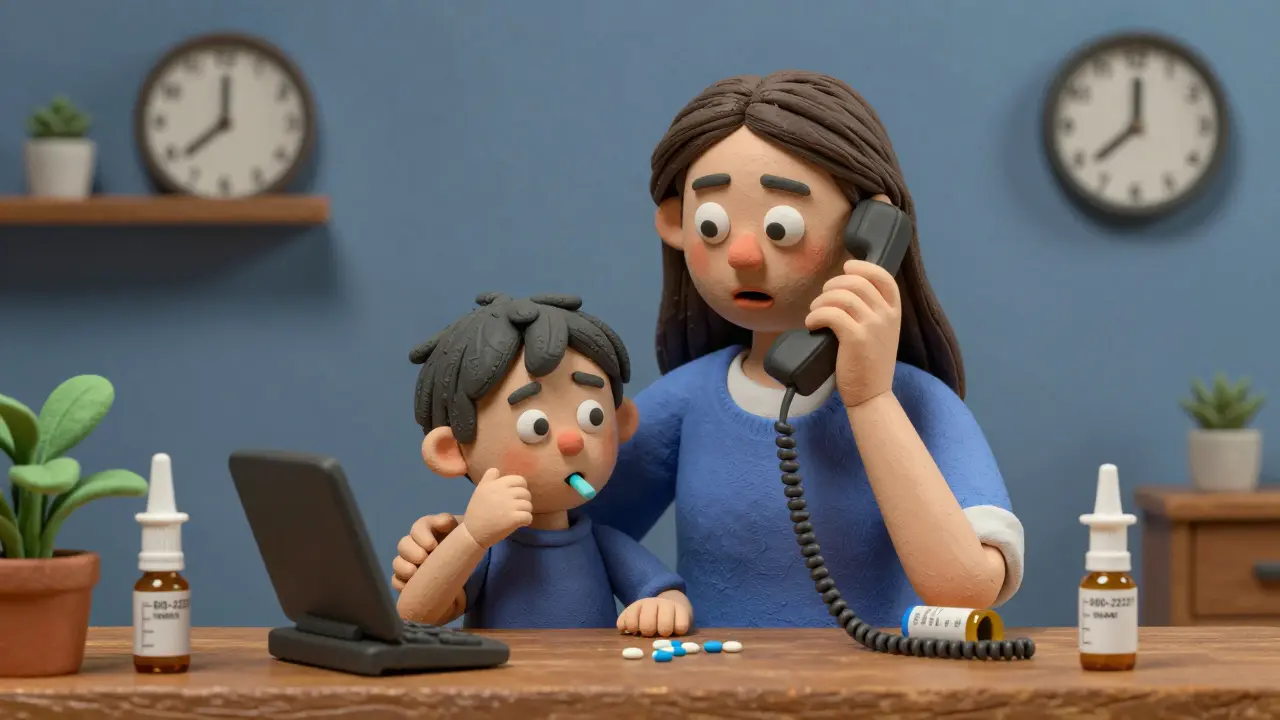
Call the Poison Control Center immediately: 1-800-222-1222. It’s free. It’s 24/7. It’s in every state. You don’t need to wait for symptoms. You don’t need to be sure. Call.
If you suspect an opioid overdose-like from a painkiller or fentanyl patch-use naloxone if you have it. The CDC now recommends keeping naloxone in homes with children, especially if opioids are used in the household. The nasal spray version (Narcan) is easy to use. Pinch the nose, spray one dose into one nostril, and call 911.
Even if your child seems fine, take them to the ER. Some overdoses take hours to show symptoms. Liver damage from too much acetaminophen? It can start quietly. A child might seem fine for 12 hours-then suddenly get very sick. Better safe than sorry.
What’s Missing? The Gaps in Prevention
The PROTECT Initiative has made huge progress. But it’s not perfect.
- Only 58% of households use child-resistant packaging correctly.
- Just 32% store medicines in locked cabinets.
- Only 63% of pediatricians talk to parents about safe storage during checkups.
And here’s the biggest blind spot: disposal. Most families don’t know how to get rid of old or unused medicine. Flushing it? Throwing it in the trash? Both are risky. The best option? Take-back programs. Many pharmacies and police stations have drop boxes. If yours doesn’t, mix pills with coffee grounds or cat litter, seal them in a bag, and throw them in the trash. Never leave them in a child’s reach-even in the garbage.
Smart devices like automated pill dispensers exist. But they cost hundreds of dollars. Most families can’t afford them. That’s why the focus must stay on low-cost, high-impact solutions: locked cabinets, clear labels, and immediate action.
What’s Next? The Road Ahead
By 2025, the FDA will require flow restrictors on all liquid opioid medications. That’s a big step. In 2026, the Up and Away campaign will launch in 12 new languages-making safety info accessible to more families.
The American Academy of Pediatrics now recommends that every child prescribed opioids also gets naloxone. That’s huge. But it only works if parents know how to use it. That’s why education matters as much as access.
The goal? Reduce pediatric medication overdoses by 10% by 2030. We’re already halfway there. With better storage, better labeling, and better habits, we can get there faster.
What should I do if my child swallows medicine by accident?
Call Poison Control immediately at 1-800-222-1222. Don’t wait for symptoms. Don’t try to make them vomit. Keep the medicine bottle handy so you can tell them what was taken, how much, and when. If it’s an opioid and you have naloxone, use it right away. Then call 911. Even if your child seems fine, take them to the ER-some overdoses don’t show up right away.
Are child-resistant caps enough to keep kids safe?
No. Child-resistant caps are designed to slow down access, not block it. Studies show that 10% of children can open them by age 3.5. That’s why you need to store medicine in a locked cabinet, out of sight and reach. Caps are a backup, not a solution.
Can I use a kitchen spoon to measure liquid medicine?
Never. Kitchen spoons vary in size and can deliver too much or too little. Always use the dosing device that came with the medicine-usually a syringe or cup marked in milliliters (mL). If you lost it, ask your pharmacy for a new one. They’ll give it to you for free.
How do I know if two medicines have the same strength?
Always check the concentration on the label. For example, infant acetaminophen is 160 mg per 5 mL. Children’s acetaminophen is the same. But older versions used to be 80 mg per 5 mL. If you’re unsure, compare the numbers. If they’re different, don’t mix them. When in doubt, call your pharmacist.
Where can I safely dispose of unused medicine?
Look for a drug take-back program at your local pharmacy, hospital, or police station. Many have drop boxes. If none are available, mix pills with coffee grounds or cat litter, put them in a sealed bag, and throw them in the trash. Never flush them unless the label says to. For liquids, pour them into a sealed container with absorbent material before disposal.
Final Thought: Prevention Is Simple, But It Takes Consistency
You don’t need a fancy device. You don’t need to be perfect. You just need to be consistent. Lock it. Read the label. Use the right tool. Call Poison Control if anything goes wrong. That’s it. And if you forget one day? That’s okay. Just remember: one mistake can change everything. So make safety a habit-not a checklist.
Laura Gabel
March 18, 2026 AT 23:06jerome Reverdy
March 20, 2026 AT 19:32Andrew Mamone
March 22, 2026 AT 06:4625% drop in ER visits? That’s 19,000 kids who didn’t have to go through trauma because someone cared enough to change packaging, labeling, and habits.
It’s not glamorous. No viral TikTok. No influencer. Just science + policy + persistence.
Also - never use a kitchen spoon. Ever. 🥄❌
MALYN RICABLANCA
March 23, 2026 AT 13:23gemeika hernandez
March 23, 2026 AT 16:03Srividhya Srinivasan
March 24, 2026 AT 16:30Justin Archuletta
March 26, 2026 AT 06:40Sanjana Rajan
March 27, 2026 AT 01:32Kyle Young
March 28, 2026 AT 16:55Aileen Nasywa Shabira
March 29, 2026 AT 00:03